Showing posts with label Judith wright. Show all posts

Sunday, September 27, 2015

Judith Wright and 'the heave of the great corporations'

'Only those coral insects live
that work and endure under
the breaker's cold continual thunder.
They are the quick of the reef
that rots and crumbles in calmer water
Only those men survive
who dare to hold their love against the world;
who dare to live and doubt what they are told.
They are the quick of life;
their faith is insolence; joyful is their grief'
Builders
Judith Wright

Today I am thinking about Judith Wright, Australia's finest poet and long time campaigner and activist and her biographer, Veronica Brady. 

They were both warriors- of the imagination, of the spirit and against injustice.

Judith Wright died in 2000  and Veronica Brady died in Perth in August this year. They are both deeply missed.

But their lives and their writing stand as a testimony and reminder of their remarkable contribution.

At Fremantle Library today I found the new republished edition of Judith Wright's The Coral Battleground, a book published in 1977, that documents the campaign to protect the Great Barrier Reef from oil and gas exploration and mining.

The book was re-published in 2014 by Spinifex Press. In it Judith Wright wrote:
 
"The Reef's fate is a microcosm of the new battle within ourselves. So this is not just a story of one campaign. The human attitudes, the social and industrial forces, and the people who in one way or other take their part in the campaign, represent a much wider field, and one in which the future of the human race may finally be decided".

The Coral Battleground begins in 1963, when Judith Wright was involved in the formation of the Queensland Wildlife Preservation Society. 
Between 1967-1971, the Society was instrumental in a campaign led by Judith Wright  and artist John Busst and environmentalist and scientist Len Webb to prevent the Queensland State Government, led by Premier Joh Bjelke-Peterson, from opening up the Great Barrier Reef to mining.
 
At the time they were denounced as radicals, fanatics and cranks.
 
Judith Wright, John Busst and Len Webb mobilized an alliance of citizens, conservation groups and trade unions against plans by the development oriented (and corrupt) Bjelke- Peterson Government  to allow the Great Barrier Reef to be exploited by mining companies.

Their campaign eventually led to the Federal Government claiming Commonwealth sovereignty over the Great Barrier Reef. In 1975 the Great Barrier Reef Marine Park Authority was established. The creation of the Great Barrier Marine Park was the first such national park in the world. The reef and its waters were listed as a world heritage site in 1981.
 
Wright once wrote:
 
 "If the Great Barrier Reef could think, it would fear us ... Slowly but surely we are destroying those great water-gardens, lovely indeed as cherry boughs and flowers under the once clear sea."
 
And now the reef is under threat again. 
 
In the Foreword to the 2014 edition of The Coral Battleground the conservationist and environmental activist Margaret Thorsborne documents a series of threat to the reef including: human induced climate change; loss of seagrass; shrinking populations of many dependent species; infestation of the crown of thorns starfish; development pressures; reduction in water quality; catchment run off; coastal and port developments and the Queensland mining boom which is driving the demand for bigger port facilities, more dredging, more reclamations, more sea dumping of dredge spoil and more and deeper channels to serve bigger ships.
 
The United Nations has warned Australia and the Queensland Governments that unless real improvement  are made to the deteriorating condition of the reef, it may be listed as a world heritage site in danger.
 
As Thorsborne notes, although Judith Wright's battle was won in the 1970's and 1980's, Australian's must face the harsh reality that the Barrier Reef is never safe while the real destroyers- industrial, financial and resource extractive capitalism- continue to declare war on the natural world.
 
Of course Judith Wright knew all this well.  In her poem For Today (from For a Pastoral Family) she wrote: 
 
We were always part of a process. It has expanded.
What swells over us now is a logical spread
from the small horizons we made-
the heave of the great corporations
whose bellies are never full.
 
Previous posts  on this blog about Judith Wright are here.

Monday, February 23, 2015

Judith Wright and the 1967 campaign to save the Great Barrier Reef

'Only those coral insects live
that work and endure under
the breaker's cold continual thunder.
They are the quick of the reef
that rots and crumbles in calmer water
Only those men survive
who dare to hold their love against the world;
who dare to live and doubt what they are told.
They are the quick of life;
their faith is insolence; joyful is their grief'
            Builders
            Judith Wright

Iain McCalman's new book The Reef: A Passionate History is a social, cultural and environmental history of Australia's Great Barrier Reef. 


Reviews of the book are here and here.

The book contains an illuminating and informative chapter titled A Poet, a Forester and an Artist join forces about the campaign waged between 1967-1971 by Australian poet, writer and activist Judith Wright, along with two colleagues artist John Busst and environmentalist and scientist Len Webb to prevent the Queensland State Government, led by Premier Joh Bjelke-Peterson, from opening up the Great Barrier Reef to mining.

Judith Wright, John Busst and Len Webb mobilized an alliance of citizens, conservation groups and trade unions against plans by the development oriented (and corrupt) Bjelke- Peterson Government  to allow the Great Barrier Reef to be exploited by mining companies.

Their campaign eventually led to the Federal Government claiming Commonwealth sovereignty over the Great Barrier Reef and its waters, and the reef's eventual listing as a world heritage site.

As McCalman notes, it was a combination of intensive grassroots campaigning, evidence of of catastrophic marine oil spills overseas, threats of trade union bans and bipartisan legislative action by Federal Liberal and Labor Governments that resulted in 1975 legislation which created the Great Barrier Reef Marine Park .

But as Judith Wright predicted, the threats to the Reef remain. 

Iain McCalman has written this recent article reflecting on the contemporary implications of the legacy of the campaign launched by Judith Wright, Len Webb and John Busst back in 1967 and the mining related developments that still threaten the Great Barrier Reef.

Judith Wright's own book about the campaign The Coral Battleground was republished in 2014. An extract from that book is here.

Other articles about Judith Wright's involvement in the campaign and her book The Coral Battleground are here and here.

In The Coral Battleground, Judith Wright wrote:
'The Reef's fate is a microcosm of the new battle within ourselves. So this is not just a story of one campaign. The human attitudes, the social and industrial forces, and the people who in one way or other take their part in the campaign, represent a much wider field, and one in which the future of the human race may finally be decided'.


Friday, September 26, 2014

South of My Days: Veronica Brady's beautiful biography of Judith Wright, Australia's finest poet


".....for Wright the truth of existence does not consist in reflection on commitment to it, but is to be found in the commitment itself: for her humanity and nature also are not and never have been something general, but are individual and singular. They demand personal response and commitment. That, I believe, is why her life has been so deeply involved with the pain of the world and of people but also why few have written so powerfully as she has done about the intensities and splendours of love, child-bearing and relationships with others and the living world around us.
Veronica Brady from an article on writing the life of Judith Wright

"Although strong in her denunciation of economic rationalist principles that were undermining the social fabric of Australian life in the eighties and nineties, she remained committed to a world of other possibilities--to see "what the human eye was meant to see /. . . knowing the human ends in the divine" (Vision). Integral to this vision is a profound respect for the sacred dimensions of ordinary life and ordinary Australians: "Living is a dailiness, a simple bread / that's worth the eating" (Grace). The ethical and gracious sense of human dignity is integral to her worldview. Artist and activist, poet and prophet, Judith Wright's images have become part of the fabric of our nation. She is the political poet dancing between the mystical experience and the demands of justice."
Gerard Hall on Judith Wright
Regular readers will know of my profound love and respect for the poetry of Australian poet Judith Wright who I believe is Australia's finest poet. 

Previous blog pieces on Judith Wright are here.


I am currently re-reading for the "umpteenth" time South of My Days  Veronica Brady's masterly biography of Judith Wright, published in 1998, just 2 years before her death. 

Brady does a wonderful job of telling the story of Judith Wright, considered by many to be Australia's finest poet.


I am always deeply moved by this book.


One reason is Judith Wright's profound and beautiful poetry which is quoted extensively in the book. Partly, it is also the inspirational life of Judith Wright- her social and environmental activism, her integrity, the dignity and humility with which she lived her life, her commitment to the ideals of justice and her uniquely Australian world view.


But my enjoyment of this book is also attributable to Veronica Brady, who in telling the life story of Judith Wright displays deep understanding, reverence and respect for the life and work of her subject.

It is particularly intriguing to re-read this book in light of Fiona Capp's book My Blood's Country, a memoir of her friendship with Judith Wright and a journey through the landscapes which inspired  Judith Wright. 

In Fiona Capp's book (and in earlier articles) she and the writer Nonnie Sharp wrote for the first time about the 25 year long relationship between Judith Wright and H.C. (Nugget) Coombs, which remained a secret to the public long after both their deaths.


In her biography, Veronica Brady choose not to reveal the exact nature of the relationship between Judith Wright and Nugget Coombs, clearly out of respect for Judith Wright's privacy and her wish to keep the relationship private.  Instead, Brady referred to their relationship as a long and close friendship.

In a recent article in the Australian journal Australian Historical Studies, the distinguished historian Jill Roe writes of the dilemma facing biographers like Veronica Brady, whose subjects are still alive. Roe writes:
Likewise many were surprised to learn of the depth and longevity of the recently revealed relationship between poet and environmentalist Judith Wright and ‘Nugget’ Coombs, which biographer Veronica Brady had described simply as a friendship in South of My Days, published in 1998, two years before Wright’s death. Maybe the time was not ripe to discuss such a delicate issue. In any event, it is a reminder that writing about a living person has its own problems. It is not just the subject’s reputation that must be considered, but the effect the treatment might have on the lives of significant others.
In her article Judith Wright's Biography: A Delicate Balance between Trespass and Honor Veronica Brady gives some insight into the challenges of telling the life story of such a public figure as Judith Wright.

Sunday, February 23, 2014

Sunday's poem: Judith Wright The Builders


The Builders
by Judith Wright

Only those coral insects live
that work and endure under
the breakers' cold continual thunder.
They are the quick of the reef
that rots and crumbles in a calmer water.
Only those men survive
who dare to hold their love against the world;
who dare to live and doubt what they are told.

They are the quick of life;
their faith is insolence; joyful is their grief.

This is life's promise and accomplishment-
a fraction-foothold taken.
Where dark eroding seas had broken,
the quick, the sensitive, the lover,
the passionate touch and intergrowth of living.
Alive, alive, intent,
love rises on the crumbling shells it shed.
The strata of the dead
burst with the plumes and passions of the earth.
Seed falls there now, birds build, and life takes over.

Other blog pieces featuring the poetry of Judith Wright are here.
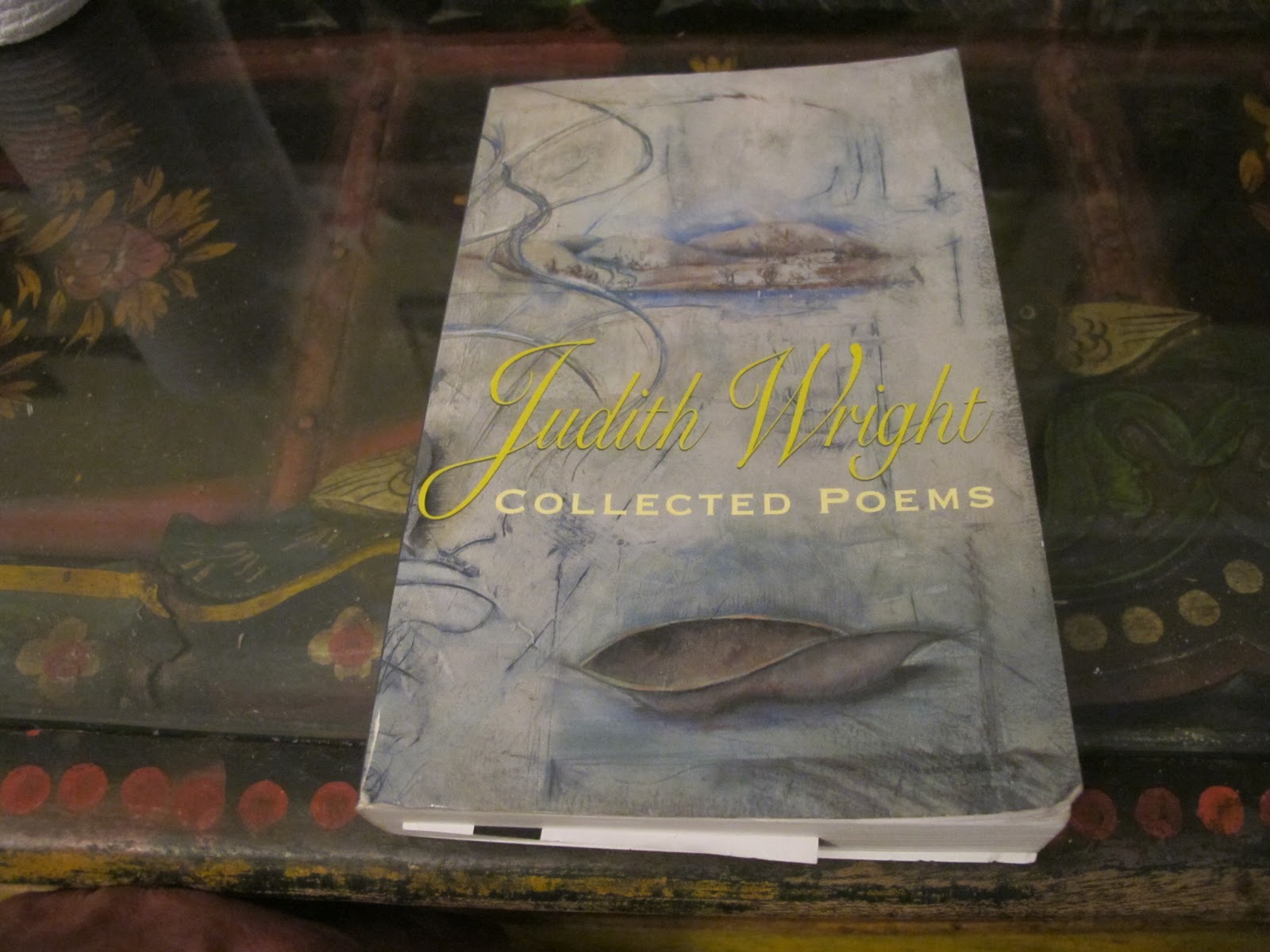
Friday, November 15, 2013

Friday's poem: For Precision by Judith Wright

As always, when in doubt, weariness, and anxiety there is the poetry of Judith Wright. 

The poem For Precision was written in 1955, the year of my birth.
For Precision
Judith Wright

Yet I go on from day to day, betraying
the core of light, the depth of darkness-
my speech inexact, the note not right, 
never quite sure what  I am saying-

on the periphery of truth. Uphold me now,
pure colours, blacks and whites, bells on the central tone,
middays, midnights. I wander among cross-lights.
Let me be sure and economical as the rayed
suns, stars, flowers: wheels let me fall as a gull, a hawk,

through the confusions of foggy talk,
and pin with one irremediable stroke-
what?- the escaping wavering wandering light,
the blur, the brilliance; forming into one chord

what's separate and distracted; making the vague hard-
catching the wraith-speaking with a pure voice,
and that the gull's sole note like a steel nail
that driven through cloud, sky and irrelevant seas,
joins all, gives all a meaning, makes all whole.


Monday, November 26, 2012

South of My Days: Veronica Brady and Judith Wright

 
".....for Wright the truth of existence does not consist in reflection on commitment to it, but is to be found in the commitment itself: for her humanity and nature also are not and never have been something general, but are individual and singular. They demand personal response and commitment. That, I believe, is why her life has been so deeply involved with the pain of the world and of people but also why few have written so powerfully as she has done about the intensities and splendours of love, child-bearing and relationships with others and the living world around us.
Veronica Brady from an article on writing the life of Judith Wright

"Although strong in her denunciation of economic rationalist principles that were undermining the social fabric of Australian life in the eighties and nineties, she remained committed to a world of other possibilities--to see "what the human eye was meant to see /. . . knowing the human ends in the divine" (Vision). Integral to this vision is a profound respect for the sacred dimensions of ordinary life and ordinary Australians: "Living is a dailiness, a simple bread / that's worth the eating" (Grace). The ethical and gracious sense of human dignity is integral to her worldview. Artist and activist, poet and prophet, Judith Wright's images have become part of the fabric of our nation. She is the political poet dancing between the mystical experience and the demands of justice. She leads us to shed our too-European eyes to see and not despoil the strange beauty of the Australian landscape. Equally, she leads us to name the fear and guilt that go hand-in-hand with a colonizing people. She invites us to the experience of justice and reconciliation in which the splendour and the terror of our nation's history and all its peoples are acknowledged, celebrated, redeemed. The mystical and the political are intertwined in Wright's poetry and life. Deaf in her final years, she continues to challenge Australians to hear the spirit of their land and its first peoples if they are to traverse the path to a more just and humane future. "For earth is spirit."
Gerard Hall on Judith Wright
Regular readers will know of my profound love and respect for the poetry of Australian poet Judith Wright who I believe is Australia's finest poet. Previous blog pieces on Judith Wright are here.

 I am currently re-reading for the "umpteenth" time South of My Days  Veronica Brady's masterly biography of Judith Wright. Brady does a wonderful job of telling the story of Judith Wright, considered by many to be Australia's finest poet.

I am always deeply moved by this book. One reason is Judith Wright's profound and beautiful poetry which is quoted extensively in the book. Partly it is also the inspirational life of Judith Wright- her social and environmental activism, her integrity, the dignity and humility with which she lived her life, her commitment to the ideals of justice and her uniquely Australian world view.

But my enjoyment of this book is also attributable to Veronica Brady, who in telling the life story of Judith Wright's displays deep understanding, reverence and respect for the life and work of her subject.

It is particularly intriguing to re-read this book after reading Fiona Capp's book My Blood's Country, a memoir of her friendship with Judith Wright and a journey through the landscapes which inspired  Judith Wright. In Fiona Capp's book (and in an earlier article) she wrote for the first time about the long relationship that Judith Wright had with Nugget Coombs. 

In her biography Veronica Brady choose not to reveal the exact nature of the relationship between Judith Wright and Nugett Coombs, clearly out of respect for Judith Wright's privacy and her wish to keep the relationship private. In her article Judith Wright's Biography: A Delicate Balance between Trespass and Honor Veronica Brady gives some insight into the challenges of telling the life story of such a public figure as Judith Wright.


Monday, September 10, 2012

Judith Wright and the champing jaws of mining companies

And therefore, when land dies?
opened by whips of greed
these plains lie torn and scarred.
Then I erode; my blood
reddens the stream in flood.
Judith Wright
 
As the  campaign against Woodside's industrialization of the Kimberley region at James Price Point intensifies it is worth remembering the prophetic warnings of Judith Wright, Australia's finest ever poet and distinguished political and environmental activist.

 In late 1968 the Australian poet and activist Judith Wright flew north from Perth to Port Hedland. The Pilbara region was undergoing unprecedented development and industrialization as a result of the region's massive iron ore resources.

At the time Judith Wright was actively involved in environmental and political struggles against mining companies, for example to save the Great Barrier Reef from mining.

As Veronica Brady points out in her biography of Judith Wright, Wright was roused by the sight of the land below her and produced one of her finest poems. Like many of her poems, Jet Flight over Derby warns against exploitation and destruction caused by mining and resource companies.

As I have written here  Judith Wright was without doubt one of the finest and most prescient intellectual minds this country has seen. So much of what she predicted and wrote about has come to pass. Jet Flight over Derby is one such example.
Jet Flight over Derby
by Judith Wright

Crossing this ravelled shore
fern-patterns of the tides
frayed like my branching nerves;
the last strung islands frayed.
And what is I? I said.

Rose-red a thousand miles
my country passed beneath.
Curved symmetry of dunes
echo my ribs and hands.
I am those worn red lands.

Stepped contours print my palms,
times sandstorms wear me down,
wind labours in my breast.
I lost my foreign words
and spoke in tongues like birds.

Then past this ravelled shore
I meet the blues of sea.
Sky's nothing entered in,
erased and altered me
till I said, What is I?

A speck of moving flesh
I cross the bird-tracked air
and it's no plce for me.
What's between sea and sky?
A travelling eye? A sigh?

This body knows its place, 
and longs to stand on land
where bone, a while upright, 
walks on an earth it knows, 
a droughty desert rose,
bearing the things it built;
difficult flower, tree, bird,
lizard and sandstone ridge.
I  am what land has made
and land's myself, I said.

And therefore, when land dies?
opened by whips of greed
these plains lie torn and scarred.
Then I erode; my blood
reddens the stream in flood.

I cross this ravelled shore
and sigh; there's man no more.
Only a rage, a fear,
smokes up to darken air.
"Destroy the earth! Destroy.
There shall be no more joy." 
Here is Gerard Hall writing about  Judith Wright:

Although strong in her denunciation of economic rationalist principles that were undermining the social fabric of Australian life in the eighties and nineties, she remained committed to a world of other possibilities--to see "what the human eye was meant to see /. . . knowing the human ends in the divine" (Vision). Integral to this vision is a profound respect for the sacred dimensions of ordinary life and ordinary Australians: "Living is a dailiness, a simple bread / that's worth the eating" (Grace). The ethical and gracious sense of human dignity is integral to her worldview.
Artist and activist, poet and prophet, Judith Wright's images have become part of the fabric of our nation. She is the political poet dancing between the mystical experience and the demands of justice. She leads us to shed our too-European eyes to see and not despoil the strange beauty of the Australian landscape. Equally, she leads us to name the fear and guilt that go hand-in-hand with a colonizing people. She invites us to the experience of justice and reconciliation in which the splendour and the terror of our nation's history and all its peoples are acknowledged, celebrated, redeemed. The mystical and the political are intertwined in Wright's poetry and life. Deaf in her final years, she continues to challenge Australians to hear the spirit of their land and its first peoples if they are to traverse the path to a more just and humane future. "For earth is spirit."

Friday, July 15, 2011

Poet of the Day: Judith Wright

....Change is my true condition,
to take and give and promise,
to fight and fail and alter.

I aim towards Forever,
but that is no one's country,
till in perhaps one moment,
dying I'll recognise it;

those peaks not ice but sunlit
from sources past my knowing,
as beauty of completion
the end of being human.
from Some Words by Judith Wright
A kind of weaving
goes on all the time in houses, its pattern
determined by the years of taking and giving.

And we were fortunate, house, to have your shelter.
Your roof crouched among trees on the turning planet,
part of a surface receiving rain and sunlight,
kept off the shrieking
spped of space, the bad weather,
enclosed our portion of time, our pattern of making.

Sunday, May 8, 2011

Poetry and daily life: Reading Judith Wright

Poetry should be an important part of our daily lives. A poem can assist us to live good lives. It enables contemplation, reverence for the cycles of daily life and a more refined moral outlook.

Judith Wright's poetry always has that effect on me. Wright is a profoundly social, political and mystical poet. Her poetry derives its power from its directness and profound humanity, and is best read "out in the world". Which is where I read her poetry today- between breaks whilst goal umpiring my teenage son's football match. Other blog pieces on Judith Wright can be found here.
Grace
by Judith Wright

Living is dailiness, a simple bread
that's worth the eating. But I have known a wine,
a drunkeness that can't be spoken or sung
without betraying it. Far past Yours or Mine,
even past Ours, it has nothing at all to say;
it slants a sudden laser through common day.

It seems to have nothing to do with things at all,
requires another element or dimension.
Not contemplation brings it: it merely happens,
past expectation and beyond intention;
takes over the depth of flesh, the inward eye,
is there, then vanishes. Does not live or die,
because it occurs beyond the here and now,
positives, negatives, what we hope and are.
Not even being in love, or making love,
brings it. It plunges a sword from a dark star.

Maybe there was once a word for it. Call it grace.
I have seen it, once or twice though a human face.

To Mary Gilmore
by Judith Wright

Having arranged for the mail and stopped the papers,
tied loaves of bread Orlando-like to the tree,
love- messages for birds; suitcase in hand
I pause and regard the irony of me.

Supposed to be fifty-six, hair certainly grey,
stepping out much like sixteen on another journey
through a very late spring, the conference papers packed
as a half excuse for a double tonged holiday;

as though I believed- well, then, as though I believed.
Remember Mary Gilmore, her little son
turned sixty four and bald; And Mary playing
her poet's game as though she'd never be done.

This is my place. It isn't far to my grave,
the waiting stone. But still there's life to do
and a taste of spring in the air. Should I sit and grieve,
Mary or keep the ink running, like you?

Years have their truth, and each as true as another.
Salute, Mary. Not long now till we know
the blackened deathly world you once foresaw;
but now-let's live. I pick up my case and go.


Request to a Year
By Judith Wright

If the year is meditating a suitable gift,
I should like it to be the attitude
of my great-great-grandmother,
legendary devotee of the arts,

who having eight children
and little opportunity for painting pictures,
sat one day on a high rock
beside a river in Switzerland

and from a difficult distance viewed
her second son, balanced on a small ice-floe,
drift down the current toward a waterfall
that struck rock bottom eighty feet below,

while her second daughter, impeded,
no doubt, by the petticoats of the day,
stretched out a last-hope alpenstock
(which luckily later caught him on his way).

Nothing, it was evident, could be done;
And with the artist’s isolating eye
My great-great-grandmother hastily sketched the scene.
The sketch survives to prove the story by.

Year, if you have no Mother’s day present planned,
Reach back and bring me the firmness of her hand.

Saturday, January 1, 2011

From sources past our knowing

 Change is my true condition,
to take and give and promise,
to fight and fail and alter.
I aim towards Forever,
but that is no one's country,
till in perhaps one moment,
dying, I'll recognise it
those peaks not ice but sunlit
from sources past my knowing,
as beauty of completion
the end of being human.
Judith Wright
Some Words
Thanks to those who read yesterday's piece on Judith Wright. 

I am an unabashed fan and admirer of Judith Wright, who I describe as an Australian prophet. Her poetry and ideas (and books and articles written about her) have featured many times on this blog (here).

Today I have been reading Gerard Hall's wonderful piece written in 2000 and Fiona Capp's beautifully written memoir My Blood's Country about Judith Wright's work and life.

Hall also describes Judith Wright as an Australian prophet and concludes with this fine summary, said better than I can:

".....the truth of her life is that she was both artist and activist; the values celebrated in her poetry are the same values she fought for in the political arena. She was always the "ethical prophet," calling Australia and Australians to renounce "pride, greed and ignorance" in favour of a spiritual vision since, as she put it, "without a vision a nation perishes."
Although strong in her denunciation of economic rationalist principles that were undermining the social fabric of Australian life in the eighties and nineties, she remained committed to a world of other possibilities--to see "what the human eye was meant to see /. . . knowing the human ends in the divine" (Vision). Integral to this vision is a profound respect for the sacred dimensions of ordinary life and ordinary Australians: "Living is a dailiness, a simple bread / that's worth the eating" (Grace). The ethical and gracious sense of human dignity is integral to her worldview.
Artist and activist, poet and prophet, Judith Wright's images have become part of the fabric of our nation. She is the political poet dancing between the mystical experience and the demands of justice. She leads us to shed our too-European eyes to see and not despoil the strange beauty of the Australian landscape. Equally, she leads us to name the fear and guilt that go hand-in-hand with a colonizing people. She invites us to the experience of justice and reconciliation in which the splendour and the terror of our nation's history and all its peoples are acknowledged, celebrated, redeemed. The mystical and the political are intertwined in Wright's poetry and life. Deaf in her final years, she continues to challenge Australians to hear the spirit of their land and its first peoples if they are to traverse the path to a more just and humane future. "For earth is spirit."

Friday, December 31, 2010

Judith Wright on the champing jaws of the political and corporate elite


Judith Wright's poem At a Public Dinner laments an Australian political and corporate elite interested in personal gain, power, status and profit.  As we enter a new year Wright's poem is more relevant than ever before.

At A Public Dinner
Judith Wright

No, I'm not eating. I'll watch the champing jaws,
solemnly eating and drinking my country's honor,
my country's flesh. The gravy's dripping red,
a nourishing stew for business. She's a goner-
crucified in fat speeches, toasted in wines
the colour of blood. And wounded past recall.
Let this occasion be her memorial.
It was all there in the first step onto land,
the flag raised, the guns fired.
No one but Harpur called here the land of equals,
the new Utopia...Go away, we're tired;

we're tired of being asked about tomorrow.
Today the profit. Today the hideous old,
the rising price of uranium, beef and gold.
Today, for the dreamers, the totally useless sorrow.

Thursday, December 23, 2010

Christmas Thoughts: Judith Wright and stumbling after the incessant pace


"We are caught in the endless circle of time and star/
that never chime with the blood; we weary, we grow lame,/
stumbling after their incessant pace
that slackens for us only when we are/
caught deep in sleep, or music or a lover's face"
Judith Wright, The Moving Image from Collected Poems

Sunday, December 5, 2010

Veronica Brady's biography of Judith Wright

".....for Wright the truth of existence does not consist in reflection on commitment to it, but is to be found in the commitment itself: for her humanity and nature also are not and never have been something general, but are individual and singular. They demand personal response and commitment. That, I believe, is why her life has been so deeply involved with the pain of the world and of people but also why few have written so powerfully as she has done about the intensities and splendours of love, child-bearing and relationships with others and the living world around us. That, I suspect, is also one of the reasons why she has had such affinity for Aboriginal people and their culture"
Veronica Brady from an article on writing the life of Judith Wright
On flights to Broome and Kalgoorlie this week I re-read Veronica Brady's masterly biography of Judith Wright. Brady does a wonderful job of telling the story of Judith Wright, considered by many to be Australia's finest poet.

I am always deeply moved by this book. One reason is Judith Wright's profound and beautiful poetry which is quoted extensively in the book. Partly it is also the inspirational life of Judith Wright- her social and environmental activism, her integrity, the dignity and humility with which she lived her life, her commitment to the ideals of justice and her uniquely Australian world view.

But my enjoyment of this book is also attributable to Veronica Brady, who in telling the life story of Judith Wright's displays deep understanding, reverence and respect for the life and work of her subject.

Earlier blog pieces on Judith Wright can be found here.

Friday, November 26, 2010

Friday's poem: Judith Wright " After the Visitors"

Judith Wright is one poet who somehow speaks to the soul. Wright's poetry and her social and political activism have featured on this blog before (here)
Judith Wright
After the Visitors
"House settles. Walls calm. Air cools.
I put away glasses, adjust the house to my shape
and turn to my work. Is it you again alone?
We are old companions, self. We can go on,
sometimes in love, sometimes lonely
with the old pang, the old delight,
the living balance between walking and sleep".

Friday, July 2, 2010

Fiona Capp on Judith Wright


Yesterday I bought Fiona Capp's new book My Blood's Country which celebrates the life and work of Judith Wright, arguably Australia's greatest poet. I have been waiting for this book for some considerable time after reading Capp's earlier piece in The Monthly.

There are few Australians I admire more than Judith Wright. There are many reasons- her poetry, her social and environmental activism, her integrity, the dignity and humility with which she lived her life, her commitment to the ideals of justice and her uniquely Australian world view.

Judith Wright was without doubt one of the finest and most prescient intellectual minds this country has seen. So much of what she predicted and wrote about has come to pass.

A great deal of writing about Judith Wright, understandably perhaps, focuses on her poetry and her life. But her greatness should be viewed through more than her poetic achievements. It seems to me that her poetry was just one part of a life committed to principles of social justice and political and environmental activism, and reflected a radical intellectual and political worldview that was critical of capitalism and unjust power and domination.

It is those "radical" aspects of her life that, with the exception of Veronica Brady's biography and recent writings about Judith Wright and books written on Australian environmental campaigns (such as Martin Mulligan's Ecological Pioneers) have not been given the same recognition. I wonder if this somehow reflects the natural suspicion and skepticism about radical social and political activism in Australia's literary and artistic communities.

I will be interested to see how Fiona Capp's book brings these threads together. The little I have read of the book so far is beautifully written, evocative and deeply affecting.

A longer review of Fiona Capp's book will appear on this blog soon. Other blog pieces I have written on Judith Wright can be read here.

Tuesday, May 18, 2010

The Poetry and politics of Judith Wright


(image courtesy of Greg Smith, Australian E Journal of
Theology)


Judith Wright's poetry has featured many times on this blog. She is, in my humble opinion, Australia's finest poet.

Her poetry actively engages with Australian social and environmental issues. In addition to her poetry and other writings, Wright was an uncompromising social activist and environmentalist. She was one of the first Australian poets to publicly acknowledge and explore the lived experiences and treatment of Aboriginal people.

Her 1971 poem Australia 1970 decries the environmental destruction perpetrated by mining, land clearing, farming and industrial development. Her voice rages at the consequences of reckless plundering of Australia's natural environment. Sadly, little has changed 40 years later.

Australia 1970
by Judith Wright


Die, wild country, like the eaglehawk,
dangerous till the last breath's gone,
drawing and striking. Die
cursing your captor through a raging eye.

Die like the tigersnake
that hisses such pure hatred from its pain
as fills the killers dreams
with fear like suicide's invading stain.

Suffer,wild country, like the ironwood
that gaps the dozer-blade.
I see your living soil ebb with the tree
to naked poverty.

Die like the soldier-ant
mindless and faithful to your million years.
Though we corrupt you with our torturing mind.
stay obstinate; stay blind.

For we are the conquerors and self poisoners
more than scorpion or snake
and dying of the venoms that we make
even while you die of us.

I praise the scouring drought, the flying dust,
the drying creek, the furious animal,
and they oppose us still;
that we are ruined by the thing we kill.

copyright Judith Wright

Sunday, April 4, 2010

Judith Wright- Living is Dailiness- " Grace"


Easter for me is contemplation, reflection, and reading. Poetry is figuring large on my reading list, including Judith Wright, Australia's finest poet. Here is her fine poem Grace.

Grace by Judith Wright

Living is a dailiness, a simple bread
that's worth the eating. But I can't have known a wine,
a drunkenness that can't be spoken or sung
without betraying it. Far past Yours or Mine,
even past Ours, it has nothing at all to say
it slants a sudden laser through common day.

It seems to have nothing to do with things at all,
requires another element or dimension.
Not contemplation brings it; it merely happens,
past expectation and beyond intention;
takes over the depth of flesh, the inward eye,
is there then vanishes. Does not live or die,

because it occurs beyond the here and now,
positives, negatives, what we hope and are.
Not even being in love, or making love,
brings it. It plunges a sword from a dark star.

Maybe there was once a word for it. Call it grace.
I have seen it, once or twice, through a human face

Tuesday, November 10, 2009

Judith Wright: "Turning Fifty"

A dear friend of mine turned 50 on Sunday. Thinking of her and the significance of the day reminded me of Judith Wright's wonderful poem Turning Fifty.
"Having known war and peace
and loss and finding
I drink my coffee and wait
for the sun to rise.

With kitchen swept, cat fed,
the day still quiet,
I taste my fifty years
here in the cup.

Outside the green birds come
for bread and water.
Their wings wait for the sun
to show their colours.

I'll show my colours too.
Though we've polluted
even this air I breathe
and spoiled green earth;

though, granted life or death,
death's what we're choosing
and though these years we live
scar flesh and mind,

still as the sun comes up
bearing my birthday,
having met time and love
I raise my cup-

dark, bitter, neutral,clean,
sober as morning-
to all I have seen and know-
to this new sun"
In her biography of Judith Wright South of My Days Veronica Brady writes of the weight of experience and passion contained in the poem. Brady suggests that the poem was a sign of the passion which was soon to flare out in Judith Wright's public life once she turned 50. And Veronica Brady writes of the significance of the line "I'll show my colours too", which she suggests reflected, perhaps unconsciously, the direction in which Judith Wright saw her own life heading at that time.

Monday, October 5, 2009

Read Poetry each day


(Artwork by Ken Sprague)

Speaking to a friend on the weekend who told me he does not read poetry. How I like Pablo Neruda's description of poetry as combining solitude with solidarity. Or Palestinian poet Mahmoud Darwish who once wrote "every beautiful poem is an act of resistance". I try to read some poetry every day. Here's why!
"When despair grows in me
and I wake in the middle of the night at the least sound

in fear of what my life and my children's lives may be,

I go and lie down where the wood drake
rests in his beauty on the water, and the great heron feeds.
I come into the peace of wild things

who do not tax their lives with forethought

of grief. I come into the presence of still water.
And I feel above me the day-blind stars

waiting for their light. For a time

I rest in the grace of the world, and I am free"
.
Wendell Berry
"Impossible to choose between absolutes, ultimates.
Pure light, pure lightlessness cannot be perceived..

We are all of us born of fire, possessed by darkness"

Judith Wright
"What if you slept
And what if

In your sleep
You dreamed

And what if

In your dream
You went to heaven

And there plucked a strange and beautiful flower
And what if

When you awoke

You had the flower in your hand

Ah, what then?"
Samuel Taylor Coleridge
"Where is the life we have lost in living?
Where is the wisdom we have lost in knowledge?
Where is the knowledge we have lost in information?"
T.S Eliot (Choruses from the Rock)
"Rich man and his poorer brother
Stood and looked at one another
Till the poor man softly swore:
You'd not be rich if I weren't poor."
Bertolt Brecht

"Death does not pain the dead
It pains those who are alive"
Mahmoud Darwish

'Sleep gently in your words
And dream that you are dreaming'

Mahmoud Darwish

"When I looked for myself I found others
And whenever I looked for them I only found my estranged self
Am I the collective I?"

Mahmoud Darwish

"It may be that when we no longer know what to do
we have come to our real work,
and that when we no longer know which way to go
we have come to our real journey.
The mind that is not baffled is not employed.
The impeded stream is the one that sings."
Wendell Berry