Showing posts with label egypt. Show all posts

Thursday, September 24, 2015

The poetry of Ahmed Fouad Negm (1929-2013)

If the sun drowns in a sea of clouds
And extends a wave of darkness onto the world
And vision dies in the eyes of the vigilant
And the road is lost in lines and circles
O shrewd traveler in straight lines and in circles,
You have no guide but the eyes of speech 

Ahmed Fouad Negm                      


Who are they and who are we?
They are the princes and the Sultans
They are the ones with wealth and power
And we are the impoverished and deprived
Use your mind, guess…
Guess who is governing whom?
Who are they and who are we?
We are the constructing, we are the workers
We are Al-Sunna, We are Al-Fard
We are the people both height and breadth
From our health, the land raises
And by our sweat, the meadows turn green
Use your mind, guess…
Guess who serves whom?
Who are they and who are we?
They are the princes and the Sultans
They are the mansions and the cars
And the selected women
Consumerist animals
Their job is only to stuff their guts
Use your mind, guess…
Guess who is eating whom?
Who are they and who are we?
We are the war, its stones and fire
We are the army liberating the land
We are the martyrs
Defeated or successful
Use your mind, guess…
Guess who is killing whom?
Who are they and who are we?
They are the princes and the Sultans
They are mere images behind the music
They are the men of politics
Naturally, with blank brains
But with colorful decorative images
Use your mind, guess…
Guess who is betraying whom?
Who are they and who are we?
They are the princes and the Sultans
They wear the latest fashions
But we live seven in a single room
They eat beef and chicken
And we eat nothing but beans
They walk around in private planes
We get crammed in buses
Their lives are nice and flowery
They're one specie; we are another
Use your mind, guess…
Guess who will defeat whom?

Translated by:Walaa Quisay

On Your Seventy Something Birthday
Ahmed Fouad Negm

Mister President
On your seventy something birthday
Happy Birthday
Although it is not a very happy day for us
And every year you are the sovereign
And we are your subjects,
We are the oppressed,
We are the humiliated,

I wonder, O sweetheart of millions
Do you still remember us, or are we forgotten?
Do you recall your political prisoners?
Or the hungry
Do you remember the displaced?
Do you remember those that were burnt to death?
Or those that drowned to their demise
May God be with you,
How much do we expect you to remember?
On your seventy something birthday
I'll say a couple of words

First
We carry filth on our backs
Do you know that The Nile is infested?
And the air is polluted, and life is hell
And the hearts of the honest are raging
You are massacring them
The economy is in shambles
And you legitimize thuggery
You say: Egypt just needs a little more tourism
But all the land here is for sale

Second
Woe betides us
To walk one step, during your reign, is to walk a mile
And laughter has become sobs and wails
And the vegetables
Do you know about the vegetables?
Well I can write books about all that's wrong with them
And the universities have either become nightclubs or old age homes
And the youth have become drunkards, without alcohol!
And knowledge has become a burden on the educated
And the teachers have become imposters
All the leaders have become your personal orchestra
Take me to my ruin, O sweetheart of millions!

Third
Do you know the Japanese?
Long ago, in nineteen fifty two
We had our own cars; we had education and the educated
We had a culture and the cultured
And literature, science and many artists
The Japanese
Were recovering from a nuclear attack
What now have they become, and what have we?

Fourth
The country's well-being is guarded by a dragon
And the courts are filled with injustices
That's your justice in its perfection
Where word of truth is discarded
And those that say it rot in cells

Fifth
The public sector …. Public?
And corruption prevailed
Devouring the corpses of my country
What more can I say, your majesty?
Each memory has its tears
I swore to myself
To write seventy eight memories
But I can't afford the paper
So happy birthday to you
And to us

Sunday, June 1, 2014

Ariel Dorfman on parallels between contemporary Egypt and Allende's military dictatorship in Chile


"After all the lives lost and sacrifices made, the hopes and aspirations, everything that led to the revolution in Egypt in the first place remains as is. The military owns 40% of the Egyptian economy. In a country of dire poverty and starvation, Egypt has the highest number of billionaires in the Middle East - second only to Saudi Arabia. Yet 1% of the population owns 90% of the Egyptian economy. The brutality of the security forces, which played a huge role in igniting the revolution, remains the same if not much worse. Corruption and monopolization of economic opportunities and access to capital remains the same. The few obscenely rich families that supported Mubarak's regime now support Sisi, and these are the families that own and control virtually all of the media outlets, telecommunications, construction and transportation industries. Even more, Sisi is working hard to reclaim Egypt's position as the playground bordello for indulgent sojourners from the Gulf countries"
Khaled Abou El Fadl


The Chilean playwright, novelist and public intellectual Ariel Dorfman notes here the parallels between the rise of Egypt's new President General Abdel Fattah el Sissi and another military dictator, former Chilean  general turned president Augusto Pinochet, who took power in Chile in 1973 in a US supported military coup which overthrew the democratically elected government of Salvador Allende.

Dorfman sees similarities between Santiago Chile in 1973 and Egypt 2014, in particular, a military coup which overthrew a democratically elected government (El Sissi led the 2013 military coup that overthrew the last democratically elected Egyptian leader Mohammed Morsi), followed by sustained bloodshed and a major crackdown on dissenters and opponents, resulting in the establishment of a military dictatorship.

As Khaled Abou El Fadl writes there are serious questions about the legitimacy of el-Sissi's 'make believe' election. 

The 2014 election took place against a backdrop of prolonged crackdown and oppression by the military, in which an estimated 40,000 political activists have been imprisoned, 3000 protesters killed and journalists imprisoned. The youth movement that inspired the 2011 revolution has been banned.

Khaled Abou El Fadl reminds us of the military's recent actions in the lead up to the election:
In November 2013, Egypt issued a new law that all but bans any and all protests. On 28 April 2014, the Court of Urgent Affairs banned the April 6 Movement - a movement that played an instrumental role in the 25 January 2011 revolution and the 30 June 2013 protests against President Muhammad Morsi. But after the April 6 Movement became critical of the military's repressive measures, the Movement was accused of "espionage," "defaming Egypt" and of undermining state institutions. Many of its members who played such an active role in bringing down Mubarak and in criticizing Morsi find themselves in prison on trumped up charges. 
Many of its members who played such an active role in bringing down Mubarak and in criticizing Morsi find themselves in prison on trumped up charges. In January 2014, American University of Cairo professor and former parliamentarian Amr Hamzawy was charged with "insulting the judiciary" because of a Twitter post criticizing a judicial ruling that closed down three non-profit educational organizations that promote democracy. Most recently, Bassem Sabry, who is well known for his blog Muwatin 'Arabi (An Arab Citizen), died under mysterious circumstances at the age of 31 - security forces claim that he "accidentally fell from his balcony."
Khaled Abou El Fad also reminds us that the US Government has committed its support and military aid has begun to flow to the military dictatorship. 


Saturday, May 21, 2011

100 days of the Egyptian revolution: Voices from within

"The revolution was a great human achievement .It means people are willing to die for freedom and justice. When you participate in a real revolution you become a much better person. You are ready to defend human values" 
Alaa  al-Awany
100 days have passed since uprisings by the Egyptian people caused the overthrow of Hosni Mubarek, the Egyptian dictator and friend of the West. But there is growing concern within Egypt  that a counter-revolution is taking place with old regime military loyalists consolidating power with army support.


The  UK Guardian has published   a series of articles from prominent activists within Egypt offering their views on the current situation.

Egypt's most celebrated writer Alaa al-Awany warns of a counter revolution by the army who is using the threat of unrest and violence by so called thugs and criminals as justification for ongoing repression.

Heba Morayef is an Egyptian based researcher for Human Rights Watch writes that torture and imprisonment by the military remains rife. Morayef describes how protestors and activists involved in the uprisings continue to be arbitrarily imprisoned.

Hossam al-Hamaalaway is a prominent Egyptian journalist, blogger and activist who writes of the resentment and anger within Egyptian society about the neo-liberal policies that have impoverished people. He argues that what is needed is socioeconomic  aqnd workplace reform- giving people decent salaries, protecting their rights and improving their economic lot. His blog is here

The piece below is extracted from his latest article:
The revolution was against the Mubarak regime but all we've managed to do so far is remove Mubarak himself. The ones running the country right now are Mubarak's generals, who were the backbone of his dictatorship from day one.

Many are therefore disappointed with Egypt's progress – me less so because I never had high expectations from an army takeover. But two things have changed in Egypt in the past 100 days which give me hope, and both relate to the fact that the revolution is unfinished. The first is that mass strikes are continuing. The second is that workers have taken the step of establishing independent trade unions, which I believe are the silver bullet for any dictatorship..................................

But the main part of any revolution has to be socio-economic emancipation for the citizens of a country; if you want to eliminate corruption or stop vote-buying then you have to give people decent salaries, make them aware of their rights and not leave them in dire economic need. A middle-class activist can return to his executive job after they think the revolution is over, but a public transport worker who has spent 20 years in service and is getting paid only 189 Egyptian pounds a month – you can't ask this guy to go back to work and tell his starving kids at home that everything will be sorted out once we have a civilian government in the future.

So this is phase two of the revolution, the phase of socio-economic change. What we need to do now is take Tahrir to the factories, the universities, the workplaces. In every single institution in this country there is a mini-Mubarak who needs to be overthrown. In every institution there are figures from the old state security regime who need to be overthrown. These guys are the counter-revolution. Maybe the counter-revolution isn't clearly organised with a specific command structure, but you have to assume that everyone who belonged to the old regime and enjoyed privileges under it is going to try to defend those privileges, and much of the malaise you see around you in Egypt today is down to that.

There is huge resentment within the Egyptian working class about the neoliberal policies that have impoverished them over the past 20 years, and the struggle for change will be a dramatic one. No doubt the western powers and Arab monarchs who are already deeply unhappy at what they see taking place in Egypt will be even more dismayed at this. But however much pressure they put on the military junta, the pressure of the street can be stronger. The Egyptian people are vigilant about their own revolution.

Friday, February 25, 2011

John Pilger on what lies behind the Arab revolt


 As always John Pilger, Australia's finest journalists, speaks a fundamental truth:
"The revolt in the Arab world is not merely against a resident dictator, but against a worldwide economic tyranny designed by the US Treasury and imposed by the US Agency for International Development (USAID), the International Monetary Fund (IMF) and the World Bank, which have ensured that rich countries like Egypt are reduced to vast sweatshops, with half the population earning less than $2 a day" 

Wednesday, February 23, 2011

From the Middle East to Madison Wisconsin

Great article by Denis Moynihan and Amy Goodman on the links between uprisings across the Middle East and protests in Madison, Wisconsin.
Just a few weeks ago, solidarity between Egyptian youth and Wisconsin police officers, or between Libyan workers and Ohio public employees, might have elicited a raised eyebrow.
The uprising in Tunisia was sparked by the suicide of a young man named Mohamed Bouazizi, a 26-year-old university graduate who could not find professional work. Selling fruits and vegetables in the market, he was repeatedly harassed by Tunisian authorities who eventually confiscated his scale. Unbearably frustrated, he set himself on fire, a spark that ignited the protests that became the wave of revolution in the Middle East and North Africa. For decades in the region, people have lived under dictatorships—many that receive U.S. military aid—suffering human-rights abuses along with low income, high unemployment and almost no freedom of speech. All this, while the elites amassed fortunes.
In other words, Wall Street hucksters, selling the complex mortgage-backed securities that provoked the collapse, are the ones who caused any pension shortfall. Pulitzer Prize-winning journalist David Cay Johnston said recently: “The average Wisconsin state employee gets $24,500 a year. That’s not a very big pension ... 15 percent of the money going into it each year is being paid out to Wall Street to manage the money. That’s a really huge high percentage to pay out to Wall Street to manage the money.”

So, while investment bankers skim a huge percentage off pension funds, it’s the workers who are being demonized and asked to make the sacrifices. Those who caused the problem, who then got lavish bailouts and now are treated to huge salaries and bonuses, are not being held accountable. Following the money, it turns out Walker’s campaign was funded by the notorious Koch brothers, major backers of the tea party organizations. They also gave $1 million to the Republican Governors Association, which gave substantial support to Walker’s campaign. Is it surprising that Walker supports corporations with tax breaks, and has launched a massive attack on unionized, public-sector employees?


Tuesday, February 22, 2011

Why are right wingers and conservatives silent on the uprisings across the Middle East?

Enjoyed this piece by Guy Rundle in Crikey on the silence of the right wingers and conservatives on the Arab uprisings.
"The Right’s gradual and encroaching silence about the Arab uprisings is a wonder to behold. On National Review, the US conservative website, which ran wall-to-wall coverage of the Iranian protests in 2009, and berated the left for not praising the brave Iranians, there is barely a word — just as there has been barely a word on Bahrain. In The Spectator, Melanie Phillips focused on the attack on US reporter Lara Logan, taking her attackers to be representative of the whole crowd — and not the women protesters and soldiers who rescued Logan. In Oz, the Bolter has a straight news rundown on his blog, and manages to use the Libyan thing to attack … the United Nations. Nothing at all on Quadrant. The News Ltd Blogger Who Cannot Be Named because S/he Will Sue (TNLBWCBNBS/HWS) confines self to a side issue. And at the Oz, a contribution from the opinion page is confined to … Strewth.
Why such reticence? The bravery of the Libyans is immense, inspiring. And they appear to be winning against a heavily armed regime whose fearsome power is crumbling …
Ah, of course. It is precisely because the Libyan uprising has occurred at all that it makes so little appearance on right-wing radar. For it kicks away another prop from the neocon argument about the Iraq invasion, and intervention more generally — that some regimes are so heavily armed that a people’s liberation must be done on their behalf. This was fall-back position No.2 in the war, as I recall, after the WMDs thing. For a giddy while there in 2003-4, the debate was mainly around who we’d invade next — Zimbabwe? North Korea, with nukes (Johann Hari’s choice)? Eventually we settled on the Northern Territory.
The “proxy liberation” defence survived for quite a while. Desperate members of the British Labour Party adopted the mantra — “the world is better off without Saddam Hussein” — although they didn’t mention the 200,000 or so other people the world was deprived of in the ensuing years.
The Libyan revolution makes it clear that the Iraqi people could have, and almost certainly would have, stood up to Saddam in this current wave of uprisings — taking upon themselves the responsibility for their own liberation, and the sacrifice of it. It’s a process whose importance lies as much in the meaning it gives to death — chosen, willed, as opposed to getting shot at a checkpoint or bombed — as it does to life. Furthermore, as the other uprisings have shown, it would have generated genuine solidarity among people, rather than the seemingly permanent divisions created by the US’s clientalism.
That’s a clue to the second reason why the Right has lost any ability to speak — the argument that there were anti-American ultra-dictators made it possible to defend dictators such as Hosni  Mubarak. Thus Melanie Phillips in one of her 50,000 jeremiads bemoaned the simple abandonment of America’s allies in a process that would not challenge America’s enemies.

Tuesday, February 15, 2011

What now for Egypt?


"In all the joy of the moment—the type of joy we see so rarely these days in the news—in all the electrifying coverage, and congratulations in the capitals of the West that stood by Mubarak for decades, there is still vast uncertainty.

The Egyptian military, now nominally in charge, has no culture of democracy much less any history of fostering real change. Funded with support from abroad, it is subject to influences from all its many new found friends of “democracy,” especially its patrons in Washington" 

Danny Schechter 
In today's Independent newspaper Robert Fisk asks some very good questions in his latest piece Is the Army tightening its grip on Egypt .
Two days after millions of Egyptians won their revolution against the regime of Hosni Mubarak, the country's army – led by Mubarak's lifelong friend, General Mohamed el-Tantawi – further consolidated its power over Egypt yesterday, dissolving parliament and suspending the constitution. As they did so, the prime minister appointed by Mubarak, ex-General Ahmed Shafiq, told Egyptians that his first priorities were "peace and security" to prevent "chaos and disorder" – the very slogan uttered so often by the despised ex-president. Plus ça change? 

In their desperation to honour the 'military council's' promise of Cairo-back-to-normal, hundreds of Egyptian troops – many unarmed – appeared in Tahrir Square to urge the remaining protesters to leave the encampment they had occupied for 20 days. At first the crowd greeted them as friends, offering them food and water. Military policemen in red berets, again without weapons, emerged to control traffic. But then a young officer began lashing demonstrators with a cane – old habits die hard in young men wearing uniforms – and for a moment there was a miniature replay of the fury visited upon the state security police here on 28 January. 

It reflected a growing concern among those who overthrew Mubarak that the fruits of their victory may be gobbled up by an army largely composed of generals who achieved their power and privilege under Mubarak himself. No-one objects to the dissolution of parliament since Mubarak's assembly elections last year – and all other years -- were so transparently fraudulent. But the 'military council' gave no indication of the date for the free and fair elections which Egyptians believed they had been promised.
Similarly, Canadian author and activist Naomi Klein expresses concern that key demands for social and economic justice freedom and democracy made by the protesters in Egypt may be sacrificed by the army and the authorities in the name of a smooth transition. Citing experience from other countries Klein writes:
As earlier pro-democracy movements have learned the hard way, much can be lost in the key months and years of transition from one regime to another.

Saturday, February 12, 2011

Remarkable events in egypt


Here is journalist and blogger Chris Floyd on the remarkable events in Egypt.
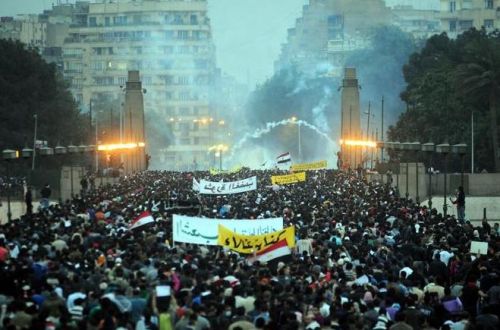
Mubarak is gone! Ordinary people took to the streets, in their hundreds of thousands, they stood their ground against state goons and hired thugs, they saw ordinary soldiers and many officers refuse to obey orders to repress them, and they have brought down a 30-year dictatorship supported by the full might of the American imperium.

Many, many things are still in play, many dangers abound, many uncertainties remain -- and many forms of retribution will no doubt be assayed by the powerful elites in both America and Egypt who have been humiliated by this uprising of the "rabble" against their "betters." But it is a great day, a day of rejoicing for all those who believe in the worth and dignity of individual human beings.
The Egyptians stood up, they asserted that worth, they embodied that dignity, and they have set themselves free. Long may they hold on to this liberation -- and long may it serve as an inspiration to everyone beset by the dead hand of elite domination.
And on the website of the Non Violent Action Network I read this:
Today let us celebrate and applaud the courageous Egyptians who struggled to bring down another dictator and set a new course for their ancient and accomplished civilization.
That is about all we should say today—thank you and congratulations, sisters and brothers of Egypt. You have shown not only individual courage, but also a cultural strength that draws from deep rivers of resources, flowing from the stories of resistance for millennia in ancient Egypt (e.g., Shiprah and Puah), from the deep waters of Islam (including such giants as Abdul Gaffar Khan and Maulana Azad, Chaiwat Satha Anand and other heroes of nonviolent resistance), from the twentieth century torrents of nonviolent resistance. You have become models for a new generation that takes up not the gun but the computer, the demonstration, the fearlessness of struggle.
Tomorrow or next week we can talk about the pitfalls of transition, about how to prevent another military dictatorship or another theft from the people by those wishing to take advantage of a power vacuum. There will be time later to ponder the shallowness of what Julius Nyerere called “flag independence” when colonialism was conquered but the revolution was only state-deep, rather than shaking up the economic, cultural and social structures ossified by decades of tyranny.
But for now, let’s shout and dance and thank God and the people of Egypt for their light shining through the darkness of yet another tyranny now conquered by courage.