Showing posts with label racial wealth inequality. Show all posts

Tuesday, August 25, 2015

Bruce Levine: the class and economic basis of the the US Civil War

Currently I am reading Bruce Levine's book The Fall of the House of Dixie about the US Civil War and the revolution that transformed the country through the collapse of slavery, the  destruction of the old South and the reunification of the country that emerged from the Civil War.

At the same time, the online radical leftist magazine Jacobin has devoted its current edition to a celebration of the 150th anniversary of the Union victory in the Civil War and the antislavery Emancipation Proclamation and an analysis of some contemporary implications. Bruce Levine has an article in that edition.

Levine writes that the Civil War was undeniably a class war. The southern political and economic elite exercised unprecedented financial and political power. They controlled the farms, banks, legislatures and Southern culture. The 50 leading Southern planters each owned more than 500 other human beings.

Levine shows how the war was primarily about preserving their wealth, power and privilege and protecting the economic and social and cultural systems built around slavery that created and sustained that wealth and power.

Levine writes that the Civil War was:
 
 ‘a rich man’s war’ . . . waged principally by poorer men and sustained by the privation of their families.’

 Levin writes how the Southern elite framed their message of white supremacy to appeal to mass audience. Levine argues that Southern secession advocates:

 “mobilized sections of the white South’s slaveless majority by presenting their cause less as a defense of slavery than as a defense of the South’s prerogatives, honor, mores, and right to govern itself.’’

Levine calls this transformation of the country through the abolition of slavery "the second American revolution." As he notes in the Jacobin article, the revolution however was notoriously incomplete:

It is true that during the 1870s and afterward, champions of white supremacy succeeded through a vicious terror campaign in denying former slaves and their descendants many of the rights that they had won in the war’s immediate aftermath. The brutally oppressive Jim Crow system that was then created remained in full force down past the middle of the twentieth century. 

 A reviewer of the book makes similar points:

Within a generation, the remnants of the Southern white aristocracy found common cause with their poor white brethren to subjugate the blacks once more through Jim Crow laws that thwarted the newly liberated. It would take the better part of another century of struggle to make fresh progress in redeeming Lincoln's original promise

Levine argues that slavery could well have lasted into the 20th century, and that it was, in fact, the Confederacy that hastened slavery's end. He suggests that while the South launched the war to preserve slavery, the Civil War in fact destroyed it more quickly than the natural course of events would have.

 "In taking what they assumed to be a defensive position in support of slavery the leaders of the Confederacy ... radically hastened its eradication."

Wednesday, August 22, 2012

The Marikana Massacre and post apartheid South Africa

There is shock and outrage inside and outside South Africa in the wake of what has become known as the Marikana Massacre, the killing by armed police of around 34 miners  and the wounding of another 75 at a platinum-mine owned by the giant Lonmin company (formerly Lonrho), near Rustenberg in the country's north.

The workers had staged a wildcat strike a few days earlier and were protesting outside the mine when on August 16th police opened fire with live ammunition in the first massacre of the post-apartheid era.

Roger Southall (Professor of Sociology at the University of the Witwatersrand) writes in this piece in Open Democracy, that the massacre exposes hard truths about post-apartheid South Africa that the country's elites have preferred to ignore.

For Southall this was a tragedy waiting to happen. He argues that the writing had been on the wall for a long time, but the powerful lacked the political will to decipher and  read the signs. 
The Marikana massacre has coincided with a time when many South Africans have come to feel increasingly uneasy, fearing that the promise of 1994 has faded and that the country has lost its way. Hopefully, it will serve as a jolt to the national conscience, and shame those who claim that the only way to attract foreign investment is by reducing the cost and conditions of labour into rethinking. But don’t count on it: for while, conceivably, the tragedy may undermine the Zuma presidency, more and greater shocks may yet be needed before government and employers combine for a serious assault upon poverty and inequality.
Southall analyses the massacre in terms of responsibility and culpability at four levels. He writes :
When the commission of inquiry comes to write its report - though it is most unlikely to allocate any responsibility before the ANC’s leadership election at Mangaung (Bloemfontein) in December 2012 - it might well choose to peel the Marikana onion in four stages.
Southall points to 4 underlying causes (stages) of the massacre:
  • the rivalry between Unions and the dynamics of the growing gulf between workers on the ground and their union officials
  • the growth of apartheid style policing
  • the  profound and bitter rivalries and struggles within the ruling ANC and the failure of Politicians to accept responsibility for the current crises
  •  the ongoing exploitation, greed and irresponsibility of mining corporations.

Saturday, February 19, 2011

Ernest Cole and life under apartheid

all photos courtesy of the Ernest Cole Trust

Ernest Cole is one of South Africa's most important photographers. He was one of the first photo journalists to expose what it was like to be black under Apartheid. Cole smuggled his camera into mining camps and used a camera hidden in a paper bag to photograph pass arrests.

One of the most viewed articles on this blog is a piece on Ernest Cole that appeared in 2010. Parts of it are reproduced below, as are some of Cole's photos.

Ernest Cole Photography as a Radical Act
(first published November 26 2010)
Ernest Cole was a colored South African who chronicled the lives of his fellow black South Africans living under apartheid. He believed in the power of photographs to show the world the horror of apartheid. His photos showed the daily brutality and hardship endured by black South Africans. The stark black and white photos he took were so powerful that his work was banned and he was forced into exile.
Cole published a book of his photographs in the US but died of cancer in 1990 in New York, just days after Nelson Mandela was released. He was 46 years old, and was penniless, destitute and homeless.
A retrospective of Cole's chilling and haunting photographs is occurring currently in South Africa. Younger South Africans are not only appreciating his remarkable work, but also learning about the inhumaity of the apartheid regime. 

A selection of his photos is here. In 2006 a documentary was made about his life and work. Articles on Ernest Cole can be read here, here, here and here.

Sunday, February 13, 2011

Closing the Gap on Aboriginal disadvantage

This week saw the the release of the Federal Government's Third Close the Gap Report on its efforts to address Aboriginal Disadvantage.

Despite important progress in some areas, the Report highlights the continual failure of Federal, State and Local Governments (and now the corporate sector) to "close the gap".

Unsurprisingly the report has quickly disappeared from public discourse and political and media media commentary.

Rather than acknowledge the failure of successive Governments to address Aboriginal disadvantage the Prime Minister pushed the responsibility back on Aboriginal people, demanding that they take greater responsibility for overcoming the problems their communities face.

As Greens Senator Rachel Siewart pointed out it was breathtakingly hypocritical of the Gillard Government to demand that Aboriginal people take greater responsibility, while simultaneously restricting how they spend their income.

Responding to the Report's release Eva Cox questions the evidence base upon which some of the Report's findings are based.

In this piece from the ABC Drum Unleashed Aboriginal leader Bev Manton offers a sustained critique of the Gillard Government Report Card:
So it is with heavy cynicism that I greet the third annual Closing the Gap report.

Rudd made the promise to deliver a statement on the government’s progress on closing the gap shortly after he won the election. The first two statements, both belated and both short of substance were a disappointment.

But Gillard’s latest delivery is even more of a let-down, and a continuation of the failures of Rudd’s unfinished business.

While she touches on “improvements” in many of the six targets federal Labor has set for eliminating Indigenous disadvantage - without providing a shred of evidence to back her claims - a key part of her statement was a call for “individual responsibility”.

“Closing the Gap means change in people’s lives. And Indigenous people know that when the child starts attending school… when the drinker stops abusing alcohol… when the adult takes the job that is there… then change begins,” she said.

“And Indigenous people know these decisions are not made by governments. They are made by people. The job of government, of communities is to support decisions.”

This is an old cliché. A dangerous and outrageous cliché, made even more dangerous and outrageous by the fact it was uttered by our nation’s leader.

It does not reflect the barriers that have been placed on generations upon generations of Indigenous people and undermines the willpower of thousands of Aboriginal Australians who battle against these barriers.

It also does not reflect the reality of life for many Aboriginal people.

The child will start attending school, when the school is built. And when the lessons are relevant, and delivered in a language they understand.

The drinkers will always abuse alcohol, just like white drinkers do. They’ll stop the drinking when they have the support in place to do so, and for the record, Aboriginal people are more likely to be tee-totallers than non Aboriginal people.

And Aboriginal people will take jobs when there are jobs to take. Prime Minister Gillard might like to explain to the nation how her party destroyed the economies of many communities when they pulled apart CDEP.

These barriers - and more - are wholly government-constructed.

A key example of this is the blanket coverage of income management on Aboriginal residents living in prescribed areas under the Northern Territory intervention.

There is scant evidence that this compulsory form of welfare quarantining is working. In fact, there is a growing body of research showing the precise opposite - that it is undermining the Government’s attempts to close the gap. It is having an adverse effect on nutrition and demonises Aboriginal people who largely spend their money wisely.

Yet this Labor Government has committed to rolling out this dog of a policy across the nation. It will be in NSW soon.

Another example is the disastrous Strategic Indigenous Housing Infrastructure Program (SIHIP), which has blown hundreds of millions of dollars on administration and still continues to waste money while communities cry out for more houses.

Many of these communities are not eligible for SIHIP funding. None of my communities in NSW - many of which are desperate for housing - qualify either.

Last year, I visited the remote communities of Irrultja, east of Alice Springs. Despite the billion-dollar NT intervention, the people of Irrultja still live in tin humpies.

They are strong people. They are courageous people. They are people who are proud in their culture and tied to their homelands.

But the Rudd government didn’t commit funds to build houses. Instead, they were given funds for electricity meters, to ensure their humpies are powered. They were denied the opportunity by the government of a first-world nation to lift their conditions from third world.

Should the people of Irrultja take responsibility for the failure of government, like Julia Gillard seems to be suggesting?

And should those affected by income management take responsibility for the failure of an evidence-light policy
?

Friday, September 17, 2010

WA miners spend their money everywhere except where the mines are

image courtesy of the ABC
 The mining and resource companies are always telling us that local economies and local communities benefit from all the money spent by those who work in the mines. 

In the Pilbara and Kimberley  region of WA 78% of mining salaries earned in the region are not spent in the region. The reason is the fly in fly out workforce.

Compare that figure to Queensland where 39% of mining salaries are spent outside the area.

For every $100 earned by miners in those regions, workers in the social welfare and health sectors earn $48 and workers in the retail trade earn $29. 

Those other workers actually live in the Pilbara and Kimberley towns and have to survive the massively inflated costs of living, housing and basic good and services that are driven up by the mining boom, without the huge salaries of their mining counterparts. 

They also live in towns suffering from the lack of long term investment by governments, the mining companies and the private sector in an adequate level of social infrastructure and public goods and services.  And they face the health, social and environmental consequences of living in close proximity to industrial plants and mining sites.

The boom economy does not reach many of those who have to live in the shadow of the mining industry.

Monday, May 24, 2010

Racial wealth gap in USA

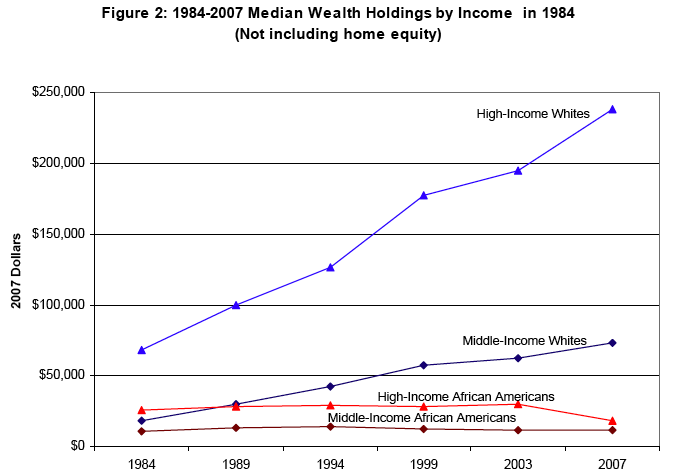
Talk about the rich getting richer?!!! Extraordinary data on Naked Capitalism about the racial wealth gap in the USA. The data is from a recent report by the US based Institute on Assets and Social Policy

Picture 48

The study authors argue that taxation policies and public policies are major factors in creating this wealth disparity. It would be most interesting to see similar Australian data.

What studies like this remind us (not that we need to be reminded in this country) that public policies that favour and benefit the wealthy and those who control capital (the rich, the corporations, the business elite) ultimately widen the wealth gap not reduce it, and they entrench and intensify inequality.