Showing posts with label war on terror. Show all posts

Monday, January 19, 2015

Zygmunt Bauman on the Charlie Hebdo attacks and murders

In this piece in Social Europe the renowned sociologist Zygmunt Bauman places the recent Charlie Hedbo attacks in their historical, social and political context.
"There were two aspects of the Charlie Hebdo murders that set them apart from the two previous cases: 
First: on 7th January 2015 political assassins fixed a highly media-visible specimen of mass media. Knowingly or not, by design or by default, the murderers endorsed – whether explicitly or obliquely – the widespread and fast gathering public sense of effective power moving away from political rulers and towards the centres viewed as responsible for public mind-setting and opinion-making. It was the people engaged in such activities that the assault was meant to point out as culprits to be punished for causing the assassins’ bitterness, rancour and urge of vengeance. 
And second: alongside shifting the target to another institutional realm, that of public opinion, the armed assault against Charlie Hebdo was also an act of personalized vendetta (going back to the pattern set by Ayatollah Khomeini in his 1989 Fatva imposed on Salman Rushdie).

If the 11 September atrocity chimed in with the then tendency to “depersonalise” political violence (following the pour ainsi dire“democratisation” of violence by mass-media publicity that divided its attention according to the quantity of its – mostly anonymous and incidental – victims, and the volume of spilt blood), the 7th January barbarity crowns the lengthy process of deregulation – indeed the “de-institutionalisation”, individualization and privatisation of the human condition, as well as the perception of public affairs shifting away from the management of established aggregated bodies to the sphere of individual “life politics”. And away from social to individual responsibility. 
In our media-dominated information society people employed in constructing and distributing information moved or have been moved to the centre of the scene on which the drama of human coexistence is staged and seen to be played"


Wednesday, May 21, 2014

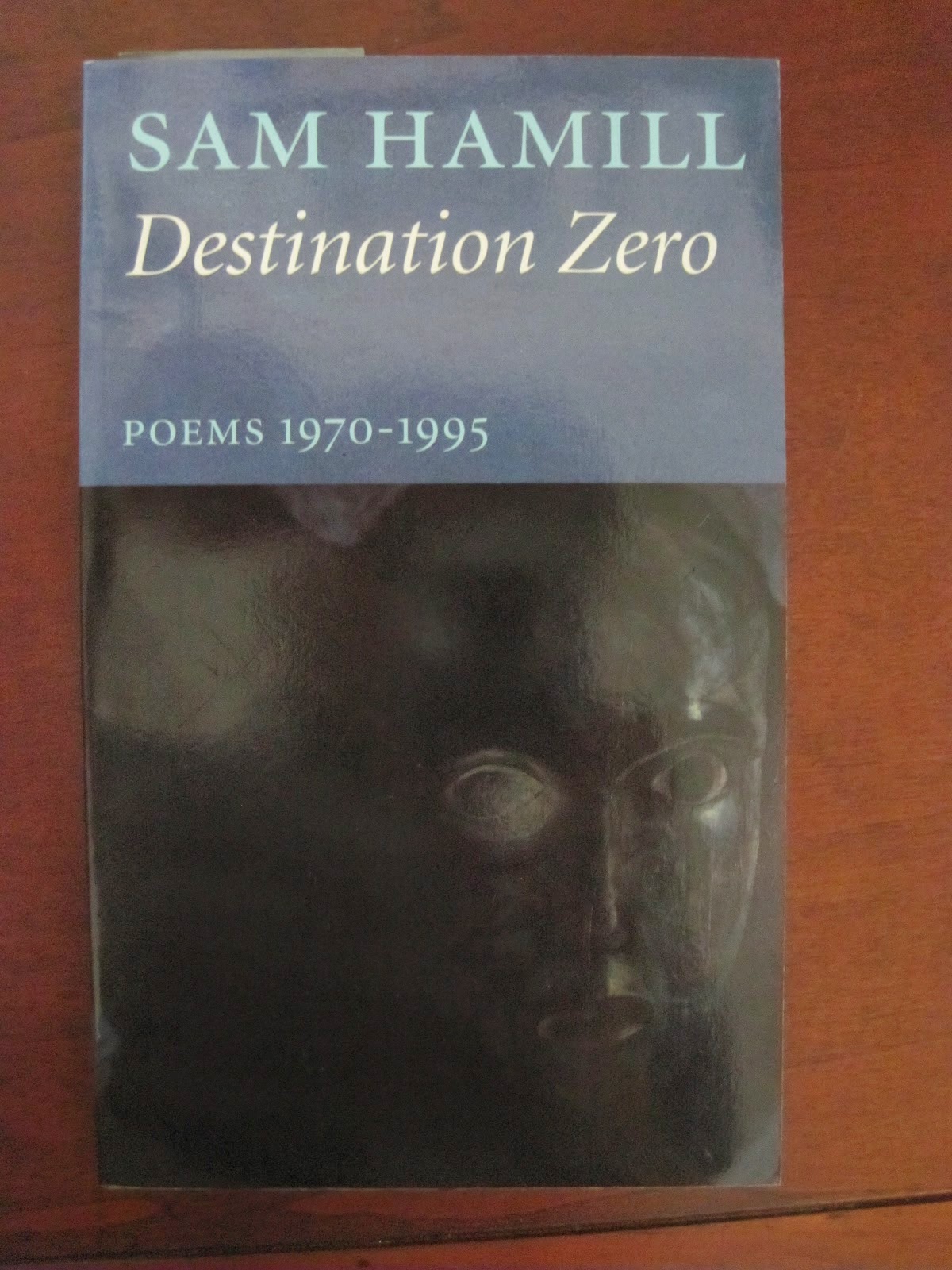
'Facing the world with eyes wide open' whilst 'standing among the missing': the poetry of Sam Hamill

Poets should speak out against what we see as the assault against our Constitution and the warmongering that's going on.  
Sam Hamill 
How much grief is a life?/ And what can be done unless/we stand among the missing, among the murdered,/the orphaned,/our own armed children, and bear witness/ 
Sam Hamill 
You can’t write about character and the human condition and be apolitical—that’s not the kind of world we’ve ever lived in.” 

Sam Hamill

****** 
True Peace 
Sam Hamill 

Half broken on that smoky night, 
hunched over sake in a serviceman's dive 
somewhere in Naha, Okinawa, 
nearly fifty years ago, 
I read of the Saigon Buddhist monks 
who stopped the traffic on a downtown 
thoroughfare 
so their master, Thich Quang Dúc, could take up 
the lotus posture in the middle of the street.
And they baptized him there with gas 
and kerosene, and he struck a match 
and burst into flame. 

That was June, nineteen-sixty-three, 
and I was twenty, a U.S. Marine. 
The master did not move, did not squirm, 
he did not scream 
in pain as his body was consumed. 
Neither child nor yet a man, 
I wondered to my Okinawan friend, 
what can it possibly mean 
to make such a sacrifice, to give one's life 
with such horror, but with dignity and conviction. 
How can any man endure such pain 
and never cry and never blink.
And my friend said simply, "Thich Quang Dúc 
had achieved true peace." 
And I knew that night true peace 
for me would never come. 
Not for me, Nirvana. This suffering world 
is mine, mine to suffer in its grief. 


Half a century later, I think 
of Bô Tát Thich Quang Dúc, 
revered as a bodhisattva now--his lifetime 
building temples, teaching peace, 
and of his death and the statement that it made. 

Like Shelley's, his heart refused to burn, 
even when they burned his ashes once again 
in the crematorium--his generous heart 
turned magically to stone. 

What is true peace, I cannot know. 
A hundred wars have come and gone 
as I've grown old. I bear their burdens in my bones. 
Mine's the heart that burns 
today, mine the thirst, the hunger in the soul. 

Old master, old teacher,
what is it that I've learned?


There is no other poet like Sam Hamill.

His poem True Peace describes his reaction to the self immolation of Buddhist priest Thich Quang Duc in June 1963 in Saigon. Thich Quang Duc sat in the middle of a busy Saigon street and waited for a fellow priest to pour petrol over him. He then set himself on fire.

Thich Quang Duc was protesting religious persecution against Buddhists by the American sponsored dictator of South Vietnam, Ngo Dinh Diem. Just weeks before  Diem's armed forces shot dead 9 Buddhists.

The murder of the monks and the self immolation of Thich Quang Duc set off a wave of protest against the deeply unpopular Diem regime, which triggered a US inspired coup approved by President John F Kennedy to overthrow the Diem regime in November 1963. The coup and overthrow of the Diem regime paved the way for escalation of US involvement in the second Vietnam War.

Sam Hamill is a distinguished American poet and political activist. 

Hamill is an outspoken and campaigning poet who has produced nearly 20 volumes of poetry and edited even more. Hamill acknowledges the influence of the Beat poets and also Zen Buddhism on his poetry.

As a young man, Hamill served in the US army as the result of a court sentence.

He is an avowed pacifist who has taught in prisons and has worked actively with women and children affected by domestic violence.

He founded and ran Copper Canyon Press for 32 years, one of the US's most innovative poetry publishers and has also translated Japanese, Chinese, Greek, Latin and Estonian poetry.

In January 2003 he was invited to the Bush White House by the President's wife Laura Bush as  part of a poetry symposium. Hamill refused to attend in protest against Bush policies in Iraq and Afghanistan. He went on to establish Poets against War, a global movement against war, to speak out about wars in Iraq and Afghanistan.

Hamill called for poets to submit poems for an anthology of poetry protesting against the wars. The anthology proved to be the largest single theme poetry anthology in history, comprising 30,000 poems by 26,000 poets. 12th February 2003 became a day of poetry against the war.

Hamill's actions inspired 135 poetry readings and events throughout the US and lead to the establishment of the website Poets Against the War.

His poetry has been translated widely with recent translations in France, Egypt, Italy and Argentina.  A Collected Volume of his work titled Habitations: Collected Poems, spanning nearly half a century of writing will be published in 2014.

He presently lives in Port Townsend, Washington, and Buenos Aires. Recent interviews and article featuring Sam Hamill are hereherehere and here.

Saturday, May 17, 2014

The war in Syria: navigating an impossible story

"All of Syria is in fact being crucified. In fact, despite their differences, Syria’s warring parties are united in the blood of Syrians – and Palestinians – which they shed on a daily basis. When over 150,000 Syrians, including 10,000 children are dead, and 6.5 million are internally displaced, and 2.5 million have fled beyond the country’s borders, no one is innocent. As for the pseudo-intellectuals who are keeping track of one body count, and ignoring the other, they must wake up to the fact that there is only one pool of victims, the Syrian people"
Ramzy Baroud

The killings and struggle for power continues in Syria. Syria is in ruins.  The Syrian war has become not just a struggle for power in Syria, but a regional struggle for Syria. 


What began in 2011 as peaceful protests for human dignity and political reform, inspired by the uprisings across the Middle East, degenerated into civil war after the Assad regime used military force to crush the popular protest. 

The result was the transformation of a popular protest into a military struggle that drew in major proxies- including Russia, US, Iran, France, Saudi Arabia, Israel and the UK.

As Eric Margolis writes:
Most of the uprising against Damascus began on the borders with Lebanon and Jordan, from where US, British, French and Saudi intelligence services organized, trained, and financed anti-Assad groups. Turkish intelligence, MIT, also fuelled the uprising in the north. 
This writer strongly believes Western special forces armed with the latest anti-tank weapons covertly supported anti-government forces – just as in the western-organized overthrow of Libya’s leader, Muammar Khadaffi.
Ramzy Baroud reminds us in his article Navigating Syriathat the Syrian war  is a stage for bloody political intrigues involving the US, UK, France, Israel, Saudi Arabia and other Arab nations who fund, arm and support the anti-Assad rebel forces, and Russia and Iran, who support, fund and arm the Assad regime. 

Russia, is the main backer of the Assad regime, with additional aid and support provided by Iran and Hezbullah.

The US, UK, France and Middle East countries, particularly Saudi Arabia have continually escalated the military conflict with their backing of the armed opponents of the Assad regime.


This is despite the rebel forces being dominated by extremist Islamist jihadi forces similar in beliefs and methods to al Qaida.

There is clear evidence that the US, UK and European countries are directly involved in training and arming the anti-Assad forces, with Saudi Arabia acting as the coordinator and distributor of arms. 

As Baroud notes, both sides perpetrate horrendous war crimes, destroy cities, massacre civilians, inflict perpetual sieges on civilian populations and commit unhindered violations of human rights massacres.

Baroud argues that neither side has the answers to the crises gripping Syria.
The Syrian narrative is very complex because a ‘just solution’ is not a matter of a clever articulation of words. Aside from the Syrian camps, parties involved include Western powers, Arab governments, Israel, Russia, Iran, and a cluster of intelligence agencies and legions of foreigners, on all sides. The agendas are mostly sinister. The media campaigns are driven by lies. The story of the Ghouta chemical attack of last year is particularly poignant. A war was about to break out, led by the US and cheered on by Arabs. A recent investigation by Pulitzer Prize-winning journalist Seymour Hersh suggests that the whole thing might’ve been a plot, involving Turkey, to indict the regime. He argues that the Americans knew it, yet still were ready to go to war
Baroud concludes his article by imploring us to stand with the Syrian people, not with the oppressors, who are both warring sides and their many supporters. 
But how do you navigate an impossible story? The answer: You side with the victim, no matter her colour, sect or creed. You remain committed to the truth, no matter how elusive. You drop every presupposition, abandon ideology, permanently discard dogma, and approach Syria with abundance of humanity and humility. We need to understand the roots of this heinous war, but we also need it to end for the good of the Syrian people. The Syrian conflict should not be a stage of bloody political intrigues for the West and Russia, Israel, Iran and the Arabs. Syria is not a God-given inheritance of the Assad-clan and their friends, or a space for another extremist experiment, as was the case in Afghanistan and Somalia, or another imaginary battlefield for social media leftists, whose claim to socialism is an occasional Facebook profile photo of a clasped fist, or an earth shattering quote about defeating capitalism.

Saturday, April 19, 2014

The American tradition of home grown 'white' right-wing terrorists

'The fact of the matter is that more people have been killed domestically by radical right extremists than Islamic extremists since 9/11'
Heidi Beirich
Southern Poverty Law Centre

Frazier Glenn Miller (Cross) is a former Klu-Klux Klan leader accused of killing three people outside Jewish community centres in Kansas City in the US.  

Cross is a Vietnam War veteran and notorious white supremacist, with a long history in the movement, including founding the Carolina Knights of the KKK.  He ran for the U.S. House in 2006 and the U.S. Senate in 2010, each time espousing a white-power platform, with a campaign steeped in race hate and anti-Antisemitism. Miller has also been an FBI informant.

This segment from Democracy Now provides further information on Miller and the shootings.


As Amy Goodman notes,  murderous rampages by right-wingers like Miller are dismissed as 'lone wolf' attacks by deranged and damaged individuals, rather than as organised terrorist attacks. 

In recent years, there has been a pattern of similar terrorist attacks, including murders and bombings by far right white supremacist groups. One example was the murder of seven people by a white supremacist at a Sikh Temple in Wisconsin in 2012. Many mass shootings in the US have been perpetrated by people with extreme right-wing sensibilities and attitudes.

There is also the epidemic of violence directed at reproductive health and abortion clinics by religious fundamentalist and right-wing groups, which has included killings, shootings, bomb-blasts, arson attacks, acid attacks and violence.

In this segment Rachel Maddow documents the long and growing threat presented by right- wing terrorist groups in the USA and explores the ways that threat is being ignored.

Miller is another example of the terrorist threat that is largely ignored by US authorities- the terrorist threat from right-wing hate groups and white supremacist groups

The FBI claims that eco-terrorists are the number one domestic terror threat to the USA. The US Department of Homeland Security gutted the unit that was supposed to investigate home grown non-Islamic terrorists after pressure from the right-wing over a leaked report that highlighted the risk of former US servicemen joining right-wing hate groups and white supremacist groups

Efforts by civil society groups and human rights organisations to expose such home grown right-wing and white supremacist terrorist groups are ignored, or actively undermined by US law enforcement and security agencies, who remain focused on Muslim groups, environmental activists and animal rights activists all of whom are labeled as terrorists. 

A recent report by the Southern Poverty Law Centre found that the murders of almost 100 people can be linked to a single far-right website.

Amy Goodman writes
While law-abiding Muslims are forced to hide in their homes, and animal-rights activists are labeled as terrorists for undercover filming of abusive treatment at factory farms, right-wing hate groups are free to organize, parade, arm themselves to the hilt and murder with chilling regularity. It’s time for our society to confront this very real threat.
And here is Juan Cole on US attitudes to 'white terrorism' and the main differences between white terrorists and others
"1. White terrorists are called “gunmen.” What does that even mean? A person with a gun? Wouldn’t that be, like, everyone in the US? Other terrorists are called, like, “terrorists.” 
2. White terrorists are “troubled loners.” Other terrorists are always suspected of being part of a global plot, even when they are obviously troubled loners. 
3. Doing a study on the danger of white terrorists at the Department of Homeland Security will get you sidelined by angry white Congressmen. Doing studies on other kinds of terrorists is a guaranteed promotion. 
4. The family of a white terrorist is interviewed, weeping as they wonder where he went wrong. The families of other terrorists are almost never interviewed. 
5. White terrorists are part of a “fringe.” Other terrorists are apparently mainstream. 
6. White terrorists are random events, like tornadoes. Other terrorists are long-running conspiracies. 
7. White terrorists are never called “white.” But other terrorists are given ethnic affiliations. 
8. Nobody thinks white terrorists are typical of white people. But other terrorists are considered paragons of their societies.9. White terrorists are alcoholics, addicts or mentally ill. Other terrorists are apparently clean-living and perfectly sane. 
10. There is nothing you can do about white terrorists. Gun control won’t stop them. No policy you could make, no government program, could possibly have an impact on them. But hundreds of billions of dollars must be spent on police and on the Department of Defense, and on TSA, which must virtually strip search 60 million people a year, to deal with other terrorists."

Friday, August 23, 2013

Chris Hedges and Chris Floyd on the Manning sentence

Chris Hedges on the 35 year sentence handed down to Chelsea (Bradley) Manning:
Although it was less than I thought the judge was going to throw at him, my gut reaction was quite emotional. I was quite upset. I think that that’s because this is part of a larger process by which any attempt to shine a light on the inner workings of power is not only being shut down, but those with a conscience who attempt to inform the wider public of, in the case of Manning, crimes that have been committed—war crimes—have become, in this society, criminals. The whole moral and legal system has been inverted. … We are seeing all of the traditional checks by which we are able to thwart government tyranny ripped down. So I look at what happened today as a kind of process, and a very depressing process, whereby not only civil liberties are shredded, but any capacity for the investigation and uncovering of the abuse of power is effectively thwarted.
On his blog Empire Burlesque Chris Floyd  points out that Manning has been given a far harsher sentence for revealing war crimes than Lt. William Calley and his My Lai massacrers were given for actually committing war crimes.  Floyd writes:
35 years for leaking documents -- while the mass murderers, drone bombers and death-squadding assassins of the Potamac Empire live free in pomp and privilege.
In an earlier piece Chris Floyd writes:
Reality in such systems -- systems that have openly demonstrated their willingness to torture people, lock them up for years without trial or kill them outright at the arbitrary order of the leader and his minions -- is not a TV show, not a movie with well-marked 'character arcs' ending in triumph for the bruised but unbowed hero. It's a dirty, ugly, degrading business, an uneven fight, pitting unarmed truth against vast, implacable, dehumanizing forces of violent domination. It is a war with many bitter defeats, both outwardly and in the souls of those caught up in it. It involves loss, destruction, humiliation, torment, ruin and doubt. There are no "heroes" in it, only human beings: some of them fighting to hang on to their humanity as best they can -- and others who have surrendered their humanity to the forces of domination.

Bradley Manning doesn't have to be a "hero." He doesn't have to make a stirring speech to give people a vicarious thrill for a moment before they click over to check their Facebook page or pop in another box set. He has shown clearly that he stands on the side of humanity -- and now he is paying the price for it. The very fact of his case has revealed the true nature of the system arrayed against him, and again.
In a  longer piece in Truthdig Chris Hedges writes:
Wednesday’s sentencing marks one of the most important watersheds in U.S. history. It marks the day when the state formally declared that all who name and expose its crimes will become political prisoners or be forced, like Edward Snowden, and perhaps Glenn Greenwald, to spend the rest of their lives in exile. It marks the day when the country dropped all pretense of democracy, obliterated checks and balances under the separation of powers and rejected the rule of law. It marks the removal of the mask of democracy, already a fiction, and its replacement with the ugly, naked visage of corporate totalitarianism. State power is to be, from now on, unchecked, unfettered and unregulated. And those who do not accept unlimited state power, always the road to tyranny, will be ruthlessly persecuted.

Sunday, November 11, 2012

Counterpunch and the "secret" history of the Obama Presidency

The excellent radical political magazine Counterpunch is full of informative and insightful articles about the secret and untold history of the newly elected Obama administration.

Dave Lindorff describes the Obama administration's role in the orchestration of  the crackdown on the US Occupy movement. Lindoff's article, which is based on documents obtained through Freedom of Information requests, show that the Obama White House, the US Government and Government agencies used national security agencies, intelligence and spying networks and Police agencies to crackdown on ordinary citizens involved in the US occupy Protests.

What the documents show is that the Obama White House used the guise of "anti-terrorism" to investigate, monitor and crackdown on groups and individuals involved in Occupy protests across the country and then attempted to conceal and cover up their involvement.

In a piece titled Is this Child Dead Enough for You  journalist and writer Chris Floyd uses the murder of another Pakistani child in a US drone attack ordered by President Obama to ask unsettling questions about the doctrine of "lesser evilism" used by many progressives and liberals  to explain their support for Obama over Mitt Romney in the recent Presidential elections.  Floyd's articles can be read on his website Empire Burlesque.

Writing about the evil of a President ordering drone attacks that kill Pakistani children Chris Floyd writes:
" the sense of triumph and exultation and glee on the part of so many progressives and liberals and ‘dissidents’ at the victory of this “lesser evil.” Where did the reluctance, the nose-holding, the sad head-shaking go? Should they not be mourning the fact that evil has triumphed in America, even if, by their lights, it is a “lesser” evil?

If you really believed that Obama was a lesser evil , if you really did find the drone wars and the White House death squads and Wall Street bailouts and absolution for torturers and all the rest to be shameful and criminal, how can you be happy that all of this will continue? Happy — and continuing to scorn anyone who opposed the perpetuation of this system.

The triumph of a lesser evil is still a victory for evil.
Of the Pakistani drone attacks Floyd writes:
As we all know, these drone missiles are, like the president who wields them, super-smart, a triumph of technology and technocratic expertise. We know, for the president and his aides have repeatedly told us, that these weapons  strike nothing but their intended targets and kill no one but “bad guys.” Indeed, the president’s top aides have testified under oath that not a single innocent person has been among the thousands of Pakistani civilians — that is, civilians of a sovereign nation that is not at war with the United States — who have been killed by the drone missile campaign of the Nobel Peace Prize Laureate.

Yet somehow, by some miracle, the missile that roared into the residential area where Naeemullah lived did not confine itself neatly to the house it struck. Somehow, inexplicably, the hunk of metal and wire and computer processors failed — in this one instance — to look into the souls of all the people in the village and ascertain, by magic, which ones were “bad guys” and then kill only them. Somehow — perhaps the missile had been infected with Romney cooties? — this supercharged hunk of high explosives simply, well, exploded with tremendous destructive power when it struck the residential area, blowing the neighborhood to smithereens.

As Wired reports, shrapnel and debris went flying through the walls of Naeemullah’s house and ripped through his small body. When the attack was over — when the buzzing drone sent with Augustinian wisdom by the Peace Laureate was no longer lurking over the village, shadowing the lives of every defenseless inhabitant with the terrorist threat of imminent death, Naeemullah was taken to the hospital in a nearby town.

This is where the picture of above was taken by Noor Behram, a resident of North Waziristan who has been chronicling the effects of the Peace Laureate’s drone war.  When the picture was taken, Naeemullah was dying. He died an hour later"

Monday, October 15, 2012

Living under the threat of US targeted drone killing

"Nadia, 10 years-old, was at school when her house was hit by a drone, killing her father and mother: “My relatives rushed to the spot and tried to recover the dead bodies trapped under the debris but we couldn’t identify them as they were completely burned.” Nadia is an only child and has moved in with her aunt in a nearby town. She says she has “no source of income with my parents gone… my aunt looks after me now and I help her in the house…but I want admission into school. I want an education. Please ask the government to provide me with a monthly stipend so I can get an education.”
case study from The Civilian Impact of Drones: Unexamined Costs, Unanswered questions
A new report by US academics at New York and Stanford Universities (with the British NGO Reprieve) into the use of covert targeted drones to kill supposed terrorists in Pakistan's tribal heartlands is a searing indictment of the Obama administration's campaign of targeted killing.  The report is titled  Living Under Drones: Death Injury and Trauma to Civilians from US Drone practices in Pakistan.

The report is part of growing outrage about the consequences of targeted drone killings by the US. Another report titled  The Civilian Impact of Drones: Unexamined Costs, Unanswered questions has been released by the Center for Civilians in Conflict and Columbia Law School's Human Rights Clinic.

The use of targeted drone killings is now a major part of US counter-terrorism strategy. The Obama administration shifted focus from the Bush administration policy of targeting high profile terrorist leaders to a reliance on analyzing patterns of life on the ground to select targets to killing. Targets for killing are now selected each week at White House meetings attended by the President.  Another Obama practice is the “double tap,” where a second strike is used to kill rescuers or mourners who respond to the initial strike.

The report shows that targeted drone killings or signature strikes which target individuals on the basis of patterns of behavior identified by US intelligence kill large number of civilians, including women and children. The report concludes that between 2562 and 3325 people have been killed by covert drones in Pakistan over an 8 year period, including 176 children.

Based on interviews with eyewitnesses and people familiar with the region, the report concludes that the drones have (1) killed a lot of civilians, including children, (2) killed very few identifiable leaders of the Taliban or Al Qaeda and (3) made a lot of new enemies for the United States.

The Report makes it very clear that the use of targeted drone killings is creating the very extremism and anti-Americanism the policy is supposed to combat. More and more Pakistanis now see the US as their enemy as a result.

The Report disputes the Obama administration claims that strikes are surgically precise with minimal collateral impact and few civilian deaths.

The extract below is from an article in the UK Guardian on the report:
The study by Stanford and New York universities' law schools, based on interviews with victims, witnesses and experts, blames the US president, Barack Obama, for the escalation of "signature strikes" in which groups are selected merely through remote "pattern of life" analysis.

Families are afraid to attend weddings or funerals, it says, in case US ground operators guiding drones misinterpret them as gatherings of Taliban or al-Qaida militants.

The report was commissioned by and written with the help of the London-based Reprieve organisation, which is supporting action in the British courts by Noor Khan, a Pakistani whose father was killed by a US drone strike in March 2011. His legal challenge alleges the UK is complicit in US drone strikes because GCHQ, the eavesdropping agency, shares intelligence with the CIA on targets for drone strikes.
"US drones hover 24 hours a day over communities in north-west Pakistan, striking homes, vehicles, and public spaces without warning," the American law schools report says.
"Their presence terrorises men, women, and children, giving rise to anxiety and psychological trauma among civilian communities. Those living under drones have to face the constant worry that a deadly strike may be fired at any moment, and the knowledge that they are powerless to protect themselves.

"These fears have affected behaviour. The US practice of striking one area multiple times, and evidence that it has killed rescuers, makes both community members and humanitarian workers afraid or unwilling to assist injured victims."

The study goes on to say: "Publicly available evidence that the strikes have made the US safer overall is ambiguous at best … The number of 'high-level' militants killed as a percentage of total casualties is extremely low – estimated at just 2% [of deaths]. Evidence suggests that US strikes have facilitated recruitment to violent non-state armed groups, and motivated further violent attacks … One major study shows that 74% of Pakistanis now consider the US an enemy."
"US targeted killings and drone strike practices undermine respect for the rule of law and international legal protections and may set dangerous precedents," the report says, questioning whether Pakistan has given consent for the attacks.

"The US government's failure to ensure basic transparency and accountability in its targeted killings policies, to provide details about its targeted killing programme, or adequately to set out the legal factors involved in decisions to strike hinders necessary democratic debate about a key aspect of US foreign and national security policy.

"US practices may also facilitate recourse to lethal force around the globe by establishing dangerous precedents for other governments. As drone manufacturers and officials successfully reduce export control barriers, and as more countries develop lethal drone technologies, these risks increase."

Sunday, August 26, 2012

Andres Breivik and the mainstreaming of extreme right wing ideas


Friday's verdict thus not only delivers justice, it also clarifies the connection between his crimes and how dangerous rightwing ideologies have infiltrated an apparently "sane" mainstream discourse. It is a problem that cannot be expunged simply by labelling it as mad, but must be tackled directly as the political threat to freedom and democracy it is.
Tad Tieze

Excellent piece here by Australian psychiatrist, writer, author, blogger and commentator Tad Tieze on the Anders Breivik verdict.
There are many reasons to welcome the verdict in the trial of Anders Behring Breivik: that he is sane and legally responsible for the murder of 77 people – mostly members of the Norwegian Labour party – on 22 July last year
The guilty verdict recognises the monstrosity of Breivik's acts, carried out in pursuit of his political beliefs. It also delivers the outcome wanted by the majority of Norwegians, in particular because it means he will spend no fewer than 21 years – and most likely life – in jail. Justice has been done to the fullest extent possible under Norwegian law.
To understand the full import of the outcome, however, one needs to look to the wider realms of politics and society. The trial was dominated by the question of Breivik's sanity for more than just procedural reasons.
Once it was realised a white, middle-class Norwegian man was the culprit and that he'd left a sickening but coherent 1,500-page manifesto for all to read, the race was on for some on the right to depoliticise Breivik's acts. The problem was that his politics were not just similar to their own, but often drawn directly from their statements, cut and pasted into his tract. In many cases the only difference was that he took their language of a war of civilisations to its logical conclusion in violence.
It wasn't just harder rightwingers such as Melanie Phillips, Mark Steyn and Pamela Geller who tried to deny the connection, but many more moderate writers and politicians. This should not be surprising, as Breivik's opposition to Muslims, multiculturalism and a "cultural Marxist" fifth column was never far from the surface in the mainstream discourse of the war on terror. Norway, for all its famed tolerance, continues to be an active part of the Nato occupation of Afghanistan.
The main form this depoliticisation took was the medicalisation of Breivik's actions in terms of psychological or psychiatric pathology. Within days, everyone from forensic psychiatrists to the London mayor, Boris Johnson, felt the need to put Breivik in a diagnostic box. Occasionally, even reportage of his personal history and psychology went to ludicrous extremes to seek his motives in anything but what he actually said. This reached its pinnacle with the first court-ordered psychiatric report, which found him to be suffering from "paranoid schizophrenia" on the basis of clumsy and inappropriate interpretation of ideas and behaviours common in far-right and online gaming subcultures.
Outrage over the findings led the court to take the unusual step of commissioning a second report. This one paid more attention to his political milieu, as well as his behaviour in jail, and found him sane – at most exhibiting signs of a personality disorder. Friday's verdict confirms this conclusion and denies to Islamophobic ideologues the comfort of a clear line of sanity separating their influence from Breivik's actions.
The verdict is doubly important as an intractable economic crisis across Europe provides opportunities for the advance of the far right. Virtually all of these rightwing parties disowned Breivik's actions while singling out in their own propaganda the same groups he targeted. At one extreme, Greece's neo-Nazi Golden Dawn party has seen its electoral support rocket to 7%, even as its thugs carry out violent attacks on migrants in the streets of Athens. But much wider networks of extreme rightwingers populate the internet and organisations of the populist right, exactly the spaces in which Breivik's ideology and commitment to action were formed.
Friday's verdict thus not only delivers justice, it also clarifies the connection between his crimes and how dangerous rightwing ideologies have infiltrated an apparently "sane" mainstream discourse. It is a problem that cannot be expunged simply by labelling it as mad, but must be tackled directly as the political threat to freedom and democracy it is.

Monday, May 2, 2011

Chris Hedges on the reported death of Osama Bin Laden

Chris Hedges is a wise journalist and writer whose opinions I deeply respect. He won a Pulitzer Prize reporting from the front lines as the Middle East Bureau Chief for the New York Times until he resigned because of comments he made about its pro war editorial policies. 
Here are his comments on the reported death of Osama Bin Laden from the US online publication Truthdig
Editor’s note: Chris Hedges made these remarks about Osama bin Laden’s death at a Truthdig fundraising event in Los Angeles on Sunday evening.
I know that because of this announcement, that reportedly Osama bin Laden was killed, Bob wanted me to say a few words about it … about al-Qaida. I spent a year of my life covering al-Qaida for The New York Times. It was the work in which I, and other investigative reporters, won the Pulitzer Prize. And I spent seven years of my life in the Middle East. I was the Middle East bureau chief for The New York Times. I’m an Arabic speaker. And when someone came over and told Jean and me the news, my stomach sank. I’m not in any way naïve about what al-Qaida is. It’s an organization that terrifies me. I know it intimately.

But I’m also intimately familiar with the collective humiliation that we have imposed on the Muslim world. The expansion of military occupation that took place throughout, in particular the Arab world, following 9/11 – and that this presence of American imperial bases, dotted, not just in Iraq and Afghanistan, but in Kuwait, Saudi Arabia, Doha – is one that has done more to engender hatred and acts of terror than anything ever orchestrated by Osama bin Laden. 

And the killing of bin Laden, who has absolutely no operational role in al-Qaida – that’s clear – he’s kind of a spiritual mentor, a kind of guide … he functions in many of the ways that Hitler functioned for the Nazi Party. We were just talking with Warren about Kershaw’s great biography of Hitler, which I read a few months ago, where you hold up a particular ideological ideal and strive for it. That was bin Laden’s role. But all actual acts of terror, which he may have signed off on, he no way planned.

I think that one of the most interesting aspects of the whole rise of al-Qaida is that when Saddam Hussein … and I covered the first Gulf War, went into Kuwait with the 1st Battalion, 1st Marines, was in Basra during the Shiite uprising until I was captured and taken prisoner by the Iraqi Republican Guard. I like to say I was embedded with the Iraqi Republican Guard. Within that initial assault and occupation of Kuwait, bin Laden appealed to the Saudi government to come back and help organize the defense of his country. And he was turned down. And American troops came in and implanted themselves on Muslim soil.

When I was in New York, as some of you were, on 9/11, I was in Times Square when the second plane hit. I walked into The New York Times, I stuffed notebooks in my pocket and walked down the West Side Highway and was at Ground Zero four hours later. I was there when Building 7 collapsed. And I watched as a nation drank deep from that very dark elixir of American nationalism … the flip side of nationalism is always racism, it’s about self-exaltation and the denigration of the other. 
 
And it’s about forgetting that terrorism is a tactic. You can’t make war on terror. Terrorism has been with us since Sallust wrote about it in the Jugurthine Wars. And the only way to successfully fight terrorist groups is to isolate themselves, isolate those groups, within their own societies. And I was in the immediate days after 9/11 assigned to go out to Jersey City and the places where the hijackers had lived and begin to piece together their lives. I was then very soon transferred to Paris, where I covered all of al-Qaida’s operations in the Middle East and Europe. 

So I was in the Middle East in the days after 9/11. And we had garnered the empathy of not only most of the world, but the Muslim world who were appalled at what had been done in the name of their religion. And we had major religious figures like Sheikh Tantawy, the head of al-Azhar – who died recently – who after the attacks of 9/11 not only denounced them as a crime against humanity, which they were, but denounced Osama bin Laden as a fraud … someone who had no right to issue fatwas or religious edicts, no religious legitimacy, no religious training. And the tragedy was that if we had the courage to be vulnerable, if we had built on that empathy, we would be far safer and more secure today than we are. 

We responded exactly as these terrorist organizations wanted us to respond. They wanted us to speak the language of violence. What were the explosions that hit the World Trade Center, huge explosions and death above a city skyline? It was straight out of Hollywood. When Robert McNamara in 1965 began the massive bombing campaign of North Vietnam, he did it because he said he wanted to “send a message” to the North Vietnamese—a message that left hundreds of thousands of civilians dead. 

These groups learned to speak the language we taught them. And our response was to speak in kind. The language of violence, the language of occupation—the occupation of the Middle East, the wars in Iraq and Afghanistan—has been the best recruiting tool al-Qaida has been handed. If it is correct that Osama bin Laden is dead, then it will spiral upwards with acts of suicidal vengeance. And I expect most probably on American soil. The tragedy of the Middle East is one where we proved incapable of communicating in any other language than the brute and brutal force of empire.

And empire finally, as Thucydides understood, is a disease. As Thucydides wrote, the tyranny that the Athenian empire imposed on others it finally imposed on itself. The disease of empire, according to Thucydides, would finally kill Athenian democracy. And the disease of empire, the disease of nationalism … these of course are mirrored in the anarchic violence of these groups, but one that locks us in a kind of frightening death spiral. So while I certainly fear al-Qaida, I know it’s intentions. I know how it works. I spent months of my life reconstructing every step Mohamed Atta took. While I don’t in any way minimize their danger, I despair. I despair that we as a country, as Nietzsche understood, have become a monster that we are attempting to fight.

Thank you.

Monday, April 25, 2011

Anzac Day and selective remembering

"War, in short prompted behaviour that would have been unthinkable, as well as dysfunctional in peacetime... War- total war- has been the critical antecedent condition for mass criminality in the modern era"
Tony Judt 2008
Today is Anzac Day and with it comes jingoism, nationalism, memorialization and glorification of war.

I am all for respecting and acknowledging the sacrifice and courage of Australian soldiers, but what we get with Anzac Day is "selective remembering": the promotion and popularization of a mythology that accords legitimacy to some truths about Australia's military history and silences others.

Much of the history we hear on Anzac Day does not enhance our appreciation and awareness of Australian history. It serves as substitute.

Thinking about Anzac Day brings to mine James Scott's book Domination and the Arts of Resistance in which he writes of the public rituals, performances and ceremonies- parades, memorials, state ceremonies- that the powerful use to distract attention away from the strategies they use to retain power. War of course being one of those.

I will spend the day reflecting on the horror and tragedy of war, and Australia's history of fighting in other country's wars.

I will think of my own family members who fought (and suffered) as a result of their war experiences. They had no interest in all the glorification and memorialisaion of war.

My mother’s brother- my uncle- fought in the Western Desert and SE Asia during WW2. After his return from war he wanted nothing to do with all the celebratory war talk. He had no time for groups like the RSL. He used to say that those who talked the loudest about war were usually the ones who had never seen the real action close up. I am reminded of Albert’s words today as I hear all those politicians and military leaders.

And I will think of a former neighbour of mine. He fought in New Guinea where he saw the horror of war. He told me once that "war is just ordinary men with families and children killing other ordinary men with families and children...... Unnecessary killing that’s what war is”.

I wonder if his message will get spoken at all the official ceremonies on Anzac Day.

A piece inspired by a conversation I had with him on the eve of the invasion of Iraq can be read here.

Anzac Day would be more honest and meaningful if we also remembered and spoke honestly about alternative narratives of Australia's past and current military history, including;
  • the foreign invasion of sovereign nations by Australian troops (Turkey, Vietnam, Afghanistan, Iraq);
  • the exploitation of Australian troops by Imperial powers (USA and Britain) ;
  • the lies and deceit that have been used time and time again (and continue to be used) to justify Australia's involvement in overseas wars (Vietnam, Iraq and Afghanistan);
  • the pointlessness of Australia's involvement in the geo-political maneuvers of imperial powers;
  • Australia's unquestioning involvement in imperial wars since the Boer War;
  • the incompetence and callousness of military and political decision makers- American, British and Australian;
  • the horror, brutality and pointlessness of war; 
  • the atrocities perpetrated by the Australian military and their allies;
  • the brutalizing effect of war on ordinary soldiers and their families and on civilians;
  • the abandonment of many Australian soldiers by the Australian military and government once they return home from war;
  • the bellicose attitudes to war and the political uses that military, media and political leaders make of Australia's military history; and
  • the warrior culture in the Australian military that allows and covers up bastardization, sexual assault, sexual predation and other military excesses.