Showing posts with label Algeria. Show all posts

Friday, September 14, 2012

The rising tide of Anti-American protests

This video, story and live blog from Al Jazeera, slide show from the online publication Foreign Policy and this report from the ABC captures commentary, footage and images from the rising tide of anti-US protest across the Muslim world.

Across the Middle East protestors have taken to the streets outside U.S. embassies in Egypt, Israel, Libya, Morocco, Sudan, Tunisia, and Yemen in response to the American-made Internet video called Innocence of Muslims

What started as protests outside the U.S. embassy in Cairo on Tuesday, Sept. 11, escalated dramatically with the attack on the U.S. consulate in Benghazi, which resulted in the deaths of four Americans, including the U.S. Ambassador J. Christopher Stevens.

The Al Jazeera report makes this point about the significance of the protests:
Whatever the cause, the events appeared to underscore how much the ground in the Middle East has shifted for Washington, which for decades had close ties with Arab dictators who could be counted on to crush dissent.

Tuesday, February 22, 2011

Why are right wingers and conservatives silent on the uprisings across the Middle East?

Enjoyed this piece by Guy Rundle in Crikey on the silence of the right wingers and conservatives on the Arab uprisings.
"The Right’s gradual and encroaching silence about the Arab uprisings is a wonder to behold. On National Review, the US conservative website, which ran wall-to-wall coverage of the Iranian protests in 2009, and berated the left for not praising the brave Iranians, there is barely a word — just as there has been barely a word on Bahrain. In The Spectator, Melanie Phillips focused on the attack on US reporter Lara Logan, taking her attackers to be representative of the whole crowd — and not the women protesters and soldiers who rescued Logan. In Oz, the Bolter has a straight news rundown on his blog, and manages to use the Libyan thing to attack … the United Nations. Nothing at all on Quadrant. The News Ltd Blogger Who Cannot Be Named because S/he Will Sue (TNLBWCBNBS/HWS) confines self to a side issue. And at the Oz, a contribution from the opinion page is confined to … Strewth.
Why such reticence? The bravery of the Libyans is immense, inspiring. And they appear to be winning against a heavily armed regime whose fearsome power is crumbling …
Ah, of course. It is precisely because the Libyan uprising has occurred at all that it makes so little appearance on right-wing radar. For it kicks away another prop from the neocon argument about the Iraq invasion, and intervention more generally — that some regimes are so heavily armed that a people’s liberation must be done on their behalf. This was fall-back position No.2 in the war, as I recall, after the WMDs thing. For a giddy while there in 2003-4, the debate was mainly around who we’d invade next — Zimbabwe? North Korea, with nukes (Johann Hari’s choice)? Eventually we settled on the Northern Territory.
The “proxy liberation” defence survived for quite a while. Desperate members of the British Labour Party adopted the mantra — “the world is better off without Saddam Hussein” — although they didn’t mention the 200,000 or so other people the world was deprived of in the ensuing years.
The Libyan revolution makes it clear that the Iraqi people could have, and almost certainly would have, stood up to Saddam in this current wave of uprisings — taking upon themselves the responsibility for their own liberation, and the sacrifice of it. It’s a process whose importance lies as much in the meaning it gives to death — chosen, willed, as opposed to getting shot at a checkpoint or bombed — as it does to life. Furthermore, as the other uprisings have shown, it would have generated genuine solidarity among people, rather than the seemingly permanent divisions created by the US’s clientalism.
That’s a clue to the second reason why the Right has lost any ability to speak — the argument that there were anti-American ultra-dictators made it possible to defend dictators such as Hosni  Mubarak. Thus Melanie Phillips in one of her 50,000 jeremiads bemoaned the simple abandonment of America’s allies in a process that would not challenge America’s enemies.

Wednesday, January 26, 2011

People rising on Arab streets

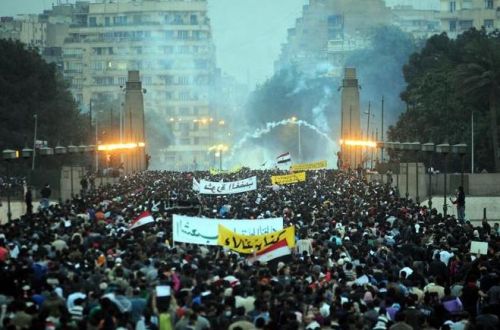
photo courtesy of Jack Shenker and the The Guardian


What is happening on Arab streets is remarkable. From the overthrow of the US supported Tunisian government to civilian demonstrations and uprisings in Egypt, the people of Arab countries are rising up against years of political, economic and military suppression.
Jack Shenker is a reporter in Egypt for the UK Guardian and his live reports of the anti-government uprisings in Egypt can be read here. Of today's demonstrations he writes: 
A remarkable day in Egyptian history, one that could have vast  ramifications within the Arab World and beyond. Observers are now asking themselves how long the international community will continue to back  Mubarak – a key western ally, despite his penchant for torture and human rights abuses, and the recipient of more US financial aid than any country in the world except Israel. However things play out tomorrow,  it’s clear a crucial fear barrier has been broken today in Egypt; if that emboldens the millions of Egyptians who have long harbored latent hostility to the government and yet who have thus far been too afraid to confront it openly, then regime change could be closer than we think." 
Interesting also to read the thoughts of Sief Da' Na, Associate Professor of Sociology and International Studies specializing in the MiddleEast and North Africa at the University of Wisconsin-Parkside on the significance of events in Tunisia across the Arab world: 
 "Repercussions of the Tunisia example will be deep and significant and will be felt throughout the region. The uprising signifies not only the failure of the neo-liberal economic model that Arab regimes pursued, but also the futility of political oppression to enforce this model in the long run. The event signifies the beginning of a new era that must be seen as a process of change and might lead to the creation of a new region. The demands by people on the street we are seeing in Tunisia, Algeria, Egypt, Jordan and elsewhere are broad. They are political, economic, and social demands signifying the dead-end of a system that employed excessive political oppression to enforce destructive neo-liberal economic policies. Privatizing the public sector essentially reversed the post independence economic achievements of these countries, increased inequality, and created intolerable living conditions for a significant part of the population.  

    "This is not to say that these protest movements are necessarily going to change the region immediately. This is a process that might take time. But I think it is irreversible despite the massive security apparatuses (equivalent to 1.3 percent of the total population in Tunisia). In Egypt, which has been under a 'state of emergency' for 30 years, it is estimated that over 300,000 people are in the State Security [one of several organizations] alone, and more people are employed in the state security and police than the military.

Thursday, December 30, 2010

Robert Fisk: exposing brutality and hypocrisy in the Middle East

photo of families whose relatives vanished during the Algerian civil war (1990-98) demand to know what happened to their loved ones during a recent demonstation in Algiers (photo courtesy of AFP/Getty)

There is no better chronicler of the brutality of Western and Arab governments in the Middle East than Robert Fisk, the Middle East Correspondent for the UK Independent.

Fisk uncovers and exposes the hypocrisy of the West and its ally Israel, but is equally critical of the leaders, political elite and leadership of the Muslim world. And Fisk knows history well.

In his latest piece Robert Fisk writes of recent celebrations in Algeria to commemorate 50 years of freedom from French rule. Fisk points out that the generals and politicians who were out in full force making speeches against colonial tyranny were themselves responsible for the deaths of an estimated 25,000 Algerians during the Algerian Civil War of 1990-1998.

While the families of the dead and civil society groups seek justice for those who died during the Algerian civil war of 1990-98, Fisk reminds us that the security forces and army responsible for many of those deaths are still in control in Algeria. Only now they are allies of the USA in the fight against "terrorism".

Wednesday, August 11, 2010

Films about France's dark colonial past


On Sunday night I watched the excellent French movie The Colonel on SBS. Part murder mystery, part historical drama, the film explores the dark side of France's colonial past, specifically the legacy of the Algerian War of Independence (1954-1962), which led Algeria to gain its independence from France.

The Algerian War of Independence lasted 8 years and cost some 1.5 million lives. The war saw countless atrocities by both sides and the systematic use of torture and targeting of civilians by the French military and the Algerian FLN.

The Colonel is one of a growing genre of outstanding and controversial French films that explore France's colonial legacy in Algeria. Some of these have been made by French film makers born in Algeria or Northern Africa. Although the war in Algeria left a bitter legacy in France, it is only recently that films are being been made about the subject, particularly the use by the French military of systematic torture and state sanctioned murder of civilians, and the use of weapons such as napalm.

These films are important, not just because they shine the light on France's colonial project, but also because they draw a parallel between past events and modern day warfare, the legality of torture and the "war on terror".

The Colonel (2006) Written by the legendary film director Costa Gavras , The Colonel juxtaposes two related narratives- the investigation of the murder of a famous retired French army Colonel who ordered atrocities and torture in Algeria, with the story of a young army officer who served in Algeria under the Colonel's command who went missing in action during the war. His story is told through a series of letters sent to an army officer investigating the murder of the Colonel.

Days of Glory (2006) exposes the discriminatory treatment by the French military and French authorities of Algerian soldiers who fought under French command during WW2. The film contrasts the courage of the Algerian men in fighting for France with their appalling treatment during and after the war. The film prompted the French Government to award pensions to the soldiers who had been denied pensions for over 60 years.

Hidden (2007) explores the individual and collective guilt associated with France's colonial past in Algeria. The film stars French actors Daniel Auteil and Juliette Binoche as a wealthy couple whose privileged lives are unsettled by a series of mysterious videos that keep appearing in the mail. Over time the videos expose more of the past of the character played by Daniel Auteil, who is implicated in a series of events inspired by an actual occurence in 1961 when French Police carried out a massacre of Algerian civilians in the middle of Paris. The true story of the massacre and the extent of the loss of life was covered up at the time and explained away as a riot.

Intimate Enemy (2007) explores the human costs of the civil war from the perspective of French soldiers, Algerian civilians and the Algerian combatants. Set in 1959, the film explores the experiences of a French battalion and its officers fighting in rural Algeria who are sent to liquidate a local FLN commander. The film shows the brutality and torture employed by both sides and exposes French use of systematic torture and napalm. The horrific consequences of such actions for the French soldiers, the Algerian civilians and combatants, is demonstrated.

Summer of 62 (2007) is a film about the final days of the Algerian War of Independence as viewed through the eyes of an 11 year old Algerian boy (whose father is fighting against the French) and his friendship with a French boy.

Outside the Law (2010) was released at the 2010 Cannes film Festival and is yet be seen in Australia. The film tells the story of three Algerian brothers who were forced out of Algeria by the French authorities in 1925 and who then grew up in mainland France. Eventually they end up joining the Algerian Independence movement inside France and stage attacks on Police and authorities within France. The film shows a number of massacres committed by the French authorities. The film sparked protests by army veterans groups and right wing groups who were outraged by what they claimed was an unjust portrayal of the French army's actions.