Showing posts with label Protest. Show all posts

Monday, February 6, 2017

Activists continue to fight bulldozers and corrupted government processes in Perth's southern suburbs

"Protest that endures.. is moved by a hope far more modest than that of public success; namely the hope of preserving qualities in one's own heart and spirit that would be destroyed by acquiescence".
Wendell Berry

In Perth's southern suburbs a remarkable community- based campaign and furious community opposition and protest is delaying the controversial Roe 8 Project, an extension to the Roe Highway, which forms part of the Barnett Government's Perth Freight Link. 

The Barnett Government intends to build the Roe highway extension through the internationally recognized Beeliar wetlands and in the lead up to the March 2017 state election the Government began clearing major urban woodlands in the suburb of Coobellup to make way for the Roe 8 extension.

The wetlands and urban woodlands are an important habitat for threatened species, including the Carnaby's Black cockatoo and the forest red- tailed cockatoo. The sites are important heritage, Indigenous heritage, environmental and recreational sites and much loved and cared for by people who live in the southern suburbs.

The clearing is a cynical election ploy, designed to shore up support in a host of southern suburb Liberal- National party held seats that are at serious risk of falling in the March election.


For the last 8 weeks thousands of ordinary citizens have mounted protests to stop the bulldozers. They have sought legal injunctions, protested on site, occupied the site, locked themselves onto machinery, held sit ins and silent vigils, scaled and lived in trees for days to protect trees from bulldozers. 


Still the clearing continues.

Hundreds have been arrested by a police force, acting on behalf of the State Government, who stand accused of  over-reaction, use of excessive and unnecessary force and random arrest of protesters.

The protesters have been demonized by the Premier and his Ministers and by the major newspaper in the City.

The Director of the Conservation Council of WA Piers Verstegen has been one of the high profile public voices of the campaign and has successfully mounted the public case against the Roe 8 extension in daily forays in the media and in speeches on site.

Piers posted this powerful piece on his Facebook site today. He calls for a Commission of Inquiry into this profoundly corrupted and destructive project.

(Piers Verstegen comments printed with permission).

After being away from the Beeliar Wetlands for a few days and with the bulldozer briefly at bay, I took a walk into the site this morning to have look at what was due to be destroyed next. What I found was incredible.

These ancient paperbark (melaluca) trees are the largest and oldest I have ever seen. They would already have towered above the Beeliar Wetland at the time when the Swan River Colony was first settled. Now they are about to be destroyed within days by Colin Barnett's Bulldozer for the Roe 8 highway.


The towering paperbarks shading the cool sedges, rushes and and other understory species are part of an endangered ecosystem – the result of the longest continuous evolutionary process on this planet. Centuries ago, this type of woodland would have covered much larger areas, but with the majority of our wetlands having been filled in, drained or used as rubbish tips, this is one of the very few areas we have left in good ecological condition.

The site is a sacred women’s place for Nyoongar people and perhaps hundreds of generations of people would have been born here. This apparently is of no consequence because the State Government has unilaterally de-listed these areas from the Register of Aboriginal Heritage sites.

This is the section of the highway where a ‘bridge’ will be built, supposedly to minimise environmental damage. The trees that will not be bulldozed will be underneath huge sections of concrete which will block all light. Their roots, and the delicate groundwater hydrology beneath their massive trunks will be disturbed by the excavation of giant footings for concrete pylons. Giant cranes, earthmovers and other heavy machinery will compact the soil and further damage what remains of this place. The actual road-building work will not commence here for many months so destroying this place right now, just weeks before the election is totally unnecessary – an act of senseless environmental and cultural vandalism.


The fact that our environmental laws can allow a place like this to be trashed for a toll road which has no business case and no clear economic benefits, shows how deeply inadequate those laws are.

Last week I posted an open letter to the WA Environment Minister regarding failures to comply with conditions leading to the unnecessary death of bandicoots and other wildlife at the clearing sites. After having no response to that letter, the community has had a small win today as the contractors suspended clearing work to allow more trapping for wildlife to take place. Here, the community has managed to uphold the conditions on the project for a single day after weeks of blatant breaches with no response to hundreds of letters, emails and calls to the Minister or the EPA.

For now, these incredible ancient paperbarks stand. But together with so many others I am struggling to contain my anger and despair at the realisation that unless a miracle occurs, they will be destroyed forever within days. A permanent ugly scar will be left in the heart of this incredible place as a constant reminder of a heartless and misguided government desperate to regain popular support by taking a tough line on the environment.

One thing that gives me hope is that I believe that what has happened here with the Beeliar Wetlands will one day be the subject of a major Commission of Inquiry with far reaching consequences. All of this evidence will be examined – right from the beginning of the flawed EPA assessment (where EPA board members had conflicts of interest and the government failed to follow its own policies), to the last few heartbreaking weeks of constant blatant breaches of environmental conditions, to the history of corrupt and improper dealings by the companies involved, and to the misuse of police resources and well over 100 arrests of peaceful community members trying to uphold our environmental laws when the government and courts fails to do so. I believe all of this evidence will provide the platform for a future government to strengthen our environmental laws so that something like this can never happen again. And while the wetlands are trashed, those reforms will happen because people stood up for what they believed in.

Sunday, May 22, 2016

Brazilian people rise up against a neoliberal coup

Photo of members of the Landless Workers Movement (MST) in Brasilia protesting against the impeachment of Rousseff. Photo:Reuters

I wrote this blog piece earlier in the week about the neoliberal coup that removed the democratically elected President of Brazil, Dilma Rousseff.

The coup was supported by the Brazilian corporate and business elite, and appears to have been supported by both the US government and US corporate interests and has installed Michel Temer (the right-wing vice president and U.S. informant) and members of the right wing neoliberal party that has lost every election since 2002.

The coup has led to a sharp outburst of resistance and protest by the Brazilian people. The new government threatened to criminalise and arrest protesters and demonstrators.

A selection of photos from the various protests is here.

Policemen ride their horses during a clash with demonstrators at a protest against the impeachment of President Dilma Rousseff, in Porto Alegre, Brazil, May 12, 2016. Photo:Reuters

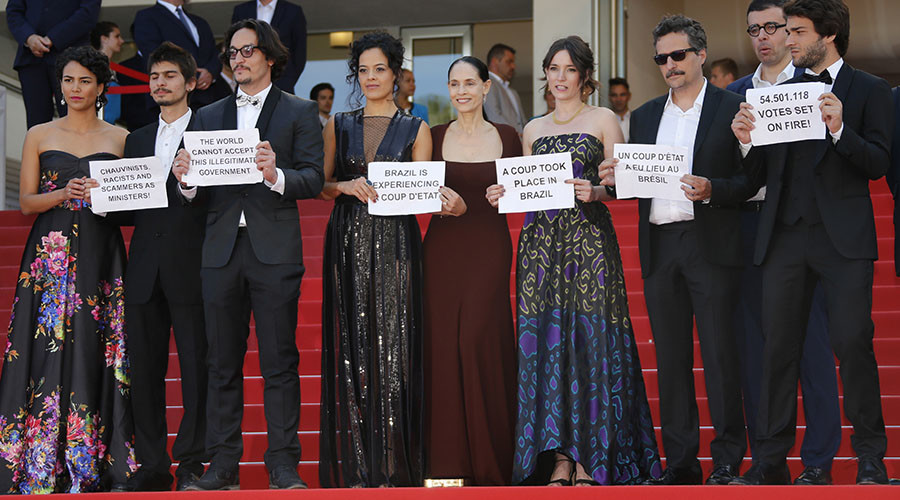
There were protests at the Cannes Film Festival  where the cast and crew of the Brazilian film Aquarius staged an improvised protest on the red carpet to show support for President Dilma Rousseff, denouncing her suspension as a ‘coup d’état.’ 

The film's writer and Director Kleber Mendonca Filho and Sonia Braga the lead actress and other members of the cast and crew unveiled printed banners ahead of their film’s premiere.

Friday, October 16, 2015

Who said poetry serves no useful purpose? Samantha Connor's poem of complaint

Samantha Connor's poem of complaint has had the desired effect, yielding a refund and a response from the Perth Convention and Exhibition Centre and a promise to address the problem.

Earlier in the week I wrote this piece (and published here in the online publication The Stringer) about Samantha's  response to her attempt to book a ticket for a Stephen Fry gig at the Perth Exhibition and Convention Centre, only to be told that as a wheelchair user she would be charged an extra $20 because, apparently, the wheelchair bays are in premium spots.

Tired of writing complaint letters to agencies who discriminate against people with disabilities she tried something different.

She wrote them a poem.

Within days this response was sent to the editor of The Stringer, an online publication that ran my piece and also publishes Samantha's writings on disability.

Hello,
My name is Meg Coffey and I am the marketing consultant for PCEC. In regards to your post today, I wish to advise you that PCEC have worked together with Ticketek in resolving the ticketing structure/pricing for Stephen Fry: Telling Tales, to be held in the Riverside Theatre.

PCEC have arranged reimbursements to wheelchair patrons that have been disadvantaged by the ticketing pricing structure set for the show.

Moving forward, PCEC and Ticketek will work together with concert promoters, to ensure wheelchair and carer seats are all priced within the same pricing category for shows to ensure no-one is disadvantaged by demand.

We want to ensure the experience of patrons in the venue is an enjoyable one and not marred by their experience when purchasing tickets for in-house shows.
Many thanks,
Meg


The Convention and Exhibition Centre are to be commended for taking action, however their reply is admission that they were knowingly gouging and discriminating against people living with a disability by applying an additional charge. 

Many people were outraged by the Convention Centre's gall in the first place to think they could rip people off and then try to extricate themselves. One person described the PCEC's reply as lame and 'as weak as  piss':
'In other words, we tried to rip people off, got caught and now we are exposed to be being "rip off" merchants! and because this lady is on to us!! we better lift our game' 

Samantha also appeared on Perth ABC morning radio and ABC News (here) where she said:
'I wrote the poem because sometimes something with an amusing twist is a better way to go, it keeps it light hearted. You can write letters until the cows come home and you don't always get the response that you want.'

As Samantha pointed out to the ABC, the problem of access and pricing to sports and entertainment venues is common for people living with disabilities in Perth and she called for more venues to look at ways to improve access, seating, ticketing and amenity for wheelchair users and people living with disability.

Samantha noted how she had been contacted by many people raising concerns about discrimination against people with disabilities by venues in Perth. She wrote:

'It's amazing how much discrimination goes on every day, unnoticed by most. We start talking about this issue, which was raised by another wheelchair user. 

Prue tells us that she can't go into the licensed area when she sees a show at another area because there's a step, and the downstairs is unlicensed - a friend can't bring her a drink downstairs. Bronwyn tells us that she has to pay eighty bucks more to attend a concert with her daughter (who is a wheelchair user) and fights for the right to sit with her kids Darren says that there is no gold season ticket at the rugby, and you can only choose between diamond (at exorbitant prices) or crappy silver. Crispin tells us that two grandstands are unavailable (no lift access) at the NIB stadium and that sports fans can't get in to see a game. Someone else, I forget who, said that going to see the cricket was impossible because the shaded seats were inaccessible and your choices were left of field in full sun. 

It's pretty interesting that the stuff we work on at systemic and policy level is all about 'increasing participation' but people literally can't get in the door, to work as well as to play or just do the things ordinary Australians do. I'm not off to Stephen Fry, for a number of reasons - one of them is that no matter what the price is, I'm still not able to go to the event unless I go alone - the wheelchair spaces are in the premium area, which have been booked out by others. My family/friends would have to sit in the bottom bit whilst I sat up the top. Yeah, nah.

I really liked that the user group and the access group for the new Stadium were and are listened to and involved all the way through. I really hope it won't be another disastrous Perth Arena in terms of access. We live in hope!'

Saturday, August 29, 2015

The murder of Emmett Till (July 25 1941-August 28 1955)

"The story of Emmett Till is one of the most important of the last half of the 20th century. And an important element was the casket.... It is an object that allows us to tell the story, to feel the pain and understand loss. I want people to feel like I did. I want people to feel the complexity of emotions."

Lonnie Bunch III, director of the Smithsonian's National Museum of African American History and Culture  

On August 28 1955 , fourteen year old African American teenager Emmett Till who was visiting relatives, was abducted and murdered in Money, Mississippi by two white men who claimed he was disrespectful to a white woman by whistling at her.

Emmett's murderers were the husband and brother of the white woman he supposedly disrespected.

In the US this weekend the significance of Emmett Till's life is being commemorated by civil rights activists, relatives of the black teen and other families "victimized by racial violence", including the family of Trayvon Martin and Michael Brown , who are uniting for a commemorative weekend in Chicago to remember Till and to continue the legacy of Till's mother, Mamie Till Mobley.

Emmett Till was born and lived in Chicago and at the time of his murder he was visiting family in Money, Mississippi.

A few days before his murder Emmett went into a local store, Bryant's Grocery and Meat Market, and, on a dare, said something to 21-year-old Carolyn Bryant, the owner's wife who was working behind the counter. A few nights later, the woman's husband, Roy Bryant, and her half brother, J.W. Milam, went to house where Emmett Till was living with his great uncle  and forced him into their car. After driving around they beat Till and drove to the Tallahatchie River. 

Emmett Till was forced carry a 75-pound cotton-gin fan to the bank of the Tallahatchie River and ordered to take off his clothes. He was beaten nearly to death, had his eyes gouged out, was shot in the head, and then his body was tied to the cotton-gin fan with barbed wire and he was thrown into the river.

Emmett Till's corpse was found three days later. He was found with a bullet hole in his head, barbed wire wrapped around his neck and a cotton gin fan weighing him down  He was so disfigured that his Mississippi relatives could only identify him by an initialled ring. 

(photo of Emmett Till in his casket) 
 
Bryant and Milam were subsequently arrested and charged with murder.
 
Authorities wanted to bury the body quickly, but Emmett Till’s mother, Mamie Bradley, requested the body be sent back to Chicago. After seeing her son's mutilated remains, she arranged an open-casket funeral to show the brutality of the white murders.

Tens of thousands of people attended his funeral or viewed his casket and images of his mutilated body were published in black-oriented magazines and newspapers, rallying popular black support and white sympathy across the U.S.

Less than two weeks after Emmett’s body was buried, the two murderers went on trial in a segregated courthouse in Sumner, Mississippi. There were few witnesses besides a relative of Emmett Till who positively identified the defendants as Emmett’s killers. On September 23, the all-white jury deliberated for less than an hour before issuing a verdict of “not guilty,” explaining that they believed the state had failed to prove the identity of the body.

 Many people around the country were outraged by the decision and also by the state’s decision not to indict Milam and Bryant on the separate charge of kidnapping.

Months after the trial and immune from further prosecution, the two men openly admitted to a national magazine that they had abducted, mutilated and murdered Emmett Till.

Roy Bryant never showed remorse for the murder, claiming in an interview in 1992 that Emmett Till had ruined his life, stating "Emmett Till is dead. I don't know why he can't just stay dead" Ray Bryant died in 1994 aged 63. 

The murder of Emmett Till  was a pivotal event for the African American civil rights movement and provided a spark that contributed to igniting the civil rights movement in the USA by exposing the brutality of the conditions of black civil rights in Mississippi.

The killing of Emmett Till has inspired songs (for example by Bob Dylan), movies, books, artistic displays and memorials.

Till's mother Mamie Till-Mobley published a book titled Death of Innocence: The Story of the Hate Crime That Changed America, which is  currently being made into a feature film

The book was co-written with  journalist Christopher Benson and was nominated for a 2004 Pulitzer Prize and won a Robert F. Kennedy Book Award special recognition that year.  She died in 2003, aged 81, 58 years after her son's murder.
 
Bob Dylan' song The Death of Emmett Till appears on the
 

The Death of Emmett Till
By Bob Dylan

’Twas down in Mississippi not so long ago
When a young boy from Chicago town stepped through a Southern door
This boy’s dreadful tragedy I can still remember well
The color of his skin was black and his name was Emmett Till

Some men they dragged him to a barn and there they beat him up
They said they had a reason, but I can’t remember what
They tortured him and did some things too evil to repeat
There were screaming sounds inside the barn, there was laughing sounds
out on the street

Then they rolled his body down a gulf amidst a bloody red rain
And they threw him in the waters wide to cease his screaming pain
The reason that they killed him there, and I’m sure it ain’t no lie
Was just for the fun of killin’ him and to watch him slowly die

And then to stop the United States of yelling for a trial
Two brothers they confessed that they had killed poor Emmett Till
But on the jury there were men who helped the brothers commit this
awful crime
And so this trial was a mockery, but nobody seemed to mind

I saw the morning papers but I could not bear to see
The smiling brothers walkin’ down the courthouse stairs
For the jury found them innocent and the brothers they went free
While Emmett’s body floats the foam of a Jim Crow southern sea

If you can’t speak out against this kind of thing, a crime that’s so unjust
Your eyes are filled with dead men’s dirt, your mind is filled with dust
Your arms and legs they must be in shackles and chains, and your blood
it must refuse to flow
For you let this human race fall down so God-awful low!

This song is just a reminder to remind your fellow man
That this kind of thing still lives today in that ghost-robed Ku Klux Klan
But if all of us folks that thinks alike, if we gave all we could give
We could make this great land of ours a greater place to live


Read more: http://www.bobdylan.com/us/songs/death-emmett-till#ixzz3k6sIgfJW

Tuesday, July 21, 2015

Remembering Ken Sprague (1927-204) and his powerful images


image by Ken Sprague

"In essence, the leitmotif of his work is about power and the abuse of power as well as the resilience of ordinary working people to this abuse... It is an art of engagement – engagement for change."
(John Green, from the Introduction to Ken Sprague – People’s Artist.)

People continue to ask about this powerful image that appears on this site. (It it also continues to appear in its original or modified form elsewhere).

The image is a drawing by Ken Sprague. I have written before here and here about Ken Sprague who I had the privilege to know during the 1980's. You can read more about Ken's life, his work and legacy here

Ken Sprague's remarkable image captures the recent zeitgeist of uprisings and revolts happening around the world, in which ordinary people are standing up and fighting against state and corporate power and political and financial plundering.

Ken's image was created decades ago but reflects his profound and lifelong commitment to  human rights, justice, peace and socialism.


Ken was a renowned artist, cartoonist, illustrator, poster designer , print maker, educator and filmmaker  who believed profoundly that art should  always serve social justice, peace, human rights and political struggle.

 The
obituary for Ken was written by John Green and appeared in the Guardian newspaper. John wrote a book on Ken's life titled Ken Sprague: People's Artist.
 Ken Sprague: Radical artist in pursuit of Socialism
By John Green ( from The Guardian 6th August 2004)


 The aim of Ken Sprague, who has died of a stroke aged 77  was, he said, “to build a picture road to socialism, to the Golden City, or as Blake called it, Jerusalem”. A painter, sculptor, muralist, banner-maker and sometime television presenter, Ken was, for half a century a regular, but dissenting cartoonist for the Daily Worker and its successor the Morning Star, and for papers like Tribune and Peace News.

As a posterman his work included material for Martin Luther King, and the women of Greenham Common — and against the Soviet invasion of Czechoslavakia, and Edward Heath’s Industrial Relations Bill. In the late 1950s and early 1960s, he was designing scenery and backdrops for Unity Theatre and was involved in the Centre 42 trade union arts project.

All round talents
His linocuts for the radical collective Cinema Action’s Kill The Bill film (1971) began an involvement in moving images. I made a film about him in 1972 which led to Jeff Perks’s 1976 BBC Omnibus documentary The Posterman. This led to a series of Channel 4 films, devised with Jeff Perks and presented by Ken, called Everyone A Special Kind Of Artist (1986). There was also a BBC South West series, The Moving Line with Joan Bakewell. In later life, he taught and practised as a  psychodrama specialist. Ken was born in Bournemouth , his father was a train driver and his mother worked in a cardboard box factory. His first work of art, in 1937, was a linocut made from linoleum, torn from the kitchen floor in response to the Spanish civil war.

Early life
He was educated at Alma Road Elementary School — until it was bombed — and Porchester Road Secondary Modern School. There the headmaster, noticing his talent, recommended that he apply to the local art college. He won a scholarship to Bournemouth Municipal  College and, from 13 and a half, studied graphics — in those days students of his background were hardly considered for fine arts courses. One morning in 1944 he volunteered, aged 17 for the Royal Marines — and that afternoon, in Southampton, he joined the Communist Party. After basic military training he was transferred to Vickers-Supermarine as a technical artist, work which took him to wartime Yugoslavia. Postwar, and after a summer stint in a circus, he completed his college diploma course in design and illustration. The CP, he told me, was his university, but after the Bournemouth Daily Echo had labelled him a college revolutionary, local job prospects dwindled. He briefly worked for a volunteer labour battalion in Yugoslavia, was employed  by the Boy Scouts and then, between 1950 to 1954 he worked in a Carlisle mining company design office — doubling as a cartoonist for the local Conservative, and Liberal newspapers. Then came a move to London as the Daily Worker’s publicity manager, which also had him working as a journalist and cartoonist. Devastated by the Soviet invasion of Hungary in 1956, in 1959 Ken left to set up, with Ray Barnard, the publicity company, Mountain & Molehill. Yet he continued producing cartoons for the Worker, and its successor the Morning Star into the 21st century.

Mountain & Molehill
M&M — later The Working Arts — was responsible for some of the most innovative trade union campaigns of the 1960s and 1970s. Ken told union leaders they had to (TO) use publicity to win hearts and minds and to see it as an integral part of union work. And it was Sprague and Barnard who initiated the sensational 1961 visit to Britain of the first man in space Soviet cosmonaut Yuri Gagarin. M&M also worked for the Indian High Commission — which led to a meeting with Jawaharlarl Nehru In the late 1960s Ken began editing the Transport and General Workers Union’s the Record, transforming it into a lively newspaper, — and illustrating it with his own cartoons. As a poster and print-maker he worked with a number of leading progressive organisations and individuals, including Pete Seeger.

New life in Devon
In 1971 he moved with his wife, Sheila, a talented potter, to Holwell, a farmhouse in Devon, and converted it into an artistic centre. Sheila died of cancer in 1973, but with his second wife, Marcia he set up the Holwell International Centre For Psychodrama and Sociodrama which continued until 1998. There Ken combined his artistic talents with pedagogic expertise, using them in this new field in which he became a leading practitioner.

It is his posters and prints that will remain his true epitaph. His innovative and prolific creativity, his recalcitrant questioning, determination and belief in others’ potential was an inspiring beacon for everyone who met him, young and old. His images remain etched in the mind, they unsettle, provoke, discomfort but also amuse. Ken was concerned about how politics impact on the ordinary person. In essence the leitmotif of his work is about power and the abuse of power as well as the resilience of ordinary people. He depicted the world as changeable. His work is imbued with unfashionable optimism, depicting a world where ethics and values still have relevance. It is the antithesis of post-modern fragmentation and its disdain of value systems. Every morning, he drew a political cartoon to assuage his anger and frustration at the state of the world. And only a few weeks before he died, he was excitedly telling me about plans for an artistic project in Cuba and a book he was determined to publish of anti-war drawings. He left the Communist Party, after the acrimonious split in 1988. He continued to call himself a communist, however, saying “The party left me, I didn’t leave the party”. He won several prestigious awards, including poster of the year award from the National Council of Industrial Design on two occasions.

He is survived by Marcia, from whom he recently separated, his five children and seven grandchildren.
John Green

Wednesday, June 4, 2014

Remembering Tienanmen Square June 1989 and the courage of those who defied Chinese tanks

Photograph by Stuart Franklin/Magnum.

The photo on the right was taken from a different vantage point and shows the man in the background preparing to confront the tanks (AP Photo Terril Jones)

Today is the 25th anniversary of the brutal Chinese crackdown in Tienanmen Square.

The iconic image of that event is the photo of a single unidentified man holding two shopping bags who steps in defiance of a line of army tanks heading to Tienanmen Square.

All through the months of April and May 1989 Chinese students and pro-democracy activists protested in Beijing and other parts of the country. The protests were triggered by the death of Hu Yaobang, a liberal reformer, who was deposed after a power struggle with hardliners over the direction of political and economic reform in China.

In early May, the protestors occupied Tienanmen Square and demanded government accountability and greater democratic and press freedom. The students and pro-democracy protesters filled the square for weeks, initiating hunger strikes and other forms of protest activities.

On the nights of the 3rd and 4th June 1989 the Chinese Government enforced martial law. 

Massive troop and tank movements around the square began, concluding in an all-out assault that culminated in retaking Tienanmen Square and surrounding areas. 

Thousands of protesters and citizens heading to join the protest in Tienanmen Square were killed and injured after the People's Liberation Army opened fire on unarmed and peaceful protesters.


this photo shows the same man defying a long line of tanks (by Arthur Tsang)

Riots ensued around the Square and throughout the capital.

The authorities proceeded to carry out mass arrests. Some people were executed and others just disappeared. An estimated 1600 were imprisoned for long periods, and 2 remain in prison 25 years later. Others were politically punished and lost jobs and positions. Many of the student leaders were forced to flee China.

The Tienanmen Square massacre and its aftermath initiated a new era of conservatism in China that continues to this day.

Various slide shows of the 1989 events at Tienanmen Square are herehere and here.

Twenty five years later, the Chinese Government are trying to prevent any mention or discussion of the uprising and the massacres by locking up, charging or harassing artists, scholars, lawyers, bloggers and relatives of victims.

Chinese citizens involved in the uprising and those who try to remember the events of 25 years ago continue to suffer persecution.

Amnesty has recorded the names of Chinese activists targeted by the Chinese authorities in the lead up to the anniversary. This includes scores of detentions and house arrest and people being charged with offences carrying prison terms for holding private memorial gatherings for the dead.

The New York Review of Books has this interview with Hu Jia, who was just 15 at the time he participated in the Tienanmen Square demonstrations. He is currently under house arrest in China over his attempt to organize a commemoration of the massacre protest activities.

The Guardian has this article, featuring interviews with 3 leaders of the 1989 protests who were forced to flee China in 1989.

Wednesday, May 28, 2014

Everyday heroes: sit-ins 50 years apart show the power of ordinary people to take action against injustice

"You don't have to be a big name to make a difference and impact change. Small things can make ripples that make a big difference"
Joan Trumpauer Mullholland

Today in a Perth court 11 Christian leaders were fined $50 each for trespass after they held a prayer vigil and sit-in at the office of the Australian Foreign Minister Julie Bishop as a protest against the plight of 1100 children imprisoned in Australia's onshore and offshore immigration detention camps.

There was some concern that the Christian leaders faced a jail sentence for their protest.

The protest in the Foreign Minister's office was followed by subsequent prayer vigils and sit-in by other Christians and Church leaders on the east coast, this time in the offices of the Immigration Minister, The Prime Minister and Leader of the Opposition.

The Christian leaders are part of a long tradition in which ordinary people use sit-ins as a form of direct action protest against injustice and domination,

This iconic photo was taken on May 28th 1963 in Jackson Mississippi and shows 3 people- 2 white people and one black woman- participating in a sit- in protest at a Woolworths lunch counter. They are surrounded by angry and aggressive white men who are pouring sugar, liquid and ketchup over the 3 protesters.

The protesters were three students- John Salter, Joan Trumpauer and Anne Moody- who were protesting against racial segregation of lunch counters in Woolworths stores throughout the American south.

Initially the protesters were jeered and taunted and then doused in sugar and ketchup. They were then beaten and kicked.  

It was one of the most violent attacks on protesters involved in a sit-in the history of the civil rights movement.

The attack went on for 3 hours as the Police stood by and watched

 The Woolworths store manager eventually had to close the store and the protesters were escorted away by Police.
 
The story of the Woolworths sit in, the events that lead up to the protest and the fall out from it (including the murder two weeks later of civil rights leader Medger Evers) and the stories of the protesters involved are told in Mike O'Brien's book We Shall Not Be Moved.

The Jackson sit-in was one of a long line of sit-ins used during the civil rights movement to protest against racial segregation in the South during the early 1960's.

Sunday, May 11, 2014

Songs of Renown: Paul Robeson, Hirsh Glik and the Hymn of the Jewish Partisans

The song Zog Nit Keynmol (in Yiddish), also known under various titles- the Hymn of the Jewish Partisans, the Partisans Song or the Song of the Warsaw Ghetto- was written in 1943 by Hirsh Glik, who was a young Jewish poet, resistance fighter and inmate of the Warsaw Ghetto. 

More about Hirsh Glik is here on the website Music and the Holocaust.

The song was adopted by Jewish partisans and resistance fighters and was a symbol of Jewish resistance against the Nazis. The song was often sung by people in concentration camps.

The song was a regular concert performance by Paul Robeson who sang the song in Yiddish and English.

Paul Robeson sang the song in a Moscow concert in 1949 during the height of Stalin's anti-Jewish purge. It was his protest against Soviet persecution of Jews.  In that concert, Robeson spoke in support of Jewish writers and actors in Russia and his friendship with Jews who had perished in Stalin's purges.

Here is how the concert is described on the website of the  Jewish Partisan Educational Foundation:
Four years after the fall of Hitler, the tune would be used as a form of resistance against another 20th century tyrant. Paul Robeson traveled to Moscow in June of 1949 to give a performance to an audience that included many Communist Party elites, as well as what little remained of the Jewish intelligentsia after Stalin's purges. At the end of the concert, Robeson stunned the audience with a surprise rendition of the Partisan Hymn. His introductory remarks contained references to the Yiddish language, the deep and enduring cultural ties between the US and Russian Jewish communities, as well as to leading Jewish intellectuals who had been "disappeared" by the regime. 
The remarks, the spontaneous translation of the song to the shocked audience, and thunderous applause that followed were cut from the recording by Stalin's censors, but the chaos is evident in the mixture of applause and jeers that follows the actual performance.
Here is a heavily censored live version of Robeson's performance from that 1949 concert:


The following comments are from Paul Robeson's son Paul Robeson Jr's biography of his father:
... One could hear a pin drop during my father remarks about the deep and enduring cultural ties between the Jewish communities of the Soviet Union and the United States, about the common tradition of the great Jewish writer Sholem Aleichem, and about the continued vitality of the Yiddish language. Finally he announced that he would sing a song of the Jewish partisans who fought to the death against their Fascist oppressors in the Warsaw Ghetto. 
Since the song had to be sung in Yiddish, he would explain the lyrics in Russian, as follows: 
'Never say that you have reached the very endWhen leaden skies a bitter future may portend;For sure the hour for which we yearn will not arriveArid our marching steps will thunder: we survive'. 
For a moment there was no sound from the stunned audience; then a single intrepid young woman stood up and applauded, and the entire audience joined in a swelling wane of applause before my father could sing a single note. Only this response to my fathers remarks remains on the recording; Stalin's censors simply cut out his remarks, and they have disappeared..." 
The Song of the Wamaw [sic] Ghetto Rebellion sung in Yiddish (Zog Nit Keynmol) - remains an a crowning jewel of this recording of the Concert. The combination of power and pathos with which my father delivered this song transfixed his listeners. When he finished, the audience released its accumulated tension like an explosive charge. Although his listeners included many of Moscows Jewish intellectual elite who were waiting for Stalins axe to fell on them, the great majority were Russian members of the Party elite which was being decimated by a purge. Jews and Russians alike, in some places seated side-by-side, were either walking in the shadow of death or had lost someone close... 
After that first release, the ovation continued to swell and recede in a series of waves which ebbed and flowed. People stood, applauded and cried out; they called my father by his patronymic-Pavel Vasilevich; some who were total strangers fell info each others arms and wept; still others sat silently with tears streaming down their faces. The first part of the audiences response is captured on this recording, but the rest has been cut by the censors. Still, the sound of this cry of hope is unforgettable, and there is little doubt that it was heard by the Master himself"
**********
Zog Nit Keynmol Hymn of the Jewish Partisans

Never say that this is the end of the road.
Wherever a drop of our blood fell, there our courage will
grow anew.
This song, written in blood, was sung by a people fighting
for life and freedom.
Our triumph will come and our resounding footsteps will
proclaim "We are here!"

From land of palm-trees to the far-off land of snow.
We shall be coming with our torment, with our woe;
And everywhere our blood has sunk into the earth
Shall our bravery, or vigor blossom forth.

We'll have the morning sun to set our day aglow;
Our evil yesterdays shall vanish with the foe.
But if the time is long before the sun appears,
then let this song go like a signal through the years.

This song was written with our blood, and not with lead;
It's not a song that summer birds sing overhead;
It was a people, amidst burning barricades,
That sang this song of ours with pistols and grenades.

Wednesday, April 9, 2014

Paul Robeson and the crimes of the US Government against African Americans


"As an artist I come to sing, but as a citizen, I will always speak for peace, and no one can silence me in this."  Paul Robeson (1898 –  1976) 

Paul Robeson is one of my heroes.  And I find this photo of the great man profoundly moving.

This photo was taken in 1951, around the time Robeson was blacklisted by the US Government, who had taken away his passport and issued stop notices at all ports to prevent him leaving the US. 

The US Government was outraged by his political advocacy for civil rights for African Americans and his frequent advocacy for the independence of colonial peoples around the globe.

The US Government believed that by isolating him inside US borders they could limit his freedom of expression and his political campaigning. Robeson was told by the US State Department that he was denied a passport because  "his frequent criticism of the treatment of blacks in the United States should not be aired in foreign countries".

This photo of Robeson was taken when he presented a petition titled “We Charge Genocide: The Crime of Government Against the Negro People” to a UN official.

The document was written by William Patterson, an African American lawyer and Communist, who was Secretary of the Civil Rights Congress. 


The document charged the U.S. with genocide against Black Americans and cited evidence of genocide by the US Government (defined as acts committed with "intent to destroy" a group, "in whole or in part"). The document argued that the US Government is complicit with and responsible for creating genocidal situations, including instances of lynching, legal discrimination, and systematic inequalities in health and quality of life. It argued that the US government is both complicit with and responsible for genocidal situations.

The document included hundreds of cases of lynching, which showed a clear pattern of government inaction or actual complicity. It charged that in the 85 years since the end of slavery more than 10,000 Blacks are known to have been lynched (an average of more than 100 per year), and that the full number can never be known because the murders are often unreported.

The American government and white press accused Robeson and Patterson and the Civil Rights Congress  of advancing the cause of Communism by exaggerating racial conflict and inequality. The US State Department forced Patterson to surrender his passport after presenting the petition to a UN meeting in Paris.

More detail about the document We Charge Genocide: The Crime of Government Against the Negro People” and Robeson's involvement in its development is here.

Saturday, September 14, 2013

Seyla Benhabib on the sigificance of global protests


"Democracy thrives on the interplay of formal representative institutions and the energies of civil society and the voices and noise of the streets."
Seyla Benhabib


For those of us who operate in the spaces of civil society, citizen led social action and social movements, Seyla Benhabib in an interview in Dissent magazine The Gezi Park Protests and the Future of Turkish Politics poses some important questions arising from the wave of global recent protests that swept through Turkey, Brazil, the Middle East, North Africa and Eastern Europe. 


Benhabib explores the implications of the recent protests across Turkey, particularly the protests that took place in Gezi Park in Istanbul.

One of the critical questions posed by Benhabib is whether this global wave of protest can transform itself into some form of organized presence in representative democratic institutions.

These new protests are also the cries of anguish of a new generation who is facing a bleak economic future—at least in Europe and the United States. There is a deep generational anxiety that is galvanizing these protests, with twenty-somethings realizing their prospects may be worse than those of their parents for the first time since the Second World War.

The student movement of 1968 was also global and had spectacular qualities. But principally this movement was guided by varieties of left-wing ideology. There were certain categories through which the world was interpreted, such as imperialism. Today, neoliberal globalization has scrambled our old categories: who are the imperialists? The United States, or China, or Saudi Arabia, all of which are exercising hegemony and regional influence in different ways?

Today’s movements are more diffuse ideologically and programmatically; they cherish politics in the first person more than conceptual abstractions; they are pragmatic and, at their best, they want a deliberative voice and the power to shape the whirling and buzzing vortex of globalization around them. For me, the question for the coming decades will be whether this contentious political energy, which I find so beautiful and hopeful, can translate into some vision of a better future society. There is, at the present, a huge “democratic disconnect” between the street and the parliaments, the public square and the courthouse.
By contrast, the student movement of 1968 took the “long march through the institutions” and produced the political leaders of the next generation, such as Daniel Cohn-Bendit, Joschka Fischer, and Otto Schilly in Germany; Bernard Kouchner in France; and in the United States, Jesse Jackson, Bill and Hillary Clinton, John Kerry, and even Barack Obama, who in no small measure owes his political orientation to his mother, a child of the sixties. Will this also be the case with your generation? I don’t know.