Showing posts with label democracy. Show all posts

Sunday, May 22, 2016

Brazilian people rise up against a neoliberal coup

Photo of members of the Landless Workers Movement (MST) in Brasilia protesting against the impeachment of Rousseff. Photo:Reuters

I wrote this blog piece earlier in the week about the neoliberal coup that removed the democratically elected President of Brazil, Dilma Rousseff.

The coup was supported by the Brazilian corporate and business elite, and appears to have been supported by both the US government and US corporate interests and has installed Michel Temer (the right-wing vice president and U.S. informant) and members of the right wing neoliberal party that has lost every election since 2002.

The coup has led to a sharp outburst of resistance and protest by the Brazilian people. The new government threatened to criminalise and arrest protesters and demonstrators.

A selection of photos from the various protests is here.

Policemen ride their horses during a clash with demonstrators at a protest against the impeachment of President Dilma Rousseff, in Porto Alegre, Brazil, May 12, 2016. Photo:Reuters

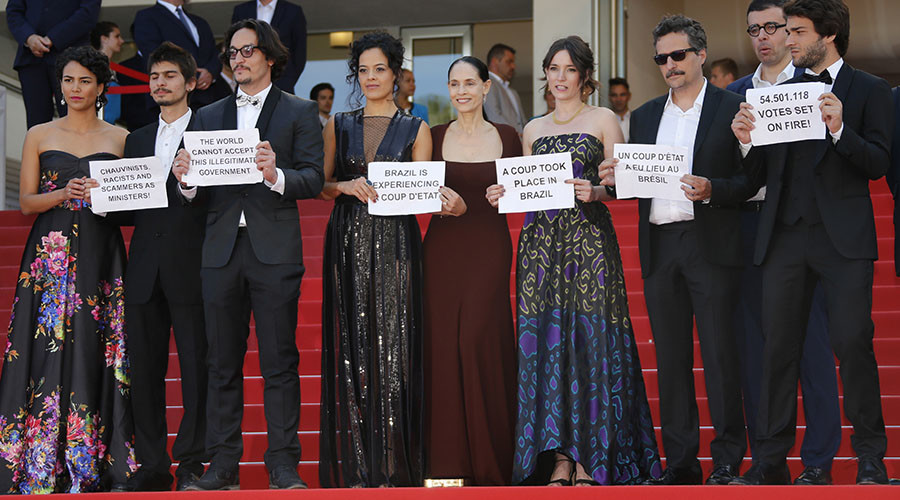
There were protests at the Cannes Film Festival  where the cast and crew of the Brazilian film Aquarius staged an improvised protest on the red carpet to show support for President Dilma Rousseff, denouncing her suspension as a ‘coup d’état.’ 

The film's writer and Director Kleber Mendonca Filho and Sonia Braga the lead actress and other members of the cast and crew unveiled printed banners ahead of their film’s premiere.

Thursday, April 21, 2016

How I miss Tony Judt


"Tony Judt was an inspiration: an intellectual Titan, a fierce warrior, a brilliant orator, a charismatic public intellectual. To be sure, he was all of the above. But he never set out to attain any of those accolades. He just wanted to say what he thought had to be said and say it until people noticed"
The Observor newspaper 

Six years have passed since the death of Tony Judt, the distinguished historian, public intellectual, political commentator, essayist and author.  His words, ideas and invigorating presence are missed in these troubled and dystopian times.

Judt was a speaker of unfashionable truths about history and the contemporary politics of Europe, America, and Israel. He was an outspoken critic of conventional wisdom and intellectual and academic dogma on many issues, including political and economic issues, social policy, American foreign policy, the war on terror, global politics, the future of Europe and the state of Israel. For his staunch criticism of Israel he was vilified and attacked.

Tony Judt died, aged 62, on 6th August 2010, just 2 years after he was diagnosed with  amyotrophic lateral sclerosis (ALS), also known as Lou Gehrig's Disease. ALS is a progressive motor-neuron disease that causes the central nervous system to degenerate. Over time, patients lose the ability to move their bodies, but retain full control over their minds.

Judt once described the effects of the disease as "progressive imprisonment without parole."

Within months of the symptoms appearing in 2008 he was paralyzed and unable to breathe without mechanical assistance.

Despite his illness, he produced some of his finest work during that time. 

He wrote the book Ill Fares the Land, a searing critique of market fundamentalism and the way we live today and an argument for a politics and economics shaped by ideas of progressive social democracy.

Judt argued that we face the terrifying prospect of perpetual insecurity and growing inequality as a result of the triumph of corporate power and market capitalism.

How prescient he was. Judt wrote:

"For 30 years we have made a virtue out of the pursuit of material self-interest. ... The materialistic and selfish quality of contemporary life is not inherent in the human condition. Much of what appears 'natural' today dates from the 1980s: the obsession with wealth-creation, the cult of privatization and the private sector, the growing disparities [between] rich and poor. And above all, the rhetoric which accompanies these: uncritical admiration for unfettered markets, disdain for the public sector, the delusion of endless growth."

Judt warned of a “new age of insecurity”- which has come to fruition. If social democracy had any future he argued, it had to be reformed, not as a set of idealist and utopian promises, but as a bulwark against all that had gone wrong during the 20th century.


Although he was critical of parts of the European left and key leftist figures, such as Eric Hobsbawn for their attachment to Soviet Communism, Judt presented the seemingly contradictory notion that a key task for the Left was to conserve its past achievements, as well as renew their moral appeal, whilst being able to change policies and develop new agendas where necessary.

Judt was prolific in the last years of his life and numerous collections of his essays, interviews and writings have appeared since his death, including, When the Facts Change: Essays, 1995-2010 (published in 2015), Thinking the Twentieth Century: Interviews between Tony Judt and Timothy Snyder (published in 2012) and The Memory Chalet (published in 2012).

Many of his essays can be found here at the New York Review of Books. 

Words were important to Tony Judt.

He believed that words lose their integrity when they privilege personal expression and rely on rhetorical flourishes. When this happens, Judt believes, public ideas that can be expressed and discussed through language fall into disrepair and eventually are lost.

Judt argues that the professionalization of writing, be it by academics, journalist, writers or politicians, favors obscurantism and has:
"encouraged the rise of a counterfeit currency of glib popular articulacy.. It is the performer rather than the subject, to whom the audience's attention is drawn".
His conclusion is a timely warning to us all:
"If words fall into disrepair, what will substitute? They are all we have".

Monday, March 31, 2014

Are there too many non-profits?

Over on one of my other blogs Radical Ideas on Civil society, the Not for Profit World and Social Justice Activism I have written this piece about the claim that there are too many non profit agencies.

My argument is as follows:
I have never understood the claim that more non profits is a bad thing. In particular, it is fundamentally anti-democratic for someone else to decide which non profits should exist, or to decide that there should be an arbitrary limit on the number of non profits.

Efforts to reduce the number of non profits, ultimately has the effect of reducing the democratic rights of citizens to take action. 
And compare this claim that there are too many non profits, with views about for profit businesses. You never hear the claim that there are too many for profit business, despite the evidence of a huge number of failing, poorly run businesses, engaged in criminal and highly questionable conduct. Rather, the view is that the more for profit businesses there are, the better.
The full piece is here. 

Tuesday, April 9, 2013

The Thatcher legacy

So former British Prime Minister Margaret Thatcher is dead. 

Like many others I won't be mourning her passing. It is more important to acknowledge and remember all those who suffered because of her policies and all those who resisted and opposed her.

Film Director Ken Loach sums it up well:
"Margaret Thatcher was the most divisive and destructive Prime Minister of modern times, mass unemployment, factory closures, communities destroyed — this is her legacy. She was a fighter and her enemy was the British working class ... How should we honour her? Let's privatize her funeral. Put it out to competitive tender and accept the cheapest bid. It's what she would have wanted."
Writing on the Overland Blog Jeff Sparrow reminds us that we should never forget many of Thatcher's political positions:
How to remember Margaret Thatcher? Shall we recall the friend of Augusto Pinochet, the woman who protested bitterly about the arrest of Chile’s murderous dictator, a man to whom, she said, Britain owed so much? What about the staunch ally of apartheid, the prime minister who labelled the ANC ‘terrorists’ and did everything possible to undermine international action against the racist regime? The anti-union zealot who described striking miners defending their livelihood as an ‘enemy within’, hostile to liberty? The militarist who prosecuted the Falklands war, as vicious as it was pointless? The Cold Warrior, who stood by Reagan’s side, while the US conducted its genocidal counterinsurgencies in Latin America? The British chauvinist who allowed Bobby Sands to slowly starve to death?
Both Jeff Sparrow and Rjurik Davidson writing in Overland reminds us that Thatcher's political legacy is very much alive and grows stronger here in Australia . Davidson makes the connection between Thatchers political and economic agenda and Julie Gillard and the Australian Labor Party's embrace of market fundamentalism.

In his piece Margaret Thatcher and the Misapplied Etiquette  Glenn Greenwald challenges those who demand respectful silence in the wake of a public figure's death, arguing that such silence is not just misguided but dangerous. He writes:
But the key point is this: those who admire the deceased public figure (and their politics) aren't silent at all. They are aggressively exploiting the emotions generated by the person's death to create hagiography. Typifying these highly dubious claims about Thatcher was this (appropriately diplomatic) statement from President Obama: "The world has lost one of the great champions of freedom and liberty, and America has lost a true friend." Those gushing depictions can be quite consequential, as it was for the week-long tidal wave of unbroken reverence that was heaped on Ronald Reagan upon his death, an episode that to this day shapes how Americans view him and the political ideas he symbolized. Demanding that no criticisms be voiced to counter that hagiography is to enable false history and a propagandistic whitewashing of bad acts, distortions that become quickly ossified and then endure by virtue of no opposition and the powerful emotions created by death. 

When a political leader dies, it is irresponsible in the extreme to demand that only praise be permitted but not criticisms. 
Greenwald concludes that:
There's something distinctively creepy about this mandated ritual that our political leaders must be heralded and consecrated as saints upon death. This is accomplished by this baseless moral precept that it is gauche or worse to balance the gushing praise for them upon death with valid criticisms. There is absolutely nothing wrong with loathing Margaret Thatcher or any other person with political influence and power based upon perceived bad acts, and that doesn't change simply because they die. If anything, it becomes more compelling to commemorate those bad acts upon death as the only antidote against a society erecting a false and jingoistically self-serving history.
In the New Left Project Tom Mills has written an excellent piece The Death of a Class Warrior in which he reviews Thatcher's political career and political legacy. Mills argues that Thatcher provided:
a sustained, violent assault on British society launched on behalf of big business in the name of ‘strong government’ and cloaked in the rhetoric of national renewal. 
Mills argues that Thatcher was able to appeal to and draw on a range of impulses that had developed during the 1970's and had coalesced into a coherent political ideology (often called neoliberalism  or market fundamentalism).  She did this by using the coercive powers of the state to: 
  • portray markets as a moral force
  • bring about mass support for big business 
  • champion markets as an empowering democratizing force
  • portray certain forms of state and Government intervention as hampering Britain’s economic effectiveness and corrupting its moral character.
  • attack the social basis of collective action and collective ideas
  • emasculate those institutional forms that could build an alternative to neo-liberal/ market fundamentalist regimes (such as trade unions, public ownership of public assets and services and  civil society)
  • fusing neoliberalism (market fundamentalism) with the moralistic, reactionary politics of ‘Middle England’ and tying the interests of capital to the bigoted preoccupations of their political base.
This sounds awfully like the political agenda of Tony Abbott and the Liberal National Coalition here in Australia.

In their piece in Counterpunch The Queen Mother of Global Austerity and Financialization Michael Hudson and Jeffrey Sommers make the direct link between Thatchers economic and political policies and the current economic and financial crises gripping the UK and Europe.
Mrs. Thatcher became the cheerleader for what became the greatest giveaway of the century as the City of London’s gain became the industrial economy’s loss. Britain’s lords of finance became the equivalent of America’s great railroad land barons of the 19th century, the ruling elite to preside over today’s descent into neoliberal austerity............The Iron Lady was convinced she was rebuilding England’s economy, while in reality it was only getting richer from London’s outlaw banks. Throughout the world, the damage wrought by this financialized economy has been immense.
Hudson and Sommers also point out that one of Thatcher's greatest effects was on the British Labor Party:   
As the uncredited patron saint of New Labour, Mrs. Thatcher became the intellectual force inspiring her successor and emulator Tony Blair to complete the transformation of British electoral politics to mobilize popular consent to permit the financial sector to privatize and carve up Britain’s public infrastructure into a set of monopolies. In so doing, the United Kingdom’s was transformed from a real economy of production to one that scavenged the world for rents through its offshore banks. In the end, not only was great damage inflicted on England, but on the entire world as capital fled developing countries for safe harbors in London’s banks. Meanwhile, governments throughout the world today are declaring “We’re broke,” as their oligarchs grow ever more rich.
And then there is music. Here are 21 Incredibly angry songs about Margaret Thatcher


Sunday, November 25, 2012

Golden Dawn and the rise of fascism in Europe

A recent post (here) featured the views of Richard Evans (a leading historian on the rise of Hitler and the Nazis) who draws parallels between the current situation in Europe and the circumstances that gave rise to Hitler and the Nazis during the 1930's.

In Roar Magazine Jerome Ross takes up the theme and warns of the rise of fascism in contemporary Greece, as exemplified by the ascendancy of Golden Dawn, the far right neo-Nazi party which is now the third most popular political party in Greece.

Golden Dawn attracts around 20% of the Greek vote, a level that is comparable to that of Hitler’s National Socialist German Workers’ Party in 1930, three years before rising to power and setting the world on course for WWII.

Golden Dawn has a high profile and prescence on the streets in Greece and is actively involved in attacks and violence directed at immigrants and Greek citizens. It has also infiltrated Greek institutions, particularly the Police Force. Ross reports that Golden Dawn is supported by 60% of the Police Force.

Ross questions why the European political and economic elite have been so silent about the rise of fascist groups such as Golden Dawn.

Never again, we used to say. Never again. How much more blatant does the situation need to get for Europe to at least express its concern and admit that the problem exists? How is it possible that a Nobel Peace laureate simply ignores the rise of violent neo-Nazi elements in its midst? Perhaps the answer is simply that European leaders realize how deeply implicated they are in the rise of Golden Dawn. Perhaps they prefer to stay silent because they know that admitting the resurgence of fascism on the continent could greatly complicate the austerity agenda they are pushing unto the European periphery. Perhaps, then, even a strong flavor of fascism might be tolerable — as long as Greece continues to service its debt.

Ross writes:
For clarity’s sake: the comparison made between National Socialism and Golden Dawn is by no means an exaggeration. We are talking about an extreme-right organization whose emblem deliberately resembles a swastika; whose leader publicly gave the Nazi salute upon his election to Parliament; whose magazine regularly features articles and pictures of the Führer himself; whose spokesman recently assaulted two female rivals on a live TV show; whose manifesto pledges to raid all immigrants out of hospitals and all non-Greek children out of kindergartens; and whose MPs actively participate in racist pogroms against Greece’s immigrant population. (Oh, and by the way, Golden Dawn’s favourite band is called Pogrom, known for such hits as “Auschwitz” and “Speak Greek Or Die”. Incidentally, its former bassist is now one of Golden Dawn’s 18 MPs.)

No surprise, then, that even the mild-mannered BBC is now making eerie comparisons with the early days of the austerity-stricken Weimar Republic. It is happening again. Fascism is once again on the rise in Europe. And what do EU leaders have to say about this? Nothing, it seems. As neo-Nazi militia run amok in the streets of Athens, Brussels and Berlin remain forever shrouded in a deafening silence. The only thing European leaders seem to care about is that Greece repays its debts. Democracy, human rights and the rule of law have all been relegated to secondary concerns — to serve financial interests, even a strong flavor of fascism now appears to be tolerable.

Earlier this month, Golden Dawn MP Ilias Panayiotaros was caught on video during a mob attack on a theatre, hurling homophobic abuse at the director of a critical play, beating up anti-fascist protesters trying to protect the theatre and a journalist trying to do his job, and finally freeing an arrested fellow fascist from a police van. All this time, police officers stood by and did nothing. No wonder: Golden Dawn proudly claims “60 percent support” among the police force. Not only do officers deliberately ignore criminal complaints and emergency calls by immigrants and activists; it is now commonly known that they actively refer Greeks who have “problems” with immigrants to Golden Dawn. As the Greek state crumbles under the weight of its debt repayments, Golden Dawn has stepped in to fill the void.

Thursday, November 15, 2012

Largest protest in European history barely rates a mention in Australia

"This austerity is a never-ending story. We see no light at the end of the end of the tunnel, just more pain and difficulties. We have to protest, do something to stop it,"
 Lisbon pensioner Jose Marques.

On Wednesday fourteen million people across 23 European states participated in the largest strike and protest in European history in the  hope of staving off decades of corporate led austerity, precarity and unemployment.

Millions of workers walked off their jobs and marched on parliament buildings across the continent. Bloody street battles ensued Spain, Portugal and Italy.

Report from the streets can be seen here, here, here, here and here

The protests barely rated a mention here in Australia, other than a few reports here,and here.

Monday, July 2, 2012

John Pilger and the political extremism that masquerades as democracy

John Pilger's latest article in New Statesman exposes the political and corporate extremism that masquerades as democracy:
Arriving in a village in southern Vietnam, I caught sight of two children who bore witness to the longest war of the 20th century. Their terrible deformities were familiar. All along the Mekong river, where the forests were petrified and silent, small human mutations lived as best they could.

Today, at the Tu Du paediatrics hospital in Saigon, a former operating theatre is known as the "collection room" and, unofficially, as the "room of horrors". It has shelves of large bottles containing grotesque foetuses. During its invasion of Vietnam, the United States sprayed a defoliant herbicide on vegetation and villages to deny "cover to the enemy". This was Agent Orange, which contained dioxin, poisons of such power that they cause foetal death, miscarriage, chromosomal damage and cancer.

In 1970, a US Senate report revealed that "the US has dumped [on South Vietnam] a quantity of toxic chemical amounting to six pounds per head of population, including woman and children". The code-name for this weapon of mass destruction, Operation Hades, was changed to the friendlier Operation Ranch Hand.  Today, an estimated 4.8 million victims of Agent Orange are children.
Len Aldis, secretary of the Britain-Vietnam Friendship Society, recently returned from Vietnam with a letter for the International Olympic Committee from the Vietnam Women's Union. The union's president, Nguyen Thi  Thanh  Hoa, described "the severe congenital deformities [caused by Agent Orange] from generation to generation". She asked the IOC to reconsider its decision to accept sponsorship of the London Olympics from the Dow Chemical Corporation, which was one of the companies that manufactured the poison and has refused to compensate its victims. 

Aldis hand-delivered the letter to the office of Lord Coe, chairman of the London Organising Committee. He has had no reply. When Amnesty International pointed out that in 2001 Dow Chemical acquired "the company responsible for the Bhopal gas leak [in India in 1984] which killed 7,000 to 10,000 people immediately and 15,000 in the following twenty years", David Cameron described Dow as a "reputable company". Cheers, then, as the TV cameras pan across the £7 million decorative wrap that sheathes the Olympic stadium: the product of a 10-year "deal" between the IOC and such a reputable destroyer.
History is buried with the dead and deformed of Vietnam and Bhopal. And history is the new enemy. On 28 May, President Obama launched a campaign to falsify the history of the war in Vietnam. To Obama, there was no Agent Orange, no free fire zones, no turkey shoots, no cover-ups of massacres, no rampant racism, no suicides (as many Americans took their own lives as died in the war), no defeat by a resistance army drawn from an impoverished society. It was, said Mr. Hopey Changey, "one of the most extraordinary stories of bravery and integrity in the annals of [US] military history". 

The following day, the New York Times published a long article documenting how Obama personally selects the victims of his drone attacks across the world. He does this on "terror Tuesdays" when he browses through mug shots on a "kill list", some of them teenagers, including "a girl who looked even younger than her 17 years". Many are unknown or simply of military age. Guided by "pilots" sitting in front of computer screens in Las Vegas, the drones fire Hellfire missiles that suck the air out of lungs and blow people to bits. Last September, Obama killed a US citizen, Anwar al-Awlaki, purely on the basis of hearsay that he was inciting terrorism. "This one is easy," he is quoted by aides as saying as he signed the man's death warrant. On 6 June, a drone killed 18 people in a village in Afghanistan, including women, children and the elderly who were celebrating a wedding. 

The New York Times article was not a leak or an expose. It was a piece of PR designed by the Obama administration to show what a tough guy the 'commander-in-chief' can be in an election year. If re-elected, Brand Obama will continue serving the wealthy, pursuing truth-tellers, threatening countries, spreading computer viruses and murdering people every Tuesday. 

The threats against Syria, co-ordinated in Washington and London, scale new peaks of hypocrisy. Contrary to the raw propaganda presented as news, the investigative journalism of the German daily Frankfurter Allgemeine Zeitung identifies those responsible for the massacre in Houla as the 'rebels' backed by Obama and Cameron. The paper's sources include the rebels themselves. This has not been completely ignored in Britain. Writing in his personal blog, ever so quietly, Jon Williams, the BBC world news editor, effectively dishes his own 'coverage', citing western officials who describe the 'psy-ops' operation against Syria as 'brilliant'. As brilliant as the destruction of Libya, and Iraq, and Afghanistan.
And as brilliant as the psy-ops of the Guardian's latest promotion of Alastair Campbell, the chief collaborator of Tony Blair in the criminal invasion of Iraq. In his "diaries", Campbell tries to splash Iraqi blood on the demon Murdoch. There is plenty to drench them all. But recognition that the respectable, liberal, Blair-fawning media was a vital accessory to such an epic crime is omitted and remains a singular test of intellectual and moral honesty in Britain. 

How much longer must we subject ourselves to such an "invisible government"?  This term for insidious propaganda, first used by Edward Bernays, the nephew of Sigmund Freud and inventor of modern public relations, has never been more apt.  "False reality" requires historical amnesia, lying by omission and the transfer of significance to the insignificant. In this way, political systems promising security and social justice have been replaced by piracy, "austerity" and "perpetual war": an extremism dedicated to the overthrow of democracy. Applied to an individual, this would identify a psychopath. Why do we accept it?

Wednesday, June 20, 2012

Reflections on the crises in Greece and the Greek Elecions

For those keeping a close eye on events unfolding in Greece Yanis Varoufakis offers a thoughtful and reasoned but deeply pessimistic analysis in this piece in Open Democracy.

Varoufakis is Director of the Political Economy Division at the University of Athens and has taught political economy and economics all over the world, including 20 years at the University of Sydney.

As Vroufkas points while the majority of Greeks voted for anti-bailout parties, a pro bailout Government is about to be formed, which explicitly excludes the radical leftist party Syriza, the party which received the second highest number of votes and with the second highest majority in the Greek Parliament.
Greek voters gave their contradictory verdict: While 55% voted for parties that stood explicitly against the ‘bailout’ terms and conditions, a pro-’bailout’ government is about to be formed – such is the nature of Greece’s electoral system (which rewards the largest party with a bonus of 50 additional MPs in the 300 seat chamber). 

The New Democracy party will lead the government even though it is utterly clear that at least one in three of the voters who backed it think very little of the party and its leader but felt they had no option but to vote for them simple because the alternative, a Syriza government, might bring upon the nation the combined wrath of Berlin, Frankfurt and Brussels. This is as inauspicious a beginning for a new government with a mountain range of challenges as one could have imagined.
Varoufakis is in no doubt that the new Government's will support another European driven bailout package (Bailout Mark 2 and Bailout Mark 3) and that such acquiescence to European (particularly German) agendas will fail, causing more hardship and suffering for the majority of the Greek people. Rather than solve the problem it will worsen the crises.

What is also deeply disturbing about the new Greek Parliament is the entrance of Fascist and Third Reich Nazi parties. Whilst this rise of fascism in Greece is partly attributed to the frenzy over austerity and the financial crisis, the other factor is the strident anti-immigrant rhetoric used by mainstream Greek politicians. Salama Boukala writes
"Just a few days before the general election of May 6, members of the coalition government and the mainstream media took to scapegoating migrants who were now accused of being responsible for the sociopolitical failures of the country. Together they orchestrated the broadcasting of a range of racist comments. The minister of public health labelled migrants a ‘sanitary bomb threatening the Greek people’ and the minister of public order proudly announced the opening of concentration camps for migrants. The use of xenophobic discourse by public authorities and the participation of the extreme right wing formation LAOS in the coalition government spread the fear of the ‘Other’ in the Greek society and legitimized further voting for the far right. These 7% of Greek voters who opted for Golden Dawn may have been experiencing an extreme collapse of their financial security, and they blamed the migrant 'Other' for it – too easily forgetting that any attack against this Other is also an attack against democracy. In today’s Greece, both of them are in danger"

Monday, May 28, 2012

Pots and pans and the rising power of social protest in Canada


You won't read much about it in the Australian press but the demonstrations and protests taking place in Montreal  and other towns and cities in Quebec (and other parts of Canada) are now among the largest and longest demonstrations in North American history.

The student strike has passed 104 days and last week an estimated 300,000 to 400,000 students, workers and their supporters took to the streets of Quebec to to protest hikes in student tuition fees and the passing of a draconian anti- protest law- known as Law 78- which bans un-permitted marches and any un-permitted gathering of more than 50 people.

Law 78 requires that marchers obtain police approval and restricts demonstrations to certain places. It also threatens organizers, and participants of such gatherings with enormous fines. The Law also makes it illegal to wear masks or otherwise hide your identity during demonstrations.

Law 78 was a direct response to the growing popularity and legitimacy of the student protest movement which has grown stronger each week and mobilizes more and more people.

What started as student protest and marches against the rising costs of university tuition and the crushing impact of student loans has transformed into a major social protest movement.

Since the passage of Law 78 last week the nightly gatherings and marches have got larger and expanded from a focus on the concerns of students to a broader concern about the right to protest and dissent and to oppose state crackdown on citizens' rights and the repression and brutality directed at the protestors by the Police and the state.  The marches  have also galvanized into a people's movement expressing opposition to the Conservative Government's austerity measures and repressive policies and deep discontent about inequality and current economic policy.

Not only have the marches and protests grown in numbers and legitimacy they have also become more innovative and high energy drawing in more and more people through everyday acts of spontaneous  resistance and solidarity.

The marches weave through residential neighborhoods and entertainment precincts and draw in people in bars, restaurants, shops, neighborhoods and apartments. The banging of pots and pans- "les casseroles"- has become an act of solidarity to express and signify people's disgust at the actions and intransigence of the Government and Police.

A movie of protesters of all ages taking to the streets with their pots and pans has gone viral (you can see it here). Initially marches were led by drummers or a cow bell but in recent marches the pots and pans protest have become a call to arms.

The pots-and-pans protest has its roots in Chile, where it was used as an effective, peaceful tool to express civil disobedience. The noisy "cacerolazo" tradition actually predates the Pinochet regime in Chile, but has endured there and spread to other countries as a method of showing popular defiance. The 2011-2012  student protests in Chile have been a catalyst and inspiration for the student uprisings in Quebec.

What is remarkable is that Law 78 and the crackdown on protest has galvanized hundreds of thousands of people and turned what was a student struggle into a people's movement, the likes of which  have not seen in over 40 years of social and political activism in Quebec.

The Quebec demonstrations and marches are now extending to other cities and towns across Canada and also building connections with the US Occupy movement.

Tuesday, February 21, 2012

Move on orders as a strategy to criminalise legitimate dissent and protest

Just one day after WA Police and the City of Perth used military like tactics to enforce a move on order against Aboriginal people reclaiming their land at Herrission Island, the WA Police have used move on orders against citizens protesting illegal logging and destruction of flora and fauna near Dardnaup.

This continues the pattern of WA Police and government authorities using move on orders to criminalise lawful protest and dissent to protect and advance the economic interests of the corporate, moneyed and political elite.

Monday, June 6, 2011

Breaking the silences in WA history: A history of WA forest protest movements

Reading a PhD thesis is not something you do for fun.

But Ron Chapman's PhD Fighting for the Forests: A History of the WA Forest Protest Movement 1895-2001 is an important document of WA  history.

I have long argued that  protest action by ordinary West Australian citizens, in the form of social movements and civil society action, has been at the forefront of most significant social, political, economic and environmental change in this state. This is not reflected in traditional narratives about Western Australian history which largely marginalize or trivialize the action taken by WA citizens fighting for social, economic, racial and environmental justice.

So I was excited to read Chapman's thesis which shows that forest protest has been a major force for environmental and political reform throughout WA history.

Chapman shows how over time small scale protest activity by citizens was transformed into a social movement that had a significant influence on forest policy and practice, culminating in the defeat of the Court Government in 2001 and the adoption of policy by the Gallop Government to protect WA forests

Chapman describes the diversity of protest activities used by WA civil society groups to focus public attention on forest issues and pressure the WA Government to change its forest policies and practices. He shows how protest groups had to constantly adapt organization and strategies to the changing social and political conditions.

Chapman's analyses the campaigns and strategies used by West Australian citizens and civil society groups from 1895 to 2001. He distinguishes a number of distinct periods, firstly from the late 19th century to 1950, and then a second period from 1950 to 2001, characterized by 5 distinct phases:
  1. Formative phase from the 1950's-60's which saved urban bushland.
  2. Transitional phase during the 1970's which adopted assertive forms of protest.
  3. Collaborative phase during the 1980's when campaigners began to collaborate with and influence political parties.
  4. Expansionary phase during the 1990's which saw the spread of local protest groups in the South west.
  5. Confrontational phase which involved an intensive campaign of confrontational and direct action.
Chapman's research demonstrate the importance of "localism" as an activist and organizing strategy. Chapman shows how the WA native forest protest movement established a network of urban and south-west activist groups which encouraged broad public support.

The eventual success of the forest protest movement resulted from the rise of these organized and effective local groups and campaigns focused on public education, media exposure and local action. The transformation of local action into an influential social movement played a significant role in bringing down a government and protecting  WA forests.

Wednesday, April 27, 2011

Free market think tanks and the assault on public services and public sector workers


Recent articles by Amy Dean and Andy Kroll in the always excellent Mother Jones demonstrate the lies told by conservative and right wing think tanks who claim that they are independent organizations concerned only with developing and promulgating ideas and policy options.

Dean writes:
Michigan? Ohio? Indiana? In the wake of Republican Governor Scott Walker’s over-the-top attacks on public sector workers in Wisconsin, many people are asking which will be the next state to draw the public spotlight. However, looking at the state-level assaults by these arch-conservatives as individual battles might be the wrong approach. Ultimately, the right-wing maneuvers at the state level are part of a closely coordinated strategy. And together they add up to a national story.
 .........the right-wing has launched a sneak attack. They are attempting to rush through different statehouses a set of laws that have nothing to do with creating jobs or strengthening the economy. Rather, the laws are about undermining the ability of groups to organize collectively and exercise political influence at the polls. Teachers and government employees, in particular, have been selected because they are some of the last organized voices that oppose an unchecked corporate agenda. They have been strategically targeted because they represent the last vestiges of middle class America.
Kroll shows that the concerted nationwide attacks on labor unions and public services in the US by Republican politicians in states like Wisconsin, Iowa, Michigan, Nevada and California are being coordinated and driven by a network of conservative and right wing think-tanks funded by the US corporate elite and some of the richest businessmen and women in the country.

What is occurring is a not just an attack on labour unions and public services. It is an autocratic power grab to enable corporate power and moneyed elites to rule unilaterally over governments, the economy, and the environment.

Kroll's article demonstrates that right wing and conservative think tanks in the US are committed political players who use their money and power to actively drive political agendas and shape political decisions.

Kroll writes:
From New Hampshire to Alaska, Republican lawmakers are waging war on organized labor. They're pushing bills to curb, if not eliminate, collective bargaining for public workers; make it harder for unions to collect member dues; and, in some states, allow workers to opt out of joining unions entirely but still enjoy union-won benefits. All told, it's one of the largest assaults on American unions in recent history.
Behind the onslaught is a well-funded network of conservative think tanks that you've probably never heard of. Conceived by the same conservative ideologues who helped found the Heritage Foundation, the State Policy Network (SPN) is a little-known umbrella group with deep ties to the national conservative movement.
Its mission is simple: to back a constellation of state-level think tanks loosely modeled after Heritage that promote free-market principles and rail against unions, regulation, and tax increases. By blasting out policy recommendations and shaping lawmakers' positions through briefings and private meetings, these think tanks cultivate cozy relationships with GOP politicians. And there's a long tradition of revolving door relationships between SPN staffers and state governments. While they bill themselves as independent think tanks, SPN's members frequently gather to swap ideas. "We're all comrades in arms," the network's board chairman told the National Review in 2007."

Wednesday, March 16, 2011

Italian democracy after 150 years

On the eve of celebrations for 150 years of Italian democracy, Geoff Andrews writes this important piece about the crises facing Italian democracy because of the rule of Silvio Berlusconi:
On 17 March 2011, Italy celebrates its150th birthday. The movement for independence known as the Risorgimento - forged out of years of wars, revolutions and rebellions - led finally to the proclamation of an Italian nation in 1861, with its first parliament in Turin.

It is natural then that the most prominent anniversary celebrations are taking place in that city, including many cultural events - as well as a special anniversary edition of Gucci-Fiat’s production of the Fiat 500, raising the criticism that an unfailing preference for style over substance is reinforced by Italy's current vacuum of political statesmanship. There are also concerts in Tuscany and firework displays in Rome. Elsewhere, however, there is little enthusiasm. The occasion finds Italy scarred by social and economic fractures, worried about rising immigration, buffeted by international criticism that focuses on its government but extends to the country as a whole, and strained by the conflicting ambitions of its various regions.
In fact, many Italians no longer believe that Italy works as a united political entity.........
Today, Italy’s lack of unity threatens the quality of democratic life more than at any time since the fascist era. In a twisted way that is appropriate, for Silvio Berlusconi has divided Italy like no other leader since Benito Mussolini. But his work is in its way even more insidious, for the new divisions he has created are only in part ideological, between right and left. At a profound social and cultural level, Berlusconi’s apparent belief that he is above the law displays a contempt for Italy’s constitution that has had dire consequences for the health of Italy’s public life. There have been voices of opposition.

Over the weekend preceding the anniversary, on 12 March 2011, up to a million Italians gathered in 100 piazzas across the country to demonstrate in defence of the constitution. They embody Italy’s best civil-society and democratic traditions, and provide a vital contrast to the current spectacle - grotesque to so many Italians - of an Italian prime minister who continues to rule by sleaze and intimidation. Among the most energetic and committed voices present were those of film directors and satirists, who sounded far more statesmanlike than the politicians responsible for the vacuum at the heart of Italy’s public life - even if they still lack the leadership necessary finally to defeat a discredited prime minister.

It is revealing that at the very moment when he is facing his own series of trials, Silvio Berlusconi has the audacity to attempt to “reform”  the judiciary. This is the action not of a statesmen or a leader with a sense of public duty, but the desperate mission of a troubled man whose excessive private interests have for nearly two decades conflicted with the public good and the desire for national reconciliation. Italy’s 150th birthday finds the country a long way from the self-confident identity of a unified and sovereign nation.

Friday, March 11, 2011

Noam Chomsky and Michael Moore: democracy is at stake in Madison Wisconsin


"If people don’t understand by now the level of this war—and it is a war, it is a class war on the people of this country by those in power and the tools that they have bought and paid for, who now serve in these legislatures"
Michael Moore
Sheldon Wolin the great American political scientist calls it "inverted totalitarianism". The inter meshing of state and corporate power, when the role of government and the political system is to serve corporate power. It is on display in Wisconsin.
After weeks of protests and resistance  the Republican Governor of Wisconsin finally forced through a bill to destroy public sector unions and disenfranchise public sector workers. In the dark of the night and without telling the opposition members of Parliament, Republicans passed an illegal bill, without a debate or vote, and without any Opposition members present.

This action was a coup d'etat by the Republican Governor whose actions have been backed and bankrolled by wealthy corporate donors. This action has bought protesters out on the street.Workers, students and union supporters raced to the Capitol.  Within hours, an estimated 7,000 people had re-occupied the Capitol. A General Strike and Day of Action is planned. Farmers are driving tractors into the city to join the protest in solidarity with public sector workers and protesters

As Noam Chomsky points out democracy is at stake in Madison Wisconsin:
In the U.S., unions are the primary counter force to corporate tyranny.

By now, U.S. private-sector unions have been severely weakened. Public-sector unions have recently come under sharp attack from right-wing opponents who cynically exploit the economic crisis caused primarily by the finance industry and its associates in government.

Popular anger must be diverted from the agents of the financial crisis, who are profiting from it; for example, Goldman Sachs, “on track to pay out $17.5 billion in compensation for last year,” the business press reports, with CEO Lloyd Blankfein receiving a $12.6 million bonus while his base salary more than triples to $2 million.

Instead, propaganda must blame teachers and other public-sector workers with their fat salaries and exorbitant pensions – all a fabrication, on a model that is all too familiar. To Wisconsin’s Gov. Scott Walker, to other Republicans and many Democrats, the slogan is that austerity must be shared – with some notable exceptions.

The propaganda has been fairly effective. Walker can count on at least a large minority to support his brazen effort to destroy the unions. Invoking the deficit as an excuse is pure farce.

In different ways, the fate of democracy is at stake in Madison, Wis., no less than it is in Tahrir Square.

Thursday, March 3, 2011

Service users finding their protest voice: the new politics of resistance in the UK

All over the UK some of the most disadvantaged and marginalized people are mobilizing against the Cameron Government's austerity measures and cuts to benefits and entitlements. What is occurring in the UK is a remarkable "new politics of opposition and resistance" led by service users, user led groups and those who depend on public services and welfare entitlements who are demanding that banks, corporations and the financial and the corporate elite should be paying for the crises, not ordinary people.

The Cameron Government is pursuing the deepest cuts to public services and welfare entitlements in UK history. Protests, demonstrations, web based organizing, social media campaigns, leafleting, sit-ins and pickets are all being used to expose the cruelty of the Cameron Government's cuts.

People with disabilities and mental health problems, homeless people, welfare recipients, users of public services, students, parent groups, disability groups, anti-poverty groups and other user led groups are outraged that the Cameron Government is attacking those who had least to do with the financial crises whilst rewarding those who caused it.

Before the recent election, the Conservatives and Liberal Democrats promised to safeguard the vulnerable, but now they are among the primary targets of government austerity measures. Rather than hold the bankers, financiers and corporate elite responsible for the financial crises, the Conservatives and Liberal Democrats have given them tax breaks, whilst turning their sights on the most marginalized.

But if the Cameron Government thought people would not fight back they were wrong. What is taking place is a new politics of opposition by service users, welfare recipients and small civil society groups. As Peter Beresford points out service users are co-opting the Government's own rhetoric of "co-production" (where service recipients are involved in designing the services they receive) and the "Big Society" to oppose public policy that targets, excludes and stigmatizes them.

And what is significant is that the target for much of the anger is NGO's (who supposedly represent and provide services to disadvantaged people) who are seen to have abandoned and betrayed the people they claim to represent.

Another target is corporations and banks including those who pay little or no taxes, as well as those providing services to the marginalized. People on welfare benefits, people with disabilities and campaigning groups such as Disabled People against the Cuts, are targeting the Atos Healthcare corporation (and its parent company Atos Origin) because they carry out the controversial assessment of eligibility for out-of-work benefits and work capability tests on behalf of the UK Government. Disabled people and welfare recipients have complained for years about the flawed decision making and injustice of Atos processes, which effectively decide people's eligibility for benefits.

More and more civil society service user groups are mobilizing against the cuts, all of whom have a strong online presence.

Uncut UK coordinates, publicizes and facilitates protest and campaigns against the banks and financial institutions.

False Economy is a campaign and website to document the extent and types of cuts and to support action against the cuts. False Economy aims to provide evidence of the impact  of the cuts.

The agency Disabled People against Cuts (DPAC) which was formed by people with disabilities documents the impact of cuts on people with disabilities and mobilizes people to oppose the cuts. It also runs workshops to assist people build resistance to ATOS and the cuts. 

The Broken of Britain is a  group of people with disabilities who aim to provide a non-partisan representative voice for disabled people affected by the cuts and welfare reform. They also campaign against negative coverage of the disabled.

The Coalition of Resistance provides a clearinghouse and national focus for all the local campaigns being organized against the cuts.

One Million against the Cuts is an online campaign to organize one million people to promote the campaign against the spending cuts.

National Days of Protest against Benefit Cuts are being organized and a People's Convention to Build Resistance to Cuts and Austerity has recently taken place. 

Wednesday, February 23, 2011

From the Middle East to Madison Wisconsin

Great article by Denis Moynihan and Amy Goodman on the links between uprisings across the Middle East and protests in Madison, Wisconsin.
Just a few weeks ago, solidarity between Egyptian youth and Wisconsin police officers, or between Libyan workers and Ohio public employees, might have elicited a raised eyebrow.
The uprising in Tunisia was sparked by the suicide of a young man named Mohamed Bouazizi, a 26-year-old university graduate who could not find professional work. Selling fruits and vegetables in the market, he was repeatedly harassed by Tunisian authorities who eventually confiscated his scale. Unbearably frustrated, he set himself on fire, a spark that ignited the protests that became the wave of revolution in the Middle East and North Africa. For decades in the region, people have lived under dictatorships—many that receive U.S. military aid—suffering human-rights abuses along with low income, high unemployment and almost no freedom of speech. All this, while the elites amassed fortunes.
In other words, Wall Street hucksters, selling the complex mortgage-backed securities that provoked the collapse, are the ones who caused any pension shortfall. Pulitzer Prize-winning journalist David Cay Johnston said recently: “The average Wisconsin state employee gets $24,500 a year. That’s not a very big pension ... 15 percent of the money going into it each year is being paid out to Wall Street to manage the money. That’s a really huge high percentage to pay out to Wall Street to manage the money.”

So, while investment bankers skim a huge percentage off pension funds, it’s the workers who are being demonized and asked to make the sacrifices. Those who caused the problem, who then got lavish bailouts and now are treated to huge salaries and bonuses, are not being held accountable. Following the money, it turns out Walker’s campaign was funded by the notorious Koch brothers, major backers of the tea party organizations. They also gave $1 million to the Republican Governors Association, which gave substantial support to Walker’s campaign. Is it surprising that Walker supports corporations with tax breaks, and has launched a massive attack on unionized, public-sector employees?