Showing posts with label acts of defiance. Show all posts

Monday, February 6, 2017

Activists continue to fight bulldozers and corrupted government processes in Perth's southern suburbs

"Protest that endures.. is moved by a hope far more modest than that of public success; namely the hope of preserving qualities in one's own heart and spirit that would be destroyed by acquiescence".
Wendell Berry

In Perth's southern suburbs a remarkable community- based campaign and furious community opposition and protest is delaying the controversial Roe 8 Project, an extension to the Roe Highway, which forms part of the Barnett Government's Perth Freight Link. 

The Barnett Government intends to build the Roe highway extension through the internationally recognized Beeliar wetlands and in the lead up to the March 2017 state election the Government began clearing major urban woodlands in the suburb of Coobellup to make way for the Roe 8 extension.

The wetlands and urban woodlands are an important habitat for threatened species, including the Carnaby's Black cockatoo and the forest red- tailed cockatoo. The sites are important heritage, Indigenous heritage, environmental and recreational sites and much loved and cared for by people who live in the southern suburbs.

The clearing is a cynical election ploy, designed to shore up support in a host of southern suburb Liberal- National party held seats that are at serious risk of falling in the March election.


For the last 8 weeks thousands of ordinary citizens have mounted protests to stop the bulldozers. They have sought legal injunctions, protested on site, occupied the site, locked themselves onto machinery, held sit ins and silent vigils, scaled and lived in trees for days to protect trees from bulldozers. 


Still the clearing continues.

Hundreds have been arrested by a police force, acting on behalf of the State Government, who stand accused of  over-reaction, use of excessive and unnecessary force and random arrest of protesters.

The protesters have been demonized by the Premier and his Ministers and by the major newspaper in the City.

The Director of the Conservation Council of WA Piers Verstegen has been one of the high profile public voices of the campaign and has successfully mounted the public case against the Roe 8 extension in daily forays in the media and in speeches on site.

Piers posted this powerful piece on his Facebook site today. He calls for a Commission of Inquiry into this profoundly corrupted and destructive project.

(Piers Verstegen comments printed with permission).

After being away from the Beeliar Wetlands for a few days and with the bulldozer briefly at bay, I took a walk into the site this morning to have look at what was due to be destroyed next. What I found was incredible.

These ancient paperbark (melaluca) trees are the largest and oldest I have ever seen. They would already have towered above the Beeliar Wetland at the time when the Swan River Colony was first settled. Now they are about to be destroyed within days by Colin Barnett's Bulldozer for the Roe 8 highway.


The towering paperbarks shading the cool sedges, rushes and and other understory species are part of an endangered ecosystem – the result of the longest continuous evolutionary process on this planet. Centuries ago, this type of woodland would have covered much larger areas, but with the majority of our wetlands having been filled in, drained or used as rubbish tips, this is one of the very few areas we have left in good ecological condition.

The site is a sacred women’s place for Nyoongar people and perhaps hundreds of generations of people would have been born here. This apparently is of no consequence because the State Government has unilaterally de-listed these areas from the Register of Aboriginal Heritage sites.

This is the section of the highway where a ‘bridge’ will be built, supposedly to minimise environmental damage. The trees that will not be bulldozed will be underneath huge sections of concrete which will block all light. Their roots, and the delicate groundwater hydrology beneath their massive trunks will be disturbed by the excavation of giant footings for concrete pylons. Giant cranes, earthmovers and other heavy machinery will compact the soil and further damage what remains of this place. The actual road-building work will not commence here for many months so destroying this place right now, just weeks before the election is totally unnecessary – an act of senseless environmental and cultural vandalism.


The fact that our environmental laws can allow a place like this to be trashed for a toll road which has no business case and no clear economic benefits, shows how deeply inadequate those laws are.

Last week I posted an open letter to the WA Environment Minister regarding failures to comply with conditions leading to the unnecessary death of bandicoots and other wildlife at the clearing sites. After having no response to that letter, the community has had a small win today as the contractors suspended clearing work to allow more trapping for wildlife to take place. Here, the community has managed to uphold the conditions on the project for a single day after weeks of blatant breaches with no response to hundreds of letters, emails and calls to the Minister or the EPA.

For now, these incredible ancient paperbarks stand. But together with so many others I am struggling to contain my anger and despair at the realisation that unless a miracle occurs, they will be destroyed forever within days. A permanent ugly scar will be left in the heart of this incredible place as a constant reminder of a heartless and misguided government desperate to regain popular support by taking a tough line on the environment.

One thing that gives me hope is that I believe that what has happened here with the Beeliar Wetlands will one day be the subject of a major Commission of Inquiry with far reaching consequences. All of this evidence will be examined – right from the beginning of the flawed EPA assessment (where EPA board members had conflicts of interest and the government failed to follow its own policies), to the last few heartbreaking weeks of constant blatant breaches of environmental conditions, to the history of corrupt and improper dealings by the companies involved, and to the misuse of police resources and well over 100 arrests of peaceful community members trying to uphold our environmental laws when the government and courts fails to do so. I believe all of this evidence will provide the platform for a future government to strengthen our environmental laws so that something like this can never happen again. And while the wetlands are trashed, those reforms will happen because people stood up for what they believed in.

Sunday, May 22, 2016

Brazilian people rise up against a neoliberal coup

Photo of members of the Landless Workers Movement (MST) in Brasilia protesting against the impeachment of Rousseff. Photo:Reuters

I wrote this blog piece earlier in the week about the neoliberal coup that removed the democratically elected President of Brazil, Dilma Rousseff.

The coup was supported by the Brazilian corporate and business elite, and appears to have been supported by both the US government and US corporate interests and has installed Michel Temer (the right-wing vice president and U.S. informant) and members of the right wing neoliberal party that has lost every election since 2002.

The coup has led to a sharp outburst of resistance and protest by the Brazilian people. The new government threatened to criminalise and arrest protesters and demonstrators.

A selection of photos from the various protests is here.

Policemen ride their horses during a clash with demonstrators at a protest against the impeachment of President Dilma Rousseff, in Porto Alegre, Brazil, May 12, 2016. Photo:Reuters

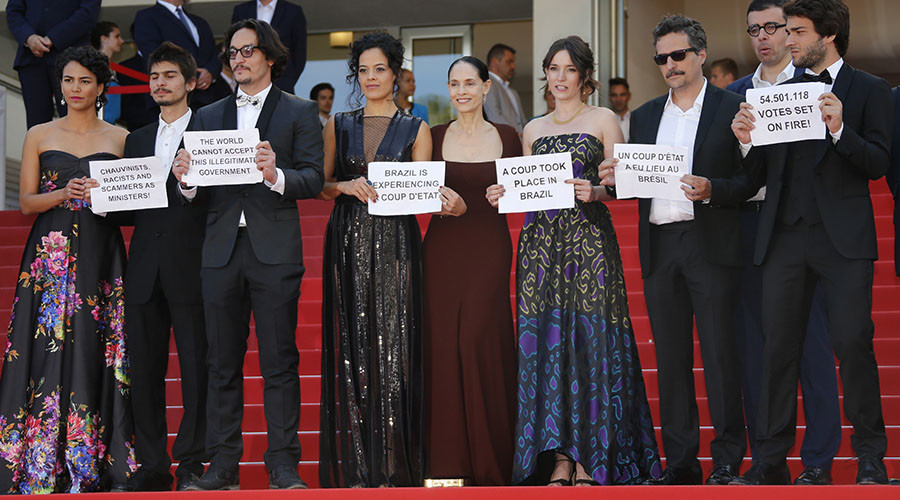
There were protests at the Cannes Film Festival  where the cast and crew of the Brazilian film Aquarius staged an improvised protest on the red carpet to show support for President Dilma Rousseff, denouncing her suspension as a ‘coup d’état.’ 

The film's writer and Director Kleber Mendonca Filho and Sonia Braga the lead actress and other members of the cast and crew unveiled printed banners ahead of their film’s premiere.

Saturday, March 12, 2016

Saturday's poem: We Believe by Staughton and Alice Lynd

We Believe
Staughton and Alice Lynd (copyright 1990)

We believe
Not only in the lengthening of days
And the return of springtime,
But in sudden reversals,


 Unexpected triumphs.

 We believe in the restoration
Of trust between friends,
And in the ability of ordinary folk


 To puncture lies.

We believe in the way to be safe
Is not to enclose ourselves in walls
Of cash and property,


But to live in solidarity
With those who need us.


 How can we give the Good
More chance to prevail?


 What can we add
To the chemistry of change?


 Surely, first, persistence.
Prisoners are obliged to learn it.


 How many times did Nelson Mandela
Reach for his shovel in the limestone quarry?


 Soon Mumia will have been behind bars
More than Mandela's 27 years.


 "Keep smiling," we told 

The man serving two life sentences
For crimes of which he may be
Completely innocent.


 He replied "I have to.
But inside my heart is broken."


 So, while we ask to persist,

 To be dogged, to stay strong,

 We must also be open every moment
To that which only yesterday
Seemed impossible,
To transformation
Of quantity into quality,


 To the instantaneous advent
Of the unimaginably new.

***
ALSO:

The good we secure for ourselves
Is precarious and uncertain
Until it is secured for all of us

And incorporated into our common life.

Staughton Lynd (b. 1929) taught history at Spelman College and Yale University. He was active in the civil rights movements.  In April 1965, he chaired the first march against the Vietnam War in Washington.  In December 1965 he made a controversial trip to Hanoi, in hope of clarifying the peace terms of the Vietnamese government and the National Liberation Front of South Vietnam.

Because of his practice of civil disobedience, Lynd was unable to continue as a full-time history teacher.  He was offered positions at  Universities in Chicago but the offers were withdrawn by University administrators.  He became a lawyer in 1976  and worked for Legal Services in Youngstown, Ohio until his retirement in 1996.  After retirement he continues to practice employment law and defend and protect workers' and prisoners' rights.

Alice Lynd (b 1930) trained as an early childhood educator and directed day care and health centres. She was active in the civil rights and anti-Vietnam war and peace movements. In 1985 she completed a law degree and became senior attorney for Northeast Ohio Legal Service. She continues to practice law in Youngstown Ohio.
 
Staughton and Alice Lynd married in 1951 and have worked for racial equality, against war, with workers and prisoners, and against the death penalty for 70 years. The Lynds became Quakers in the 1960's.
 
Between them, they  have written over 30 books.

An interview with the Lynds is here.

The Lynds are inspired by the  concept of accompaniment, which involves placing themselves at the side of the poor and oppressed, not as dispensers of charity or as fugitives from the middle class, but as equals in a joint process to which each person brings an essential kind of expertise.
 
In his book  Accompanying, Staughton Lynd distinguishes between organizing and accompaniment strategies of social change. The critical difference is that in accompanying,  colleagues view themselves as two experts, each bringing indispensable experience to a shared project- the idea of together as equals.
 
An interview with Lynd about the approach is here.

Saturday, October 24, 2015

The Marikana effect and struggles for economic, racial and social justice in South Africa

 
"Will millions of disgruntled South Africans one day generate a political force capable of breaking what are now disastrous sweetheart relations between state, ruling party, labour aristocrats, parasitical local and multinational corporate mining houses?"
Patrick Bond
 
Widespread student protests across South Africa campuses and public spaces have forced the Zuma led ANC Government into a back down on plans to raise university tuition fees by 11%.

For months students have protested against the Government's plans (as well as other issues).
 
While the immediate trigger was the fees hike, the causes of the protest go much deeper and reflect growing politicisation of students and campuses in response to widespread frustration and anger over the circumstances facing young people in South Africa, including high unemployment, a weakening economy, poverty, racial inequality, the failure of the post-apartheid ANC Government to improve the economic circumstances of many black young people and political corruption.

The protests bought together students from across the racial and economic divide, uniting black and white students from townships, rural areas, poorer urban areas, comfortable middle class suburbs and wealthy areas.

The student protests are not isolated incidents, but part of an ongoing wave of protest activity across South Africa since 2004, which has intensified since the 2012 Marikana massacre.
 
 The 2012 Marikana Massacre was the worst act of post-apartheid state-police violence since the advent of democracy in South Africa.
On August 16 2012, members of the South African Police Force opened fire on a crowd of striking mine workers outside the Marikana Platinum mine in Rustenberg South Africa. The police attack left 34 miners dead, 78 wounded and more than 259 people arrested.

The mine was run by Lommin, a London based miner, who is the world’s third largest platinum miner (80% of the world’s platinum is in South Africa).

As Nick Davies writes in the Guardian:
 
For South Africa, it was a special kind of nightmare, since it revived images of massacres by the state in the old apartheid era, with one brutal difference – this time it was predominantly black policemen, with black senior officers working for black politicians, who were doing the shooting. 

Patrick Bond  contends that the Marikana massacre was a premeditated massacre:

When a ruling party in any African country sinks to the depths of allowing its police force to serve white-dominated multinational capital by killing dozens of black workers so as to end a brief strike, it represents a profound turn. Beyond just the obvious human-rights and labor-relations travesties, Marikana revealed the extreme depths of ruling-class desperation represented by the fusion of Ramaphosa’s black capitalism, the London mining house Lonmin’s collaboration (via Ramaphosa) with the mining and police ministers, the alleged “sweetheart unionism” of the increasingly unpopular NUM, the brutality of state prosecutors who charged 270 massacre survivors with the crime of murder.

Nick Davies's detailed outline of events leading up to the massacre, which highlights the role of union leader Mgcineni Noki, who died in the massacre while  trying to broker a peaceful solution, is here.

Unrest at the Marikana mine began on 10 August 2012 when mineworkers went on strike for improved wages and conditions after Lommin refused to pay workers a living wage and address unbearable employment and living conditions.

The build-up to the massacre was marked by rising tensions between rival unions. Miners, two police officers and two security guards were among 10 people killed as violence escalated.
The day before the massacre, one of the corporation’s main shareholders and a Board member of the corporation, who is  the Deputy President of South Africa, Cyril Ramaphosa, emailed the Police Minister to demand that Police take action

In his email to the Police Minister Ramaphosa wrote:

“The terrible events that have unfolded cannot be described as a labor dispute. They are plainly dastardly criminal and must be characterized as such. There needs to be concomitant action to address this situation.” 

The UK Guardian described the role played by Ramaphosa thus:

Ramaphosa, a board member of Lonmin platinum mine where thousands were protesting in August 2012 – made phone calls that allegedly escalated the confrontation; sent emails reportedly calling for action to be taken against “these criminals”, whose crime was to seek a wage increase; and held secret meetings to get the government and police to “act in a more pointed way” to quell the unrest.
 
Police were ready and willing to act after clashes with the miners over previous days had resulted in the deaths of 10 people, including miners, mine security and Police.
 
The next day, police opened fire with automatic weapons into the crowd a few metres away. 

The Commission of Inquiry into the massacre set up by the South African Government released its official findings in March 2015 and whilst implicating Police in the massacre, it failed to hold anyone responsible, and the ANC Government action has taken no against Police and others responsible.
 
Police authorities acknowledged at the Inquiry that they were at fault, with police action disproportionate to the dangers they faced.
 
Patrick Bond,  Director of the Centre for Civil Society at University of KwaZulu-Natal writes:
 
Led by former senior judge Ian Farlam, the Commission learned that members of the South African Police Service planted evidence (putting weapons on the bodies of corpses to pretend the killing was in self-defense), hid crucial video records, laughed heartily at the scene, and indeed had earlier planned much of the massacre

Families of those killed and victims are outraged that not one person has been held to account and continue to call for accountability. 275 miners have recently launched a civil claim against the ANC Government and families of the slain mine workers have filed a claim against the Police Minister.

Patrick Bond suggests that the massacre and the subsequent inquiry acted as catalyst for a wave of citizen-driven protest activity and dissent across South Africa, opening up a large crack in the façade of the ruling ANC- corporate- state hegemony.
 
Bond notes that protests and organised acts of resistance have continued to grow since the Marikana massacre, with over 2000 protests taking place in the last year. 

The Center for Civil Society at KwalaZulu Natal University, of which Patrick Bond is the Director, maintains a Social Protest Observatory to document the extent and type of protest activity occurring across South Africa.
 
These protests reflect new alliances formed in the wake of the Marikana massacre and include groups and communities rendered more precarious by the neoliberal restructuring of South Africa.
 
This protest activity involves impoverished rural township and urban communities, the unemployed and precariously employed, schools students and organised labour and is directed at many issues including the injustice of poverty (bread and food  riots); persistent inequality; unbearable wage, employment and  living conditions; privatisation; crime; mismanagement of mineral wealth; prevailing power relations and the corruption of politicians, institutions, corporations and municipalities.
 
Despite the wave of protest activity across South Africa, Patrick Bond argues that the many protest and oppositional groups in civil society have not yet cohered into a powerful movement or voice for economic, racial and social justice.

Bond suggests  that the progressive and radical left has not yet capitalised on post-Marikana cracks in the ruling political corporate state hegemony, even as disaffection  and protest continues unabated.
 
One question about the recent student protests is whether the student movement, which won an important victory in relation to university fees, can develop beyond its current moment and coalesce with the other protest movements across South Africa to form a powerful social movement for economic and racial justice.

Another question is what the political, institutional and police responses will be to this wave of protest activity. This time the Government has backed down. But reactions have so far been uneven, even ambiguous- sometimes relying on police violence and brutality against protestors, others times relying on compromise and co-option.

Friday, October 16, 2015

Who said poetry serves no useful purpose? Samantha Connor's poem of complaint

Samantha Connor's poem of complaint has had the desired effect, yielding a refund and a response from the Perth Convention and Exhibition Centre and a promise to address the problem.

Earlier in the week I wrote this piece (and published here in the online publication The Stringer) about Samantha's  response to her attempt to book a ticket for a Stephen Fry gig at the Perth Exhibition and Convention Centre, only to be told that as a wheelchair user she would be charged an extra $20 because, apparently, the wheelchair bays are in premium spots.

Tired of writing complaint letters to agencies who discriminate against people with disabilities she tried something different.

She wrote them a poem.

Within days this response was sent to the editor of The Stringer, an online publication that ran my piece and also publishes Samantha's writings on disability.

Hello,
My name is Meg Coffey and I am the marketing consultant for PCEC. In regards to your post today, I wish to advise you that PCEC have worked together with Ticketek in resolving the ticketing structure/pricing for Stephen Fry: Telling Tales, to be held in the Riverside Theatre.

PCEC have arranged reimbursements to wheelchair patrons that have been disadvantaged by the ticketing pricing structure set for the show.

Moving forward, PCEC and Ticketek will work together with concert promoters, to ensure wheelchair and carer seats are all priced within the same pricing category for shows to ensure no-one is disadvantaged by demand.

We want to ensure the experience of patrons in the venue is an enjoyable one and not marred by their experience when purchasing tickets for in-house shows.
Many thanks,
Meg


The Convention and Exhibition Centre are to be commended for taking action, however their reply is admission that they were knowingly gouging and discriminating against people living with a disability by applying an additional charge. 

Many people were outraged by the Convention Centre's gall in the first place to think they could rip people off and then try to extricate themselves. One person described the PCEC's reply as lame and 'as weak as  piss':
'In other words, we tried to rip people off, got caught and now we are exposed to be being "rip off" merchants! and because this lady is on to us!! we better lift our game' 

Samantha also appeared on Perth ABC morning radio and ABC News (here) where she said:
'I wrote the poem because sometimes something with an amusing twist is a better way to go, it keeps it light hearted. You can write letters until the cows come home and you don't always get the response that you want.'

As Samantha pointed out to the ABC, the problem of access and pricing to sports and entertainment venues is common for people living with disabilities in Perth and she called for more venues to look at ways to improve access, seating, ticketing and amenity for wheelchair users and people living with disability.

Samantha noted how she had been contacted by many people raising concerns about discrimination against people with disabilities by venues in Perth. She wrote:

'It's amazing how much discrimination goes on every day, unnoticed by most. We start talking about this issue, which was raised by another wheelchair user. 

Prue tells us that she can't go into the licensed area when she sees a show at another area because there's a step, and the downstairs is unlicensed - a friend can't bring her a drink downstairs. Bronwyn tells us that she has to pay eighty bucks more to attend a concert with her daughter (who is a wheelchair user) and fights for the right to sit with her kids Darren says that there is no gold season ticket at the rugby, and you can only choose between diamond (at exorbitant prices) or crappy silver. Crispin tells us that two grandstands are unavailable (no lift access) at the NIB stadium and that sports fans can't get in to see a game. Someone else, I forget who, said that going to see the cricket was impossible because the shaded seats were inaccessible and your choices were left of field in full sun. 

It's pretty interesting that the stuff we work on at systemic and policy level is all about 'increasing participation' but people literally can't get in the door, to work as well as to play or just do the things ordinary Australians do. I'm not off to Stephen Fry, for a number of reasons - one of them is that no matter what the price is, I'm still not able to go to the event unless I go alone - the wheelchair spaces are in the premium area, which have been booked out by others. My family/friends would have to sit in the bottom bit whilst I sat up the top. Yeah, nah.

I really liked that the user group and the access group for the new Stadium were and are listened to and involved all the way through. I really hope it won't be another disastrous Perth Arena in terms of access. We live in hope!'

Tuesday, October 6, 2015

The death of an American revolutionary: Grace Lee Boggs (1915-2015)

'I think that too much of our emphasis on struggle has simply been in terms of confrontation and not enough recognition of how much spiritual and moral force is involved in the people who are struggling. We have not emphasized sufficiently the cultural revolution that we have to make among ourselves in order to force the government to do differently.'
 
'Activism can be the journey rather than the arrival'
Grace Lee Boggs
 
'We are not subversives. We are struggling to change this country because we love it'
Grace Lee Boggs
 
After 75 years of committed social and political activism, the legendary Chinese-American author, activist, philosopher and campaigner Grace Lee Boggs (1915-2015) has died. Boggs was one of the oldest American activists and campaigners.
 
Grace Lee Boggs was involved with the civil rights, labor, Black Power, Asian-american, feminist, climate change and urban renewal movements. 
 
Boggs was a deep thinker, committed to the role of philosophy in social change. She did not believe in mindlessly doing in the name of good. For her people had to think deeply and critically about the world around them.  She distinguished between what she called protest organising and visionary organising. Whilst recognising the importance of the former, she called for more of the latter.
 
Boggs also refused to be put in any particular "cause" box,  using her voice for civil rights, education reform, anti-racism, climate change, urban revitalization, and countless other issues that she saw as all undeniably connected.
 
She thought that the systematic failures of capitalism were  at the heart of most social pathologies and social problems, and believed that transformation would come not from the actions of elected leaders, but through action at the grassroots level. 
 
A film about her life and ideas  American Revolutionary: The Evolution of Grace Lee Boggs was released in 2014.
 
The New York Times wrote:
 
Her odyssey took her from the streets of Chicago as a tenant organizer in the 1940s to arcane academic debates about the nature of communism, from the confrontational tactics of Malcolm X and the Black Power movement to the nonviolent strategies of the Rev. Dr. Martin Luther King Jr., and finally to her own manifesto for change — based not on political and economic upheavals but on community organizing and resurgent moral values.
 
In the online journal Guernica, Michelle Chen writes that Grace Le Boggs lived in Detroit from the 1950s, with her husband, activist and auto worker James Boggs, in the early days of the civil rights movement.  Chen writes:
 
 'Her life has spanned numerous human catastrophes, from the Great Depression and the atom bomb to the incineration of Vietnam. But what keeps her optimistic is the fact that she’s also lived through “the great humanizing movements of the past seventy years,” including the black freedom struggle, the antiwar campaigns, and other historic mass actions. Detroit is now at the vanguard of an even more massive transition, she argues, evolving a new way of organizing society that focuses on self-reliance and a rejection of material excess.'
 
Grace Lee Boggs wrote extensively about the history and potential of revolution as the driver of radical social change, based on an optimistic belief that revolutionary change was just around the corner 
 
In the early 1970s she co published Revolution and Evolution in the Twentieth Century, a sweeping historical text that explores forms of Marxist revolution through uprisings in China, Russia, Vietnam, and contemporary community-based groups.
 
In 2011, aged 95, she wrote her fifth book  The Next American Revolution: Sustainable Activism for the Twenty-First Century, in which she reimagined revolutionary politics as a project of holistic transformation connected to global and historical transformations and intimately embedded in the individual soul.
 
"People are aware that they cannot continue in the same old way but are immobilized because they cannot imagine an alternative. We need a vision that recognizes that we are at one of the great turning points in human history when the survival of our planet and the restoration of our humanity require a great sea change in our ecological, economic, political, and spiritual values."
 
In an interview she said:
 
I think that rebellions arise out of anger, and they’re very short-lived. And a revolution has some sense of a long time frame, millions of years that we’ve been evolving on this planet. We have to think in a very different sense than the way we think now. We think in terms of quick fixes, that solutions will come out of a few protest demonstrations, and calling upon the government to do something. And we can keep trying to do that, and it won’t work. 
 
Boggs argued that it is the people most directly affected by injustice, the victims of injustice, who are the real agents of revolutionary change:
 
I think the trouble is that most people tend to look for quick solutions. .............I think people look at revolution too much in terms of power. I think revolution has to be seen more anthropologically, in terms of transitions from one mode of life to another. We have to see today in light of the transition, say, from hunting and gathering to agriculture, and from agriculture to industry, and from industry to post-industry. We’re in an epoch transition.....We have to think of revolution much more in terms of transitions from one epoch to another.
 
Interviews, articles and obituaries are here, here, here, here and here.

Tuesday, September 1, 2015

Another tale of WA's forgotten and hidden history: Don McLeod and the 1946 Pilbara strike


"He basically waged war against the West Australian government. He collected an enormous cache of documentation; he was going to run this huge High Court case based on legislation back in the late 1800s to try to achieve land rights for Aboriginal people. Pretty much to his dying day he was in there boots and all fighting for Aboriginal people."
Deborah Wilson on Don McLeod


Since  2010  I have been writing about the historical silences and the hidden and forgotten history of Western Australia.
 
This includes blog pieces on Aboriginal deaths in custody, Aboriginal poet Jack Davis on Aboriginal history, and the death of John Pat, the Wagerup community taking on Alcoa, the Esperance lead scandal, the scandal of asbestos and Wittenoom, the Atlas oil spill, corporate money and political parties, the imprisonment of an 8 year old Aboriginal boy for stealing a Freddo Frog, the long history of internment camps, the significance of the citizen sector and civil society protest movements, nuclear industry and the corporate stranglehold on NFPs,  

A number of blog pieces here and here were about the 1946 Pilbara strike by Aboriginal pastoral workers for fair pay and better working conditions  in the Pilbara region of Western Australia.
 
The strike was a historic event in Australian history. It was the first major strike by Aboriginal people and one of the longest strikes in Australian history. Sadly, the Pilbara strike is largely a footnote  in the 'official' view of Western  Australian history. A recent history of WA since 1826 gives the strike scant attention.
 
A key figure in the 1946 strike was Don McLeod, a white miner, activist, trade unionist and communist who had been initiated into Aboriginal society and culture. McLeod, along with Aboriginal lawmen Dooley Bin Bin and Clancy McKenna  were the coordinators and leaders of the strike.
Don Mcleod was chosen as the key negotiator. At the time he was  a delegate for the Australian Workers Union in Port Hedland.

The strike was planned as far back as 1942 at an Aboriginal law meeting attended by  200 senior Aboriginal law men representing twenty three language groups from much of the remote north west of Western Australia. The meeting lasted six weeks. 

The decision was  taken to postpone the strike until after the Second World War had ended. 
 
At the time Aboriginal workers were paid for their work with supplies such as tobacco and flour instead of cash. The situation in the Pilbara was akin to slavery: if Aboriginal people left a job they could be pursued by the police and forcibly brought back.
 
On May 1 1946, after years of planning, 800 Aboriginal pastoral workers walked off the large pastoral stations in the Pilbara  and from employment in the two major towns of Port Hedland and Marble Bar.
 
Despite constant harassment the strikers sustained themselves using a method of surface mining for tin, and trading skins and pearl shells. The strike continued until August 1949 when the striker's determination and tenacity were rewarded with improvements to pay and conditions for Indigenous people.
 
At the end of the strike many Aboriginal people refused to  work for white station owners. 
         
The strikers also realised a dream of economic independence. They established a number of successful cottage industries and mining concerns and in 1951 they registered Pindan,  the first Indigenous-owned company in Western Australia which went on to own several pastoral stations, including the Strelley station near Port Hedland and establish an independent community school.
 
In 2012, Anne Scrimgour argued that the community and political activism that resulted from the activities of the strikers and particularly from Pindan, the indigenous corporation they created, continued for decades after the strike and was largely overlooked in studies of Aboriginal and social justice activism in Australia.
 
The ABC website has posted a recent story about Don McLeod, which draws from Deborah Wilson's book Different White People: Radical Activism for Aboriginal People 1946-1973 published by the University of WA Press.

Wilson argues that the Pilbara strike was a trigger point that led to the modern Aboriginal rights movement.