Showing posts with label dissent. Show all posts

Sunday, May 22, 2016

Brazilian people rise up against a neoliberal coup

Photo of members of the Landless Workers Movement (MST) in Brasilia protesting against the impeachment of Rousseff. Photo:Reuters

I wrote this blog piece earlier in the week about the neoliberal coup that removed the democratically elected President of Brazil, Dilma Rousseff.

The coup was supported by the Brazilian corporate and business elite, and appears to have been supported by both the US government and US corporate interests and has installed Michel Temer (the right-wing vice president and U.S. informant) and members of the right wing neoliberal party that has lost every election since 2002.

The coup has led to a sharp outburst of resistance and protest by the Brazilian people. The new government threatened to criminalise and arrest protesters and demonstrators.

A selection of photos from the various protests is here.

Policemen ride their horses during a clash with demonstrators at a protest against the impeachment of President Dilma Rousseff, in Porto Alegre, Brazil, May 12, 2016. Photo:Reuters

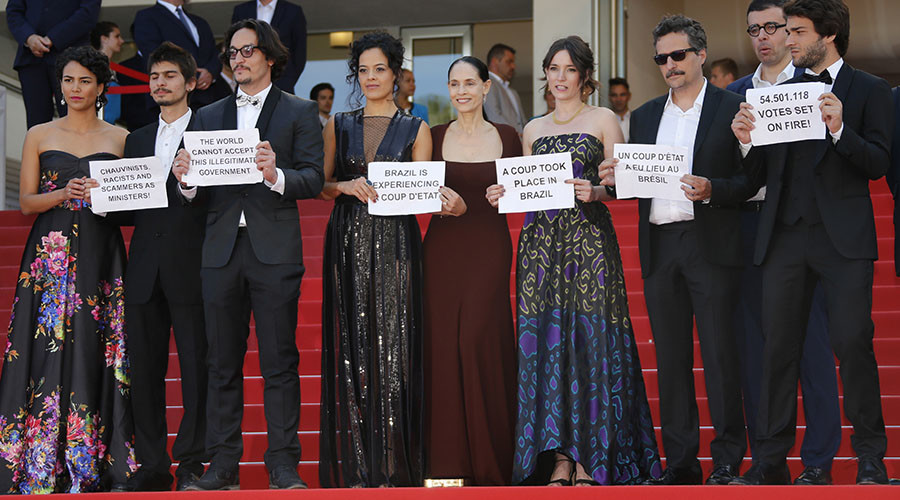
There were protests at the Cannes Film Festival  where the cast and crew of the Brazilian film Aquarius staged an improvised protest on the red carpet to show support for President Dilma Rousseff, denouncing her suspension as a ‘coup d’état.’ 

The film's writer and Director Kleber Mendonca Filho and Sonia Braga the lead actress and other members of the cast and crew unveiled printed banners ahead of their film’s premiere.

Thursday, September 3, 2015

'Nothing about us without us': The Barnett Government and social policy making that excludes end users

photo of Samantha Connor courtesy of ABC

My colleague and friend Samantha Connor is a renowned and fearsome Western Australian disability activist, advocate, writer and campaigner. (You can read about Samantha here and here). Her writings on disability issues on The Stringer are here.)
 
Today she has a letter in the West Australian newspaper in response to a recent story and statement by the Disability Minister Helen Morton who claimed the WA had the best disability system in Australia and that WA's system of providing support and services to people living with disabilities called My Way, was far better than the Federal Government's pilot NDIS system currently being trialled in WA. 
 
Samantha writes:
 
'"It’s unfortunate that Minister Helen Morton and the WA Government has decided that it’s to be ‘My Way or the Highway’ (WA’s own services best for disabled, 2.9.15). Announcing that WA has the best scheme might be in the best interests of both government and providers, but what about people with disability themselves?
 
The evaluation for the two disability schemes, the Commonwealth National Disability Insurance Scheme, and the State based My Way scheme, will not be completed for many months. Preliminary feedback indicates that the jury is still out, with many end users critical of aspects of the State based scheme and others finding the Commonwealth scheme difficult to engage with.

 WA has a regrettable track record of declaring ourselves ‘the best’ when it comes to disability care and support. That flies in the face of the commentary of many people with disability and their families who have found our State system not only lacking, but appalling.'
 
As a disability advocate, a person with a disability and a parent of children with a disability, I ask our State Government to think carefully about making decisions for us and speaking upon our behalf. We understand that this is about your carefully built State systems and your individual interests – but for we people with disability of Western Australia, this is about our lives."
 
As Samantha rightly notes, politicians and State Governments are using the roll out of the NDIS for their own political purposes, as much as they aspire to assist people with disabilities.

The WA Government's is actively using the NDIS to serve its own political and policy agenda. 

The Barnett government presents an idealised picture of a disability system that they claim effectively serves the needs of people living with disabilities, despite evidence to the contrary and is using the opportunities presented by the NDIS to extend its agenda of privatisation and outsourcing of government funded and provided health, social and community services.
 
The Minister has come to rely on West Australian parochialism, spin, overinflated political rhetoric and dismissal of her critics as a way to conceal major policy failures across a number of her portfolio responsibilities, including disability, child protection and children's services, mental health and suicide prevention.
 
The Disability Services Commission, who is fighting to protect and maintain its position of power and influence over WA's disability sector, has also shown itself willing to engage in political manoeuvrings in its support for the Barnett Government's agenda. It released this statement yesterday
 
" Getting additional resources is important, but what the WA State Government is focussed on, is making sure WA gets the best NDIS in the nation - a system that will provide the best supports and services to people with disability, their families and carers. The supports that people with disability need to live good lives in their local communities. The individual packages costs in the Lower South West may be lower than the national average, but this may not be the case when the Cockburn-Kwinana area rolls in.

 The learnings from the two trials of the NDIS in WA will help inform how the NDIS will operate in WA into the future. But, the State Government can’t wait until the trials are over to start the conversation with the Commonwealth about rolling out an NDIS for all people with disability in WA. The Minister for Disability Services wants to start the conversation now. She has been told by many people that WA NDIS My Way works – they like the support provided by My Way Coordinators who know them, their family and their community.

 The Minister wants to make sure we have an NDIS in WA that is local, builds on the best of our current system and includes the additional State and Commonwealth funding required to meet the needs of all people with disability. This is what is most important."

As Samantha rightly points out the people whose lives are directly affected by all this political posturing- people living with disabilities, their families and carers- are actively excluded from these debates and decisions.

Similar comments were made today by Women With Disabilities WA Inc (WWDWA), an organisation run by and for people with disabilities, who released the following statement:

The organisation believes that it is counter to the original principle of self management to have able-bodied professionals and politicians who don’t personally use the services under trial speaking on behalf of people with disabilities.

There is little evidence in any of the articles that promote the WA My Way scheme that the real experts were interviewed - people with disabilities who are actually using the My Way scheme.

Chair of WWDWA Inc, Ms Zeliha Iscel, said: “One of the central tenets of the disability rights movement is “nothing about us without us”. The current WA My Way and National NDIS schemes both fail to embody this principle and therefore are at risk of failing people with disabilities and our families.”

Ms Iscel stressed that the reality of the My Way and NDIS trials is a lot more complex than the current media reports and government spokespeople have made it out to be. She further emphasised, “It is far too early to be making definite statements about which trial is the best for Western Australia.”

Coordinator of WWDWA Inc, Ms Rayna Lamb says there is a risk of people with disabilities being steamrolled into the NDIS My Way scheme because of the WA government's insistence on WA exceptionalism, regardless of what is actually best for people with disabilities.

Women With Disabilities WA Inc strongly urges the media and government spokespeople to go directly to the people with disabilities and those who support us to get real experience and knowledge on how both trials are running so far. Ms Iscel said: “To do anything less is to treat people with disabilities as perpetual children who are not permitted a voice in our own lives. In 2015, this is unacceptable”.

WWDWA Inc is run by women with disabilities and provides systemic advocacy and peer support for women with disabilities. http://wwdwa.org.au/
 

Tuesday, July 21, 2015

Remembering Ken Sprague (1927-204) and his powerful images


image by Ken Sprague

"In essence, the leitmotif of his work is about power and the abuse of power as well as the resilience of ordinary working people to this abuse... It is an art of engagement – engagement for change."
(John Green, from the Introduction to Ken Sprague – People’s Artist.)

People continue to ask about this powerful image that appears on this site. (It it also continues to appear in its original or modified form elsewhere).

The image is a drawing by Ken Sprague. I have written before here and here about Ken Sprague who I had the privilege to know during the 1980's. You can read more about Ken's life, his work and legacy here

Ken Sprague's remarkable image captures the recent zeitgeist of uprisings and revolts happening around the world, in which ordinary people are standing up and fighting against state and corporate power and political and financial plundering.

Ken's image was created decades ago but reflects his profound and lifelong commitment to  human rights, justice, peace and socialism.


Ken was a renowned artist, cartoonist, illustrator, poster designer , print maker, educator and filmmaker  who believed profoundly that art should  always serve social justice, peace, human rights and political struggle.

 The
obituary for Ken was written by John Green and appeared in the Guardian newspaper. John wrote a book on Ken's life titled Ken Sprague: People's Artist.
 Ken Sprague: Radical artist in pursuit of Socialism
By John Green ( from The Guardian 6th August 2004)


 The aim of Ken Sprague, who has died of a stroke aged 77  was, he said, “to build a picture road to socialism, to the Golden City, or as Blake called it, Jerusalem”. A painter, sculptor, muralist, banner-maker and sometime television presenter, Ken was, for half a century a regular, but dissenting cartoonist for the Daily Worker and its successor the Morning Star, and for papers like Tribune and Peace News.

As a posterman his work included material for Martin Luther King, and the women of Greenham Common — and against the Soviet invasion of Czechoslavakia, and Edward Heath’s Industrial Relations Bill. In the late 1950s and early 1960s, he was designing scenery and backdrops for Unity Theatre and was involved in the Centre 42 trade union arts project.

All round talents
His linocuts for the radical collective Cinema Action’s Kill The Bill film (1971) began an involvement in moving images. I made a film about him in 1972 which led to Jeff Perks’s 1976 BBC Omnibus documentary The Posterman. This led to a series of Channel 4 films, devised with Jeff Perks and presented by Ken, called Everyone A Special Kind Of Artist (1986). There was also a BBC South West series, The Moving Line with Joan Bakewell. In later life, he taught and practised as a  psychodrama specialist. Ken was born in Bournemouth , his father was a train driver and his mother worked in a cardboard box factory. His first work of art, in 1937, was a linocut made from linoleum, torn from the kitchen floor in response to the Spanish civil war.

Early life
He was educated at Alma Road Elementary School — until it was bombed — and Porchester Road Secondary Modern School. There the headmaster, noticing his talent, recommended that he apply to the local art college. He won a scholarship to Bournemouth Municipal  College and, from 13 and a half, studied graphics — in those days students of his background were hardly considered for fine arts courses. One morning in 1944 he volunteered, aged 17 for the Royal Marines — and that afternoon, in Southampton, he joined the Communist Party. After basic military training he was transferred to Vickers-Supermarine as a technical artist, work which took him to wartime Yugoslavia. Postwar, and after a summer stint in a circus, he completed his college diploma course in design and illustration. The CP, he told me, was his university, but after the Bournemouth Daily Echo had labelled him a college revolutionary, local job prospects dwindled. He briefly worked for a volunteer labour battalion in Yugoslavia, was employed  by the Boy Scouts and then, between 1950 to 1954 he worked in a Carlisle mining company design office — doubling as a cartoonist for the local Conservative, and Liberal newspapers. Then came a move to London as the Daily Worker’s publicity manager, which also had him working as a journalist and cartoonist. Devastated by the Soviet invasion of Hungary in 1956, in 1959 Ken left to set up, with Ray Barnard, the publicity company, Mountain & Molehill. Yet he continued producing cartoons for the Worker, and its successor the Morning Star into the 21st century.

Mountain & Molehill
M&M — later The Working Arts — was responsible for some of the most innovative trade union campaigns of the 1960s and 1970s. Ken told union leaders they had to (TO) use publicity to win hearts and minds and to see it as an integral part of union work. And it was Sprague and Barnard who initiated the sensational 1961 visit to Britain of the first man in space Soviet cosmonaut Yuri Gagarin. M&M also worked for the Indian High Commission — which led to a meeting with Jawaharlarl Nehru In the late 1960s Ken began editing the Transport and General Workers Union’s the Record, transforming it into a lively newspaper, — and illustrating it with his own cartoons. As a poster and print-maker he worked with a number of leading progressive organisations and individuals, including Pete Seeger.

New life in Devon
In 1971 he moved with his wife, Sheila, a talented potter, to Holwell, a farmhouse in Devon, and converted it into an artistic centre. Sheila died of cancer in 1973, but with his second wife, Marcia he set up the Holwell International Centre For Psychodrama and Sociodrama which continued until 1998. There Ken combined his artistic talents with pedagogic expertise, using them in this new field in which he became a leading practitioner.

It is his posters and prints that will remain his true epitaph. His innovative and prolific creativity, his recalcitrant questioning, determination and belief in others’ potential was an inspiring beacon for everyone who met him, young and old. His images remain etched in the mind, they unsettle, provoke, discomfort but also amuse. Ken was concerned about how politics impact on the ordinary person. In essence the leitmotif of his work is about power and the abuse of power as well as the resilience of ordinary people. He depicted the world as changeable. His work is imbued with unfashionable optimism, depicting a world where ethics and values still have relevance. It is the antithesis of post-modern fragmentation and its disdain of value systems. Every morning, he drew a political cartoon to assuage his anger and frustration at the state of the world. And only a few weeks before he died, he was excitedly telling me about plans for an artistic project in Cuba and a book he was determined to publish of anti-war drawings. He left the Communist Party, after the acrimonious split in 1988. He continued to call himself a communist, however, saying “The party left me, I didn’t leave the party”. He won several prestigious awards, including poster of the year award from the National Council of Industrial Design on two occasions.

He is survived by Marcia, from whom he recently separated, his five children and seven grandchildren.
John Green

Wednesday, May 28, 2014

Everyday heroes: sit-ins 50 years apart show the power of ordinary people to take action against injustice

"You don't have to be a big name to make a difference and impact change. Small things can make ripples that make a big difference"
Joan Trumpauer Mullholland

Today in a Perth court 11 Christian leaders were fined $50 each for trespass after they held a prayer vigil and sit-in at the office of the Australian Foreign Minister Julie Bishop as a protest against the plight of 1100 children imprisoned in Australia's onshore and offshore immigration detention camps.

There was some concern that the Christian leaders faced a jail sentence for their protest.

The protest in the Foreign Minister's office was followed by subsequent prayer vigils and sit-in by other Christians and Church leaders on the east coast, this time in the offices of the Immigration Minister, The Prime Minister and Leader of the Opposition.

The Christian leaders are part of a long tradition in which ordinary people use sit-ins as a form of direct action protest against injustice and domination,

This iconic photo was taken on May 28th 1963 in Jackson Mississippi and shows 3 people- 2 white people and one black woman- participating in a sit- in protest at a Woolworths lunch counter. They are surrounded by angry and aggressive white men who are pouring sugar, liquid and ketchup over the 3 protesters.

The protesters were three students- John Salter, Joan Trumpauer and Anne Moody- who were protesting against racial segregation of lunch counters in Woolworths stores throughout the American south.

Initially the protesters were jeered and taunted and then doused in sugar and ketchup. They were then beaten and kicked.  

It was one of the most violent attacks on protesters involved in a sit-in the history of the civil rights movement.

The attack went on for 3 hours as the Police stood by and watched

 The Woolworths store manager eventually had to close the store and the protesters were escorted away by Police.
 
The story of the Woolworths sit in, the events that lead up to the protest and the fall out from it (including the murder two weeks later of civil rights leader Medger Evers) and the stories of the protesters involved are told in Mike O'Brien's book We Shall Not Be Moved.

The Jackson sit-in was one of a long line of sit-ins used during the civil rights movement to protest against racial segregation in the South during the early 1960's.

Sunday, May 11, 2014

Songs of Renown: Paul Robeson, Hirsh Glik and the Hymn of the Jewish Partisans

The song Zog Nit Keynmol (in Yiddish), also known under various titles- the Hymn of the Jewish Partisans, the Partisans Song or the Song of the Warsaw Ghetto- was written in 1943 by Hirsh Glik, who was a young Jewish poet, resistance fighter and inmate of the Warsaw Ghetto. 

More about Hirsh Glik is here on the website Music and the Holocaust.

The song was adopted by Jewish partisans and resistance fighters and was a symbol of Jewish resistance against the Nazis. The song was often sung by people in concentration camps.

The song was a regular concert performance by Paul Robeson who sang the song in Yiddish and English.

Paul Robeson sang the song in a Moscow concert in 1949 during the height of Stalin's anti-Jewish purge. It was his protest against Soviet persecution of Jews.  In that concert, Robeson spoke in support of Jewish writers and actors in Russia and his friendship with Jews who had perished in Stalin's purges.

Here is how the concert is described on the website of the  Jewish Partisan Educational Foundation:
Four years after the fall of Hitler, the tune would be used as a form of resistance against another 20th century tyrant. Paul Robeson traveled to Moscow in June of 1949 to give a performance to an audience that included many Communist Party elites, as well as what little remained of the Jewish intelligentsia after Stalin's purges. At the end of the concert, Robeson stunned the audience with a surprise rendition of the Partisan Hymn. His introductory remarks contained references to the Yiddish language, the deep and enduring cultural ties between the US and Russian Jewish communities, as well as to leading Jewish intellectuals who had been "disappeared" by the regime. 
The remarks, the spontaneous translation of the song to the shocked audience, and thunderous applause that followed were cut from the recording by Stalin's censors, but the chaos is evident in the mixture of applause and jeers that follows the actual performance.
Here is a heavily censored live version of Robeson's performance from that 1949 concert:


The following comments are from Paul Robeson's son Paul Robeson Jr's biography of his father:
... One could hear a pin drop during my father remarks about the deep and enduring cultural ties between the Jewish communities of the Soviet Union and the United States, about the common tradition of the great Jewish writer Sholem Aleichem, and about the continued vitality of the Yiddish language. Finally he announced that he would sing a song of the Jewish partisans who fought to the death against their Fascist oppressors in the Warsaw Ghetto. 
Since the song had to be sung in Yiddish, he would explain the lyrics in Russian, as follows: 
'Never say that you have reached the very endWhen leaden skies a bitter future may portend;For sure the hour for which we yearn will not arriveArid our marching steps will thunder: we survive'. 
For a moment there was no sound from the stunned audience; then a single intrepid young woman stood up and applauded, and the entire audience joined in a swelling wane of applause before my father could sing a single note. Only this response to my fathers remarks remains on the recording; Stalin's censors simply cut out his remarks, and they have disappeared..." 
The Song of the Wamaw [sic] Ghetto Rebellion sung in Yiddish (Zog Nit Keynmol) - remains an a crowning jewel of this recording of the Concert. The combination of power and pathos with which my father delivered this song transfixed his listeners. When he finished, the audience released its accumulated tension like an explosive charge. Although his listeners included many of Moscows Jewish intellectual elite who were waiting for Stalins axe to fell on them, the great majority were Russian members of the Party elite which was being decimated by a purge. Jews and Russians alike, in some places seated side-by-side, were either walking in the shadow of death or had lost someone close... 
After that first release, the ovation continued to swell and recede in a series of waves which ebbed and flowed. People stood, applauded and cried out; they called my father by his patronymic-Pavel Vasilevich; some who were total strangers fell info each others arms and wept; still others sat silently with tears streaming down their faces. The first part of the audiences response is captured on this recording, but the rest has been cut by the censors. Still, the sound of this cry of hope is unforgettable, and there is little doubt that it was heard by the Master himself"
**********
Zog Nit Keynmol Hymn of the Jewish Partisans

Never say that this is the end of the road.
Wherever a drop of our blood fell, there our courage will
grow anew.
This song, written in blood, was sung by a people fighting
for life and freedom.
Our triumph will come and our resounding footsteps will
proclaim "We are here!"

From land of palm-trees to the far-off land of snow.
We shall be coming with our torment, with our woe;
And everywhere our blood has sunk into the earth
Shall our bravery, or vigor blossom forth.

We'll have the morning sun to set our day aglow;
Our evil yesterdays shall vanish with the foe.
But if the time is long before the sun appears,
then let this song go like a signal through the years.

This song was written with our blood, and not with lead;
It's not a song that summer birds sing overhead;
It was a people, amidst burning barricades,
That sang this song of ours with pistols and grenades.

The rising voice of Paul Robeson


All that Paul Robeson stood for had enormous impact on American and global history. The combination of his art, intellect and humanity was rarely paralleled. The cruelties visited upon him by the power of the State stands as a great blemish on the pages of American history.”
Harry Belafonte


"..while Robeson’s reputation and name recognition will gradually grow, he will remain a marginal figure, greatly admired by the relatively few Americans who understand his giant accomplishments and his remarkable courage, but otherwise eclipsed by one of the ugliest episodes in our country’s history, one of the lasting legacies of McCarthyism and the Cold War'
Peter Dreier


We are witnessing a growing recognition of the remarkable life and achievements of Paul Robeson, who is unquestionably one of the towering figures of the twentieth century.

There are few people whose achievements can match those of Paul Robeson.

In an article in the Los Angeles Review of Books titled, We are long overdue for a Paul Robeson revival, Peter Dreier writes that Paul Robeson was the most talented man of the twentieth century.

Dreier writes:
He was an internationally renowned concert and opera singer, film star and stage actor, college football star and professional athlete, writer, linguist (he sang in 25 languages), scholar, orator, lawyer, and activist in the civil rights, labor, and peace movements. In the 1930s and 1940s, Robeson was one of the best-known, and most admired, Americans in the world. Today, however, he is almost a forgotten figure. Few Americans know his name or accomplishments.
We are familiar with authoritarian governments that seek to “erase” the memory of prominent critics, but how can it happen in a democracy like the United States? Starting in the late 1940s, as the Cold War escalated, America’s political establishment began an assault on Robeson’s career and reputation because of his political activism and outspoken radicalism. He was blacklisted, his concerts and recording contracts canceled, and his passport revoked. By the mid-1950s, he had become a marginal figure — emotionally depressed, physically exhausted, and politically isolated.
As Dreier points out, other public figures who challenged the status quo retained their reputation, but not Robeson. Dreier writes:
He is, at best, a footnote in history textbooks, little known outside a small circle of Americans with a special interest in the history of the civil rights and left-wing movements, although somewhat better known among African Americans than white Americans.
But as Dreire and others have noted, Robeson's outstanding achievements are at last being recognized. 

A range of factors are at work;
Here in Australia Robeson is remembered for his famous 1960 visit, which is the subject of recent historical investigation (described in this article by Ann Curthoys and this piece in The Australian), recent ABC Radio programs (here) and his famous concert on the building site of the Sydney Opera House, which at the time was under construction. 


Tuesday, January 21, 2014

Attacks on the independence of civil society and the voluntary sector

" We are on a slippery slope, where it is becoming increasingly common to hear the view that voluntary organisations should deliver services but not challenge the status quo, especially if they receive government funding. We are already seeing a ‘chilling effect,’ with increasing evidence of self- censorship by voluntary organisations"
Roger Singleton, Chair of the Independence Panel for the UK Voluntary Sector
 The Panel for the Independence of the UK Voluntary sector has just released its 2014 report titled Independence Undervalued: The Voluntary Sector in 2014,  and the picture it paints is despairingly familiar to the situation in Australia. 

The Report shows that the independence of the voluntary sector and civil society is under attack from Governments dedicated to the imposition of market based ideas and policies  :
 "The voluntary sector is losing its ability to protect the most vulnerable in society as a result of government attacks on its campaigning activities, lack of consultation over policy changes, and funding arrangements that put the future of an independent sector at risk"
In its media release the Panel:
  • calls on the British Prime Minister David Cameron to take action to stop weakening the independence of the sector and to rebuild trust.  
  •  calls on voluntary sector leaders to take a stand to preserve the sector’s independence, which it says is vital to a healthy and compassionate democracy and the reason why so many people lend their support to charities and trust their services.
  •  documents numerous instances of a serious and growing threat from the government to Britain’s long tradition of independent voluntary action including:
  • Growing criticism by some politicians, including the Secretary of State for Justice, of charities’ role as voices of communities.  There is an increasingly commonly expressed view that charities should simply deliver services and not speak out against injustices – leading to voluntary organisations self-censoring because they are afraid of losing government work, appearing too political or because of gagging clauses in state contracts.
  • New and proposed restrictions to the ability of voluntary organisations to challenge government decisions in the courts on behalf of vulnerable individuals.
  • Restrictions to campaigning put forward in the Lobbying Bill without consultation and, despite subsequent changes, with continuing concerns about their impact.
  • Cuts in government consultation periods, leaving voluntary organisations too little time to respond to important questions, despite assurances this would change.
  • "gagging clauses" in contracts for the government’s Work Programme, which prevent preventing subcontractors from criticizing the programme or releasing potentially embarrassing data.
  • Damage to support in communities due to loss of public funding for local specialist voluntary organisations as public service contracts concentrate on economies of scale rather than social return.
  • Many state-sponsored charities subject to government interference, for example in appointment of board members.
  • A weak Charity Commission ill-equipped to maintain public confidence that charities are pursuing an independent mission that is furthering the public good and not state sponsored or driven by private gain; and lack of government compliance with a document signed by David Cameron to protect the independence of the sector, the Compact.
Panel chair Sir Roger Singleton CBE said:

“An independent voluntary sector lies at the heart of a compassionate, democratic society, a role that has become especially important as engagement with mainstream politics declines and the state reduces in size. Yet we are on a ‘slippery slope’, in which the independence of voluntary organisations is increasingly undervalued and under threat and there are insufficient safeguards to protect an independent future for the sector. It is increasingly seen either as a delivery arm of the state or only legitimate where it provides services but does not speak out for wider social change.
 The full 64 page report of the Panel is here

Saturday, September 14, 2013

Seyla Benhabib on the sigificance of global protests


"Democracy thrives on the interplay of formal representative institutions and the energies of civil society and the voices and noise of the streets."
Seyla Benhabib


For those of us who operate in the spaces of civil society, citizen led social action and social movements, Seyla Benhabib in an interview in Dissent magazine The Gezi Park Protests and the Future of Turkish Politics poses some important questions arising from the wave of global recent protests that swept through Turkey, Brazil, the Middle East, North Africa and Eastern Europe. 


Benhabib explores the implications of the recent protests across Turkey, particularly the protests that took place in Gezi Park in Istanbul.

One of the critical questions posed by Benhabib is whether this global wave of protest can transform itself into some form of organized presence in representative democratic institutions.

These new protests are also the cries of anguish of a new generation who is facing a bleak economic future—at least in Europe and the United States. There is a deep generational anxiety that is galvanizing these protests, with twenty-somethings realizing their prospects may be worse than those of their parents for the first time since the Second World War.

The student movement of 1968 was also global and had spectacular qualities. But principally this movement was guided by varieties of left-wing ideology. There were certain categories through which the world was interpreted, such as imperialism. Today, neoliberal globalization has scrambled our old categories: who are the imperialists? The United States, or China, or Saudi Arabia, all of which are exercising hegemony and regional influence in different ways?

Today’s movements are more diffuse ideologically and programmatically; they cherish politics in the first person more than conceptual abstractions; they are pragmatic and, at their best, they want a deliberative voice and the power to shape the whirling and buzzing vortex of globalization around them. For me, the question for the coming decades will be whether this contentious political energy, which I find so beautiful and hopeful, can translate into some vision of a better future society. There is, at the present, a huge “democratic disconnect” between the street and the parliaments, the public square and the courthouse.
By contrast, the student movement of 1968 took the “long march through the institutions” and produced the political leaders of the next generation, such as Daniel Cohn-Bendit, Joschka Fischer, and Otto Schilly in Germany; Bernard Kouchner in France; and in the United States, Jesse Jackson, Bill and Hillary Clinton, John Kerry, and even Barack Obama, who in no small measure owes his political orientation to his mother, a child of the sixties. Will this also be the case with your generation? I don’t know.

Thursday, November 15, 2012

Largest protest in European history barely rates a mention in Australia

"This austerity is a never-ending story. We see no light at the end of the end of the tunnel, just more pain and difficulties. We have to protest, do something to stop it,"
 Lisbon pensioner Jose Marques.

On Wednesday fourteen million people across 23 European states participated in the largest strike and protest in European history in the  hope of staving off decades of corporate led austerity, precarity and unemployment.

Millions of workers walked off their jobs and marched on parliament buildings across the continent. Bloody street battles ensued Spain, Portugal and Italy.

Report from the streets can be seen here, here, here, here and here

The protests barely rated a mention here in Australia, other than a few reports here,and here.

Friday, July 20, 2012

Social Justice Hall of Fame

I really like what Peter Dreier has done with his new book The 100 Greatest Americans of the 20th Century: A Social Justice Hall of Fame.

Dreier has written a history of 20th century radical and progressive leaders in the USA and movements that changed history. The book comprises short articles on each person. A number of the profiles can be read here.

One of my heroes Paul Robeson was among the 100 named. Other key figures included in Dreier's book include: 

 C.Wright Mills

Bob Dylan

Muhammad Ali

Woody Guthrie

David Brower (environmentalist)

As someone who worked for the Family Planning Association here in WA I was interested in this piece on Margaret Sanger, the founder of Planned Parenthood,  a pioneering organization for sexual and reproductive health rights.. The Family Planning Associations in Australia were modeled on the Planned Parenthood Foundation.

Wednesday, July 18, 2012

The importance of the citizen sector in challenging unjust power and fighting for social justice

Western Australia has a long history of citizen led activism in support of the rights of people seeking asylum in Australian.

Since the introduction of the policy of mandatory detention by the Keating government in the early 1990's, WA citizens have been at the forefront of opposing mandatory detention and Australia's increasingly punitive policies toward people seeking asylum in this country.

Activism and collective action by ordinary citizens (what I call the citizen sector) has been instrumental in exposing the shocking and sorbid history of Australia's treatment of asylum seekers. Mainstream NGOs, particularly those who receive public funding, or those who place a high value on partnerships with Governments tend to be cautious about directly and publicly opposing and challenging Government policy.

I have written before about the increasing importance of the "citizen sector", which is the sphere of collective activity involving the ongoing efforts of committed citizens to create positive social, environmental, economic and political change. The citizen sector is very different to the mainstream, funded NGO sector, although they often collaborate on various campaigns and issues and some citizen action occurs through and in partnership with mainstream NGOs and groups such as trade unions.

The citizen sector holds Governments and corporations to account and makes democracy and society work. It is the citizen sector that attempts to expose, challenge and limit the misuse and abuse of state, economic, corporate and political power. The citizen sector mobilises and acts to protect the rights of citizens, individuals and communities.

The citizen sector is a fundamental plank in what is often referred to as "civil society". Citizen sector organizations and groups effectively mobilise and organise the voices and efforts of citizens to act for the common good. They take action to directly oppose and challenge the policies and actions of Governments and corporations, something mainstream NGOs are much less willing to do.

On Monday night I attended a forum organised by the WA based Refugee Rights Action Network (RRAN), one such citizen led activist and campaigning group that has worked for over a decade to expose and oppose Australia's regressive and cruel asylum seeker policies, including the policy of mandatory detention. RRAN provides a vehicle for ordinary citizens and professionals and service providers who work in the field to take action against mandatory detention and asylum seeker polices.

The forum looked at the historical and political basis of Australia's policy of mandatory detention and explored the political landscape surrounding refugee and asylum seeker policy and the role of citizen activism in challenging the policy.

RRAN is avowedly an activist group who takes direct action against Australia's detention system and directly challenges the policies and institutions responsible for implementing the Australian Government policy, including DIAC and Serco.

As part of its campaign RRAN is organizing a convergence to the Northam Detention centre on the 26th August. (more information here).

Coincidentally, this week another West Australian refugee activist has played a key role in mobilising over 200 academics to sign a letter of protest at Australia's treatment of asylum seekers.

Anne Pederson, an academic at Murdoch University, has spent the last decade pursuing justice for refugees and asylum seekers and as an academic has researched and written about asylum seeker and refugee issues. Concerned by the increasing hostile and punitive policy environment and critical of the solutions proposed by both political parties, Pederson drafted a letter of protest and gathered support from 200 of her fellow academics.


The letter argues that sending asylum seekers to neighbouring countries “will undermine Australia’s efforts to develop a viable regional framework, as it reinforces regional perceptions that Australia is interested in exporting its refugee ‘problem’ rather than collaborating in a genuine multilateral process".

The letter calls for the Australian Government to:
  • increase its yearly humanitarian intake to 25,000
  • implement community-based detention
  • increase UNHCR funding so refugees have “viable alternatives to jumping on boats”
  • process asylum seekers in Indonesia “themselves” before transporting them to Australia.

Wednesday, June 20, 2012

Reflections on the crises in Greece and the Greek Elecions

For those keeping a close eye on events unfolding in Greece Yanis Varoufakis offers a thoughtful and reasoned but deeply pessimistic analysis in this piece in Open Democracy.

Varoufakis is Director of the Political Economy Division at the University of Athens and has taught political economy and economics all over the world, including 20 years at the University of Sydney.

As Vroufkas points while the majority of Greeks voted for anti-bailout parties, a pro bailout Government is about to be formed, which explicitly excludes the radical leftist party Syriza, the party which received the second highest number of votes and with the second highest majority in the Greek Parliament.
Greek voters gave their contradictory verdict: While 55% voted for parties that stood explicitly against the ‘bailout’ terms and conditions, a pro-’bailout’ government is about to be formed – such is the nature of Greece’s electoral system (which rewards the largest party with a bonus of 50 additional MPs in the 300 seat chamber). 

The New Democracy party will lead the government even though it is utterly clear that at least one in three of the voters who backed it think very little of the party and its leader but felt they had no option but to vote for them simple because the alternative, a Syriza government, might bring upon the nation the combined wrath of Berlin, Frankfurt and Brussels. This is as inauspicious a beginning for a new government with a mountain range of challenges as one could have imagined.
Varoufakis is in no doubt that the new Government's will support another European driven bailout package (Bailout Mark 2 and Bailout Mark 3) and that such acquiescence to European (particularly German) agendas will fail, causing more hardship and suffering for the majority of the Greek people. Rather than solve the problem it will worsen the crises.

What is also deeply disturbing about the new Greek Parliament is the entrance of Fascist and Third Reich Nazi parties. Whilst this rise of fascism in Greece is partly attributed to the frenzy over austerity and the financial crisis, the other factor is the strident anti-immigrant rhetoric used by mainstream Greek politicians. Salama Boukala writes
"Just a few days before the general election of May 6, members of the coalition government and the mainstream media took to scapegoating migrants who were now accused of being responsible for the sociopolitical failures of the country. Together they orchestrated the broadcasting of a range of racist comments. The minister of public health labelled migrants a ‘sanitary bomb threatening the Greek people’ and the minister of public order proudly announced the opening of concentration camps for migrants. The use of xenophobic discourse by public authorities and the participation of the extreme right wing formation LAOS in the coalition government spread the fear of the ‘Other’ in the Greek society and legitimized further voting for the far right. These 7% of Greek voters who opted for Golden Dawn may have been experiencing an extreme collapse of their financial security, and they blamed the migrant 'Other' for it – too easily forgetting that any attack against this Other is also an attack against democracy. In today’s Greece, both of them are in danger"

Wednesday, May 30, 2012

Left Turn: some of Australia's leading leftist thinkers think afresh

Looking forward to reading the new book Left Turn: Political Essays for the New Left  edited by Antony Loewenstein** and Jeff Sparrow* both fine Australian writers, thinkers and campaigners.

Antony Loewenstein points out that the book is not a manifesto for change but rather a collection of interesting ideas that don’t necessarily get aired or discussed.

 The book is published by Melbourne University Press. A short review of the book is here  and a Facebook site for discussion of the book is here.

More about Anthony Loewenstein is here and some of Jeff Sparrow's writings are here.

A discussion between Antony and Jeff at the book's launch is available (here) on the Readings website. Extracts are below.

Antony Loewenstein: You were an activist before you became a writer and editor. Why do you think the Left still matters?

Jeff Sparrow: Because Australian politics has reached a dangerous impasse. The world situation is becoming increasingly fraught, and yet the simplest of reforms now seem entirely off the table. Climate change provides an obvious example of the growing gulf between what needs to happen and what’s actually being offered but there are plenty more instances.

Crucially, the range of ideas given serious consideration in Australian public life has become scarily narrow. In some ways, you could say the real division today lies not between the two main parties, but rather between the beliefs accepted by all political insiders (neoliberal economics, support for the US alliance, moderately conservative social norms, etc) and any other ideas whatsoever.

What’s more, the central tenets of that insider consensus seem impervious to external challenge. In other fields, being wrong about everything would be considered a career handicap. In Australian politics, the pundits who touted for the disastrous wars in Afghanistan and Iraq have only become more influential, just as the economists who entirely failed to predict the GFC or the European meltdown dominate the discussions.

That’s the idea behind this book. It’s an attempt to open up debates, to give to voice for arguments from the Left, positions that generally don't get much of a hearing.

JS: As an independent journalist, how do you think the Left should react to the deep distrust of the mainstream media, especially when it comes to war, politics and protests?

AL: Not just whinge about it but both better critique the failings of the corporate media and support alternatives to it. Take the post 9/11 period. Far too many mainstream journalists haven’t just been physically embedded with the American and Australian military in Iraq or Afghanistan, they've been embedded psychologically with patriotic fervour. ‘Our’ side doesn’t commit crimes, we’re told, it’s an aberration if soldiers massacre civilians. This is pure propaganda and not the impression of civilians in a range of countries we're occupying, including Afghanistan (I just returned from there and heard it myself).

In Australia, there are few Leftists given space to challenge the establishment line over war and peace. There are occasional voices contesting this policy or that strategy but few who have consistently claimed that the ‘war on terror’ is more about instilling fear in the community than killing our enemies.
The writers in Left Turn don’t merely complain about the status-quo; they try to give alternatives to wilful, mainstream media blindness.

AL: Why hasn’t the Left been more successful in articulating alternatives to the GFC? Does the Occupy Movement represent an answer?

JS: The general cynicism about so many institutions, from newspapers to politicians, often translates into a disengagement from politics of any kind. Voters disenchanted with the major parties are just as likely to tune out from political discussions as they are to explore alternatives.

That's why the Occupy phenomenon was so important, since it managed, even if only briefly, to capture the political imagination. In my chapter on Occupy, I quote the American writer Barbara Ehrenreich: ‘Perhaps the best kept political secret of our time,’ she says, ‘is that politics, as a democratic undertaking, can be not only “fun”, in the entertaining sense, but profoundly uplifting, even ecstatic.’

There was certainly something of that in the Occupy protests. It’s the sentiment the Left needs to recapture — an ecstatic sense of the possibility of real change.

JS: Are you optimistic about the political future?

AL: I have no faith that the major parties in the West are interested in or capable of serious reform. We see this in Australia, Britain, America and much of Europe. These are political hacks who live and breathe the neo-liberal agenda despite its public popularity being at an all-time low. In my view, third or fourth party alternatives are vital to resurrect of true democracy.

But I have some hope in independent and online media to investigate parts of our world that can inform a deeper political understanding in our own country. In a globalised media environment, we can see instantly the failings elsewhere and hopefully learn from them.

A largely unregulated market system remains in place across the West and Occupy offered a small window into a far more equitable system. An issue like climate change will only be solved this way. Furthermore, if more people realised the realities of our foreign policy on the nations suffering because of them, I like to believe the political elites would be forced to adjust accordingly.

*Jeff Sparrow is the editor of Overland literary journal. He is the author of a number of books including Killing: Misadventures in Violence and the forthcoming Money Shot: A Journey into Porn and Censorship.

**Antony Loewenstein is an independent journalist and author of two best-selling books, My Israel Question and The Blogging Revolution. He is currently working on a book and documentary about disaster capitalism.