Showing posts with label capitalism. Show all posts

Saturday, March 11, 2017

In memory of Trevor Grant: a real Australian journalist

"But all I feel is sadness; sadness not just that I'm going to die prematurely, but sadness that I live in a society that, so often and so easily, still writes off human lives as collateral damage in the pursuit of profit."
Trevor Grant

"Sport is another commodity to be bought and consumed these days, and a roll-over, puppy-dog media, which often has financial relationships with the biggest sports, ensures this process goes unchallenged."
Trevor Grant

"With Trevor’s passing, Tamils, refugees and everyone concerned about truth and justice have lost a great friend and committed fighter. His commitment - which never wavered during his illness - should inspire us to continue the search for truth and justice.  Trevor was a good and courageous man. We will miss him."
Callum Macrae, director of documentary, 'No Fire Zone: The Killing Fields of Sri Lanka.'

Trevor Grant died a week ago. He was just 65, another Australian victim of mesothelioma, asbestos cancer,  a disease caused by the callous pursuit of corporate profit.

I never met Trevor Grant, but I admired and respected his writing as a journalist, particularly his exposure of the corrupt links between sport and corporate interests and the influence of corporate thinking, and his campaigning, research and advocacy work on behalf of the Tamil people.

Grant spent 40 years as a journalist  much of that time as a sports journalist and broadcaster in the mainstream media, writing about Australian rules football and cricket. 

After he left mainstream journalism, Grant started driving a truck as a volunteer, distributing food and furniture to Tamil refugees.  Martin Flanagan tells how Grant came to become involved on behalf of the Tamil people:

"Being an affable character, he engaged them in conversation and kept hearing stories he'd never heard before, stories about rape, torture, abduction and killings. Then he met a young Tamil man who had smuggled out photos of what went on during the final days of the country's civil war between the Tamils and the Rajapaksa government, the same government the Australian government is now working with to repatriate Tamil boat people ever more quickly."

Grant ran a sports program What's the score sport? on Melbourne community radio 3CRR in which he explored how sport was captured and controlled by corporate and business interests. He continued to write articles for the Age newspaper, but most of his writing appeared in leftist publications, including Green Left Weekly,  Red Flag and Independent Australia.

For Independent Australia, he wrote about what he called 'enlightened racism' in Australian Rules Football. His articles for Red Flag, mainly on the genocide and destruction of the Tamil people by the Sri Lankan government, are here.

His articles for Green Left Weekly are here.

Grant exposed the hypocrisy of the AFL on issues of racism, homophobia and misogyny and the fear and ignorance of the unconventional and critical thinking that dominated mainstream sport.  In a 2013 article in the Melbourne Age he wrote:

"The boofhead culture that has defined male professional sport, and its mostly male media, for aeons has gone through a makeover in recent times, with the AFL putting itself at the head of social justice campaigns. But the truth is that racism, sexism and homophobia still exist in footy clubs and their big support bases. And, inevitably, a man who feels so strongly about these cruel, destructive prejudices is going to struggle to cope in an environment that gives them so much oxygen.

"The highly paid image-makers project the AFL as a broad, enlightened church, free of the bigotry of the past. But, really, it is like any other corporate environment in pursuit of a singular aim, and therefore unable to accommodate anyone who dares to step outside its rigid parameters. So often there is a difference between the public face and the private reality."


In an article about cyclist Lance Armstrong, Grant wrote about the capture and corruption of professional cycling by corporate capitalism:

"The corporatisation of cycling has been a long and arduous process but capitalism has dug in its poisonous claws and isn’t about to let go. Along the way, it has produced many victims, including Tom Simpson and the 1998 Tour de France winner Marco Pantani, a serial drug cheat who died of a cocaine overdose in 2004. Now the reputation of the greatest cyclist of all time, Lance Armstrong, whose recovery from cancer inspired so many people around the world, is in tatters."

Grant continued:

"Let us be clear about one thing. International professional cycling is first and foremost a business and run by some of the world’s biggest capitalists. The cyclists are merely workers acting under instructions from their profit-hungry bosses. Indeed, as the entire sports world pours scorn on Armstrong, it studiously avoids the real culprits – blood-sucking corporations that earn huge profits on the backs, legs, and hearts, of the riders, most of whom are paid a relative pittance. The Tour de France is the flagship of a billion dollar industry, with the capacity to catch drug cheats any time it wants. All it needs is the will. It has the money to finance revolutionary testing regimes and it has a very good idea about who is using drugs. They are their workers and this business, through the Tour owners and the sponsors, is closely involved in their workers’ performance"

Grant was a high-profile activist and campaigner against social, political and economic injustice. He worked on behalf of refugees and asylum seekers, especially from Sri Lanka, and wrote a book on atrocities in their homeland, Sri Lanka's Secrets – How the Rajapaksa regime gets away with Murder. The book provided a detailed account of war crimes committed against the Tamils by the Sri Lanka government and its foreign allies.

In 2012-2013, he campaigned for a boycott of the Sri Lankan cricket team in Australia and led protests outside cricketing venues. 

In an article in the Melbourne Age he described the direct links between the Sri Lankan Government's policy of murder and genocide targeting the Tamil people and the Sri Lankan cricket team:

"But what will be forgotten in the excitement is the dark side to this team. It's not so much the individual players but, what and who, they really represent. In other words, the rich and powerful in the Sri Lankan nation and an elected government that is alleged to be engaging in genocide against the poorest of its own people, many of whom are seeking refuge here. The Sri Lankan President is part of this elite and a man who loves to align himself with sport, especially cricket. He has openly influenced selection, made sure the new national stadium in Colombo was named after him, and rarely misses a photo opportunity with a star in creams. Brutal oppressors love to use sport to launder their image. But Rajapaksa can't fool anybody who reads about world affairs......

The links between this regime and the cricket team are there for all to see. The recently retired captain, Sanath Jayasuriya, is now an elected representative of the Rajapaksa government. Spinner Ajantha Mendis, named on stand-by for the Tests but likely to play in the one-day series, is a second-lieutenant and gunner in the Sri Lankan Army who saw active service in the civil war. Rajapaksa was guest of honour at his wedding last year.

The former captain, Arjuna Ranatunga, is a politician who was in the government camp before switching further to the right in recent times. He described General Sarath Fonseka, the military commander of the Tamil massacre, as a wonderful man who can "save" Sri Lankan politics."

Grant  co-founded the Tamil Refugee Council  and served as its Convener. He founded  Refugee Radio at 3CR Community Radio and organised vigils and protests to highlight ongoing human rights violations in Sri Lanka.

Grant was highly respected amongst refugee campaigners for his principled stand and campaigning for the rights of Tamil asylum seekers and refugees. One activist colleague of mine wrote about Trevor:

"I very quickly friended Trevor on Facebook, would immediately devour every article he wrote for the magazine, and was thrilled to bits to finally meet him when we protested at the MCG against Sri Lankan human rights abuse. He was a hero, a lovely man, a great writer, and he will be sorely missed for years to come by everybody with a social conscience".

In 2015, aged 63, Grant was diagnosed with mesothelioma, the result of decades of working in newspaper offices containing asbestos. He wrote about his diagnosis in this ABC article.

'What I discovered through the process of a Supreme Court action I launched in September last year shocked me to the core. Thanks to the work of an industrial hygienist whose files can pinpoint asbestos in buildings throughout the Melbourne CBD, I discovered I had been working close to the dangers of asbestos for decades, both at The Age building at 250 Spencer Street, where I worked from 1969-1970 and 1978-1989, and the Herald office on 44-74 Flinders Street, where I worked from 1970-74 and 1989-1996. Records showed workers in both these buildings, mostly printers and tradesmen working with insulation, had contracted mesothelioma during these times. I worked on separate floors from these people, but I'd had a lot of regular contact with many on the printing and composing room floors, especially as a young sub-editor. 

My first question was, how come I didn't know that I'd been working for decades in an environment that had killed people? Why isn't it compulsory for those responsible for these death-traps to notify potential victims?"

Grant concluded with these powerful words:

"I expected to be angry about all this; angry about a cynical corporation (Hardie) risking so many thousands of lives, including my own, for the sake of its bottom line; angry every time I saw the foreign minister Julie Bishop on television and was reminded she was paid handsomely as a lawyer to represent one of these vulture corporations; angry that nobody warns potential victims that they had worked in places where others had contracted the disease."

Grant was a committed trade unionist, a member of the Media Entertainment and Arts Alliance and was actively involved with the Australian Construction, Forestry, Mining and Energy Union (CFMEU), until his death. He was a committed supporter of Palestine, West Papua, and Indigenous peoples around the world.

Richard Flanagan has written this fine piece about Trevor Grant in the Melbourne Age. Sri Lankan and Tamil spokesperson acknowledge the contribution of Trevor Grant in this article. Other pieces  in memory of Trevor Grant are here, here, here and here.

Monday, May 23, 2016

Ken Loach, the Palme D'Or award and a film on the horrors of neoliberal austerity


"The world we live in is at a dangerous point right now. We are in the grip of a dangerous project of austerity driven by ideas that we call neo-liberalism that have brought us to near catastrophe. It has led to billions of people in serious hardship and many millions struggling from Greece in the east to Spain in the west while this has brought a tiny few immense wealth..... When there is despair, the people from the far right take advantage. We must say that another world is possible and necessary.”
Ken Loach in his acceptance speech to the Cannes Film Festival


Great to hear that British left wing filmmaker Ken Loach has won his second Palme D'Or at the Cannes Film Festival for his new film I Daniel Blake about the impact of Britain's barbaric welfare system.

In his acceptance speech Ken Loach slammed neoliberal austerity policies and welfare cuts across Europe and in Britain:

"There is a conscious cruelty in the way that we are organising our lives now, where the most vulnerable people are told that their poverty is their own fault... If you have no work it's your fault you haven't got a job"

I Daniel Blake shows what happens to people trapped in a punitive neoliberal welfare bureaucracy designed to give expression to the political rhetoric of 'lifters and leaners' in contemporary Britain.

The film documents the shame and horror of poverty and 'workfare' in UK and shows what happens when an older man living in Newcastle has a heart attack and can no longer work. He is declared fit for work, meaning his benefits are stopped, and he goes hungry.

A review of the film from the UK Independent is here:

Ken Loach’s latest feature (unveiled in competition in Cannes) is a story of an eminently decent man being ground down by an uncaring British welfare state. Scripted by Loach’s regular collaborator Paul Laverty, it is a melodramatic and sometimes very didactic film but also an intensely moving one.

This is the second time that Loach has won the Palme D'Or, the Cannes Festival's highest award. Loach won the award in 2006 for his film The Wind That Shakes the Barley, about two brothers who join the IRA in the early 1920s. He is the ninth Director to win the award twice. 

Loach, who has directed 50 features for screen and TV, has been a left wing socialist activist and political campaigner for most of his career.

Sunday, May 22, 2016

Brazilian people rise up against a neoliberal coup

Photo of members of the Landless Workers Movement (MST) in Brasilia protesting against the impeachment of Rousseff. Photo:Reuters

I wrote this blog piece earlier in the week about the neoliberal coup that removed the democratically elected President of Brazil, Dilma Rousseff.

The coup was supported by the Brazilian corporate and business elite, and appears to have been supported by both the US government and US corporate interests and has installed Michel Temer (the right-wing vice president and U.S. informant) and members of the right wing neoliberal party that has lost every election since 2002.

The coup has led to a sharp outburst of resistance and protest by the Brazilian people. The new government threatened to criminalise and arrest protesters and demonstrators.

A selection of photos from the various protests is here.

Policemen ride their horses during a clash with demonstrators at a protest against the impeachment of President Dilma Rousseff, in Porto Alegre, Brazil, May 12, 2016. Photo:Reuters

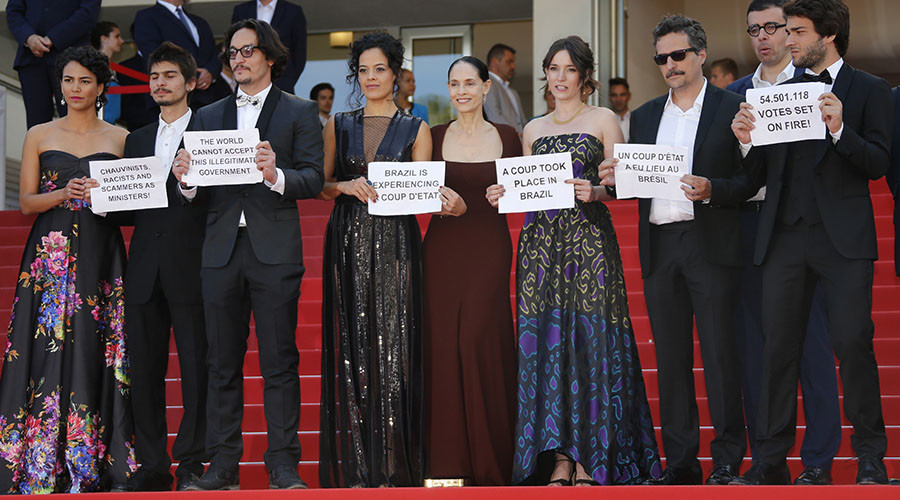
There were protests at the Cannes Film Festival  where the cast and crew of the Brazilian film Aquarius staged an improvised protest on the red carpet to show support for President Dilma Rousseff, denouncing her suspension as a ‘coup d’état.’ 

The film's writer and Director Kleber Mendonca Filho and Sonia Braga the lead actress and other members of the cast and crew unveiled printed banners ahead of their film’s premiere.

Thursday, May 19, 2016

The neoliberal coup in Brazil

The slow motion neoliberal coup in Brazil, which masquerades as impeachment of the President for corruption, took another turn this week with the ousting of President Dilma Roussef and her replacement by Vice-President Michel Temer and the right -wing Brazilian Democratic Movement Party or PMDB (in Brazil impeachment results in the appointment of a person from a different party to that of the elected President).

Roussef was dismissed over allegations of accounting manipulation that supposedly misrepresented the fiscal position of the government. The allegations will be heard by the Brazilian Senate, which itself is awash with corruption.

In reality, her dismissal was a right-wing neoliberal coup by a right-wing party and their powerful corporate and business backers to wrench the country from the hands of a moderate left government and condemn Brazil to a path of unrepentant neoliberalism. This, despite the same right wing party losing 4 elections in the last 14 years.

In 2002, Brazil threw off the shackles of a 22 year long military dictatorship supported by the UK and US Governments, by electing the left wing Workers Party led by Lula Da Silva. 'Lula' was President until 2012 when he had to stand down because Brazilian Presidents cannot be in power for more than 3 terms. His replacement was Dilma Roussef who lead the Workers Party to a fourth election victory in 2014.

While the Workers Party implemented many important reforms- the minimum wage was doubled and public and social services expanded, poverty was reduced by 55 percent, extreme poverty by 65 percent and inequality reduced significantly- Brazil remains one of the most unequal countries in the world.

Although Roussef's party was mired in corruption scandals, she was not accused of impropriety. The collapse in the oil price hit Brazil's economy hard and forced Roussef to make severe cuts which demoralised her supporters. As her popularity plummeted Brazil's right wing corporate and political elite saw the opportunity to strike.

Political corruption is endemic in Brazil
Brazilian politicians are notoriously corrupt. Nearly 3/5 of the Brazil's congress (318 members) is under investigation or face charges, including many who backed her impeachment. The Speaker of the House who led the impeachment process is accused of squirreling away $5 million in Swiss bank accounts.

As Glenn Greenwald points out, Temer is a deeply corrupt and unpopular politician stained by his own corruption scandals. He is accused of involvement in an illegal ethanol purchasing scheme and was found guilty of, and fined for election spending violations for which he faces a 8 year ban on running for office.

Many members of the Brazilian Democratic Movement Party have been involved in the most serious corruption scandal in Brazil’s history. Known as Operation Car Wash, the scandal involves hundreds of millions of dollars of money laundering and bribery surrounding the state-run Petrobras oil company.

A key agenda for impeaching Rousseff was to stop investigations of corruption against Congress members and media executives.

A neoliberal coup
The real purpose behind the coup was on display within days when Temer appointed a government made up of white male members of the BMDP, even though  they had lost 4 elections since 2002, including an election 18 months ago.

Seven of the ministers he appointed are under investigation for their alleged role in the Petrobras corruption scandal.

Temer showed his intention to serve the interests of his corporate and business backers. Without a mandate, Temer immediately announced a suite of neoliberal austerity measures, including sweeping cuts to government spending, reversing constitutional commitments to education and health spending, slashing pensions, cutting thousands of public sector jobs, freezing the minimum wage, gutting labour laws and weakening workers rights and privatisation of infrastructure, institutions and services.

Temer also announced his intention to appoint Goldman Sachs and IMF officials to run the economy.

Temer's appointments include  an agriculture minister who is an agribusiness billionaire known as the “soy king”, who is said to have destroyed more rain forest than any living person. The Minister of Justice is an open advocate of police repression.  In his previous role as Secretary of Public Security in São Paulo, he ordered the military police to invade a high school that had been occupied by students protesting against theft of funds allocated for school lunches. The Finance Minister is a former CEO of Bank of Boston and an advocate of extreme neoliberal economic policies.


US involvement in the coup
Once again, as in many other recent coups in Latin America, the hands of the US Government and US corporate and business interests are all over the Brazil coup.

The US President and Secretary of State were silent on the coup.

Wikileaks has recently exposed Temer's connections to the US Government. Wikileaks has  released declassified material showing that Temer was an embassy informant for US intelligence and military, raising serious questions about US Government and corporate involvement in the coup.

The damning evidence was provided in a series of tweets by the WikiLeaks Twitter account that linked Temer to diplomatic cables highlighting the information he provided to the U.S. military and National Security Council.

The USA has long opposed Roussef's independent-mindedness and participation in the BRICS trade grouping seeing it as a threat to US influence in the region. Edward Snowden's revelation that the NSA had been tapping her phone, led Roussef to deliver a blistering speech at the United Nations accusing the US of violating international law and violating “the principles that must guide the relations among…friendly nations".

Leftist governments in Brazil and Venezuela have long been
targets of US destabilization efforts. Mark Weisbrot writes that the US has always supported coups against left wing governments in Latin America:

"...including — in just the 21st century — Paraguay in 2012, Haiti in 2011 and 2004, Honduras in 2009, and Venezuela in 2002. President Obama went to Argentina to lavish praise on the new right-wing, pro-U.S. government there, and the administration reversed its prior policy of blocking multilateral loans to Argentina. It could be a coincidence that the scandal at Petrobras followed a major NSA spying operation that targeted the company — or not. And within Brazil today, the opposition is dominated by politicians who favor Washington."

Democracy Now reported that in the lead up to the coup key Opposition leaders from the PMDP right wing party traveled to Washington to meet with and brief senior US officials.

There is also evidence that some of those involved in the coup have links to the US billionaires and influential political funders, the Koch Bros. The Free Brazil Movement, a far right group committed to neoliberal market solutions, is linked to groups financed by the Koch Bros.

Some groups actively involved in the coup also have direct links to corporations, big business and corporate elite in Brazil. The Chair of the group Students for Liberty has business interests connected to companies previous involved in the 1964 military coup and the organisation VemPra Rua (Come to the Streets) is funded by a foundation owned by Brazil's richest businessman.

As Glenn Greenwald writes, the Brazilian corporate media is a key player in what he calls a 'neoliberal coup', by drumming up and legitimizing corruption allegations and supporting impeachment, supposedly in the name of democracy and freedom and to protect against corruption. This is despite the new right-wing government being more corrupt that the one it replaced.

Reporters Without Borders wrote:

"In a barely veiled manner, the leading national media have urged the public to help bring down President Dilma Rousseff. The journalists working for these media groups are clearly subject to the influence of private and partisan interests, and these permanent conflicts of interests are clearly very detrimental to the quality of their reporting.”

Maria Luisa Mendonca, Director of Brazil Network for Social Justice and Human Rights noted the role of media outlets in calling for demonstrations against the Rousseff government and ignoring large demonstrations against the impeachment:

"A key player is Globo TV, which is known for supporting the military dictatorship that lasted more than 20 years in Brazil. Globo executives were recently mentioned in connection with the Panama Papers, and in the investigations against FIFA for illegal procedures in negotiating broadcast rights of soccer games. At the same time, large demonstrations against the impeachment and in defense of the democratic process that elected president Rousseff have been ignored by mainstream media."

Response to the coup
Street protests against the coup erupted across Brazil immediately and a group of over 800 international academics and intellectuals calling itself “Humanity Against the Coup in Brazil” released a statement  condemning the coup.

The new  government threatened  to criminalise and arrest protesters and demonstrators.
Leaders of other Latin America countries condemned the coup.

In this piece Lawrence Reichard writes on the response of some everyday Brazilians in the neighborhood where he lives in Rio.

Here in Australia there has been virtually no serious reporting of the Brazil, coup. The only reporting Australians get about Brazil focuses on Australia's preparation for the Rio Olympics.

In The Nation, Dave Zirin writes that the Brazil coup is yet another reason to protest the Rio Olympic Games. Zirin has written previously about the ways that the Brazilian corporate and political elite are exploiting the Rio Olympic Games for private economic gain and political power. Zirin has argued that the Rio Olympics cemented the coup.

There are growing calls for a boycott of the Rio Olympic Games in protest against the coup.

Monday, May 16, 2016

Corporate crime wave: Australia's epidemic of corporate criminality


“As crimes pile up they become invisible”
Bertolt Brecht

“Corporate crime poses a significant threat to the welfare of the community. Given the pervasive presence of corporations in a wide range of activities in our society, and the impact of their actions on a much wider group of people than are affected by individual action, the potential for both economic and physical harm caused by a corporation is great.”
Law Reform Commission of New South Wales

In two recent submissions, I argue that Australia is in the wake of a global and national epidemic of corporate and business malfeasance, lawlessness and criminality, and has become a haven for corporate and white collar crime.

Crimes committed by those at the top of the corporate (and political) hierarchy are routinely ignored or brushed under the carpet and Australia governments and the various regulatory authorities have failed to take action against increasingly egregious and escalating levels of unlawful and criminal conduct by corporations and business.

One submission was to an Australian Senate Inquiry into Penalties for White Collar Crime (which has since lapsed because of the government's dissolution of both houses.) My submission is available here as Submission No 18 under the banner of the Nemesis Project which I coordinate.

The second submission was to the Federal Attorney's General's public consultation on Deferred Prosecution Agreements for corporate and business crime (submission is not yet publicly available but will be here).

In the submission to the Senate Inquiry into Penalties for White Collar Crime, I argue that:
  • Over recent decades legal and regulatory systems have been dismantled or loosened to remove constraints against corporate and investor profit-making and profit-taking.
  • Corporate and white-collar crime is traceable to a gross failure of the law. Legal constraints have been cast aside or not applied to their fullest. Corporations and business groups have worked to limit the effectiveness of efforts to stamp out corporate crime. They make it more difficult to prosecute crimes.
  • Corporations and business have actively subverted the law, as well as government regulation and ethical standards, in order to maximize their profits and ensure that resources flow to them. There has been a pervasive legal and political failure to control unlawful conduct by corporations and business.
  • For decades, the regulatory authorities have failed to investigate and take action against corporate and white collar crimes.  Governments, corporate regulators and law enforcement authorities and politicians have been unwilling to take serious action against corporate criminals who knowingly swindle and harm ordinary Australians.
  • The dominant response to corporate and business offending has been regulation rooted in co-operation. These strategies work predominantly to the advantage of powerful corporate and business interests.
These views were supported by numerous other submissions to the Senate Inquiry, as well as a recent report by the Australia Institute.
A submission to the Senate Inquiry by the the Economic Consultancy LF Economics provides a damming indictment of corporate criminality and control fraud within the FIRE sector (finance, insurance and real estate).
They contend that systemic criminal activity exists in the FIRE sector, with the full knowledge of all the regulatory authorities and State and Federal governments, and  places consumers at grave risk of having their finances and livelihoods destroyed.
LF Economics calls for much greater enforcement and prosecution of corporate and financial criminality:
Australians have been betrayed by the regulatory agencies’ neglect and continual siding with lenders and corporate management, despite their full knowledge of the catastrophic pain endured by many who have lost their homes, assets and life savings. ….. A strict focus on rules, regulations, standards, codes and penalties will have a negligible effect on control frauds because these crimes are simply ignored in reality. Two decades of fruitless inquiries and tweaking of innumerable rules and regulations has merely contributed to the losses endured by typical ‘mum and dad’ investors, now into many tens (perhaps hundreds) of billions of dollars. The nation already has an abundance of appropriate laws and regulations to contain and dismantle these control frauds, yet regulators are averse to enforcement, rendering these powers null and void.
The Australia Institute report Corporate Malfeasance in Australia shows that corporate malfeasance is endemic and widespread in Australia. Its findings include:
  • Budget cuts enacted by the current government have compromised the ability to investigate corporate wrongdoing.
  • There are hundreds of cases against corporations and business being pursued by Australian regulators each year, however progress is seriously impaired by the lack of staffing and resources.
  •  There are fewer regulators ‘patrolling the corporate beat’ in Australia with government agencies responsible for monitoring corporate wrongdoing and malfeasance having their staffing cut between 14-16% since the 2013-14 Budget.
Despite this corporate crime wave, the Abbott/Turnbull Government is considering introducing a Deferred Prosecution Agreements (DPA) Scheme to give corporations accused of wrongdoing and criminality the opportunity to defer prosecution in exchange for a monetary payment and compliance with a range of conditions. DPAs involve a shift from prosecution to compliance.

A DPA is a contractual agreement between government and a corporate entity that allows government to impose sanctions and set up and monitor institutional changes, in exchange for an agreement that government forego further investigation and corporate criminal indictment.

Governments and regulatory authorities (particularly in the USA and UK) have relied primarily on deferred prosecution agreements, however corporations and business continue to engage in unlawful and criminal conduct. Indeed, the criminality has intensified and become more brazen.

In the US, despite an epidemic of criminality, the authorities have been unwilling to charge and prosecute corporate criminals and one consequence of the adoption of DPA’s, is that Federal prosecutions of corporate and white collar crime is at a 20 year low.

In my submission, I argue that Deferred Prosecution Agreements are no solution to the epidemic of serious corporate malfeasance and criminality that has made Australia a haven for corporate crime.

There is no evidence that DPAs deter corporate and white collar crime and they may, in fact, encourage crime by reducing the threats of prosecution and incarceration. As the number of DPAs rise, the number of prosecutions decline.

My submission opposed the adoption of a DPA scheme in Australia.

Sunday, May 8, 2016

Climate change and the Canadian City destroyed by wildfires


Watching the shocking images and footages of the terrible destruction and human suffering caused by the wildfires that have destroyed the City of Fort McMurray in Alberta Canada, I am reminded of Wendell Berry's poem The World Bought and Sold.

I dream by night the horror
That I oppose by day.
The nation in its error
And by its work and play

Destroys its land, pollutes
Its streams, and desecrates
Air and light. From the roots
It dies upwards, our rights


Divinely given, plundered
And sold by purchased power
That dies from the head downward
Marketed hour by hour


That market is a grave
Where goods lie dead that ought
To live and grow and thrive,
The dear world sold and bought

To be destroyed by fire,
Forest and soil and stone.
The conscience put to hire
Rules over flesh and bone

To take the coal to burn
They overturn the world
And all the world has worn
Of grace, of heath. The gnarled

Clenched and forever shut
First of their greed makes small
The great life. Hollowed out,
The soul like the green hill

Yields to the force of dearth. 
The crack in the despot's skull
Descends into the earth,
And what was bright turns dull

Wendell Berry (from Leavings)


Fort McMurray is at the heart of one of the world's largest climate destroying industries- the Alberta Tar Sands industry. It is a city and region reliant on fossil fuel extraction. The region has the world's third-largest reserves of oil. As much as a quarter of the country's oil production has been halted by the fire, raising concerns about the effect on the Canadian economy.

The New York times reports:

"....the blaze has consumed whole swaths of Fort McMurray, ranking it as one of the most devastating fires in Canada’s history. The fast-moving flames turned many of the city’s homes — and the baby photos and wedding albums and other treasures that could not be packed in time — into little more than charcoal."

20,000 homes have been destroyed and the entire population of 88,000 people was forced to evacuate through a post apocalyptic landscape, in what is the largest wildfire evacuation in the history of Alberta.


The fire is still spreading and threatens to break out into neighboring provinces of Saskatchewan and the Northwest Territories.

The shocking irony for the suffering people of Fort McMurray, whose city has been destroyed by wildfires and quasi apocalyptic conditions, is that the fires are the result of unseasonably hot weather conditions resulting from rising temperatures caused by climate change and greenhouse gas emissions.

Writing in Climate Central, Brian Kahn provides a sober context for the Fort McMurray wildfires:

"What’s happening in Fort McMurray is a perfect encapsulation of the wicked ways that climate change is impacting wildfire season. A drier than normal winter left a paltry spring snowpack, which was quickly eaten away by warm temperatures. That left plenty of fuel on the ground for wildfires to consume."

Scientific America reports that the Fort McMurray wildfire is indicative of a warming planet and is the latest in a lengthening lineage of wildfires in the northern reaches of the globe. 

It quotes Mike Flanagan, a wildlife researcher at the University of Alberta:

"This fire is consistent with what we expect from human caused climate change affecting our fire regime".

Writing in New Yorker magazine, Elizaberth Colbert writes that raising environmental concerns in the midst of human tragedy is to risk the charge of insensitivity. However, she argues that failing to acknowledge the connection is to risk another kind of offense. She writes:

Though it’s tough to pin any particular disaster on climate change, in the case of Fort McMurray the link is pretty compelling. In Canada, and also in the United States and much of the rest of the world, higher temperatures have been extending the wildfire season. Last year, wildfires consumed ten million acres in the U.S., which was the largest area of any year on record. All of the top five years occurred in the past decade.

In Slate magazine, Eric Holthaus links the fires directly to climate change and analyses why people are so hostile and unwilling to accept science that links wildfires to climate change. He writes:

"The sensitivity here, I think, lies in Canada’s unique blend of politics as both an oil producer and a nation on the front lines of climate change. Over the past decade or so, Canada has become a major oil producing state (thanks mostly to Alberta) and the recent rise and fall of oil prices has created a kind of petrostate politics. Indeed, as oil prices have fallen, Alberta’s government has become increasingly cash-strapped, even to the point of cutting funding for wildfire prevention, as Reuters revealed on Thursday. The juxtaposition of that political environment with this specific disaster in the heart of Canadian oil country led to a clamp down on discussion. Right now, Trudeau is trying to have it both ways. Eventually, he’ll have to choose. Albertans know this and are justifiably worried about how future climate policies will affect their lives. 

Beyond all of the political reasons why climate change has become such a charged topic, the social science hints at why truly accepting the threat of climate change is so difficult for so many people: Doing so means accepting that our current way of life, our means of survival, even, are potentially untenable. Accepting climate science can mean accepting that our means of supporting ourselves are impossible. In other words, accepting climate science can threaten our very identities. It is understandable that people would react with fear, anger, and, yes, even vitriol. That does not mean, however, that climate change is not happening, and we should not take it seriously. It simply means the path forward will often require intense personal sacrifice. That is no small thing."

Drew Brown writes about what he calls the 'black irony' of the Fort McMurray wildfires:

"Hardcore environmentalists will no doubt spend a lot of time stressing the black irony of having the Mecca of the Canadian oil industry go up in flames to a climate change-induced wildfire. But those concerns will fall on deaf ears until the immediate human tragedy at play here in northern Alberta has subsided."

The other 'black' irony is that the burning of Fort McMurray coincides with a political offensive by those who support fossil fuel extraction and burning to expand the tar sands pipelines across Alberta. The governments of Alberta and neighboring British Columbia are also planning major expansions in fossil fuel production.