Showing posts with label France. Show all posts

Monday, January 19, 2015

Zygmunt Bauman on the Charlie Hebdo attacks and murders

In this piece in Social Europe the renowned sociologist Zygmunt Bauman places the recent Charlie Hedbo attacks in their historical, social and political context.
"There were two aspects of the Charlie Hebdo murders that set them apart from the two previous cases: 
First: on 7th January 2015 political assassins fixed a highly media-visible specimen of mass media. Knowingly or not, by design or by default, the murderers endorsed – whether explicitly or obliquely – the widespread and fast gathering public sense of effective power moving away from political rulers and towards the centres viewed as responsible for public mind-setting and opinion-making. It was the people engaged in such activities that the assault was meant to point out as culprits to be punished for causing the assassins’ bitterness, rancour and urge of vengeance. 
And second: alongside shifting the target to another institutional realm, that of public opinion, the armed assault against Charlie Hebdo was also an act of personalized vendetta (going back to the pattern set by Ayatollah Khomeini in his 1989 Fatva imposed on Salman Rushdie).

If the 11 September atrocity chimed in with the then tendency to “depersonalise” political violence (following the pour ainsi dire“democratisation” of violence by mass-media publicity that divided its attention according to the quantity of its – mostly anonymous and incidental – victims, and the volume of spilt blood), the 7th January barbarity crowns the lengthy process of deregulation – indeed the “de-institutionalisation”, individualization and privatisation of the human condition, as well as the perception of public affairs shifting away from the management of established aggregated bodies to the sphere of individual “life politics”. And away from social to individual responsibility. 
In our media-dominated information society people employed in constructing and distributing information moved or have been moved to the centre of the scene on which the drama of human coexistence is staged and seen to be played"


Saturday, March 29, 2014

The hegemony of 'Anzac': a Review of Joan Beaumont's Broken Nation: Australians in the Great War

'The myth of Anzac was promulgated to enable Australians to live with the otherwise unbearable carnage of World War I. Broken Nation helps explain its provenance and continuing power'.
Marilyn Lake
Having just finished Joan Beaumont's excellent new book Broken Nation: Australians in the Great War, I was interested to read Marilyn Lake's* review of the book in the Australian Book Review. 

Other reviews of the book are here and here.

Joan Beaumont's book describes the destructive impact of the Great War (WW1) on Australia, and challenges the official view, still promulgated by historians,commentators and political and military leaders, that WWI  somehow gave birth to the nation and the much celebrated ‘Anzac spirit’.

Beaumont tells the story of military grand plans, strategies, battles and the obscene carnage that took place on the battlefields of Gallipoli, Palestine and the Western Front and the terrible impact on the men who fought on the front line. She also tells us what was happening back in Australia-socially, politically, economically and in the hearts and minds of people.

Beaumont skillfully blends detailed description of Australia's military involvement in WW1, with political analysis of the political debates back in Australia, and detailed exploration of the divisions and conflicts that were opened up by the war in Australia, particularly the conscription debates and the impact of the terrible loss of life back in Australia.

In the opening paragraph of her review Marilyn Lake writes:
If you read only one book about Australia’s experience of World War I, as the deluge of commemorative publications marking the outbreak of the war becomes a veritable tsunami, make it Broken Nation, an account that joins the history of the war to the home front, and that details the barbarism of the battlefields as well as the desolation, despair, and bitter divisions that devastated the communities left behind.
Reading Beaumont's book is harrowing as she describes in great detail, the terrible carnage of war, the horror and brutality of the industrial slaughter of modern warfare and the incompetence, indifference and arrogance of military and political leaders who willingly sacrificed young lives in the cause of meaningless grand plans.

There are profound lessons in Beamount's impressive work.

Beaumont argues that the scars and conflicts opened up by the  war mobilized the forces of conservatism and provided opportunities for the forces to the right of the political spectrum to dampen and constrain the capacity for progressive social and political reform that had placed Australia in the vanguard internationally in the years before 1914. 

Beaumont also argues that the forces of war gave free rein to the political power of Australian xenophobia, which when combined with paranoia about so called 'left wing radicalism', intensified the potential for violence within Australian political culture.

Beaumont describes how the 'Anzac myth created by WW1  became hegemonic', reflecting narratives and values that now dominate popular culture and Australian public and political life. 


These narratives and values are deployed to justify and and legitimize military intervention in foreign countries, violence and aggression in sporting contests, national security, social cohesion, racist behavior and xenophobia and the individualistic and materialist culture of contemporary Australian society.

* Marilyn Lake is herself a distinguished historian, whose book What's Wrong with Anzac,  demolishes the Anzac mythology and exposes the ways that the experience of Australian soldiers during WW1 has been, and continues to be used by politicians and the military establishment to serve contemporary political purposes and militarize Australian history and Australian society.

Thursday, November 15, 2012

Largest protest in European history barely rates a mention in Australia

"This austerity is a never-ending story. We see no light at the end of the end of the tunnel, just more pain and difficulties. We have to protest, do something to stop it,"
 Lisbon pensioner Jose Marques.

On Wednesday fourteen million people across 23 European states participated in the largest strike and protest in European history in the  hope of staving off decades of corporate led austerity, precarity and unemployment.

Millions of workers walked off their jobs and marched on parliament buildings across the continent. Bloody street battles ensued Spain, Portugal and Italy.

Report from the streets can be seen here, here, here, here and here

The protests barely rated a mention here in Australia, other than a few reports here,and here.

Monday, January 24, 2011

Honoring those who work for a better world

 " Most of the real work on this planet is not done for profit: it’s done at home, for each other, for affection, out of idealism, and it starts with the heroic effort to sustain each helpless human being for all those years before fending for yourself becomes feasible."
Rebecca Solnit

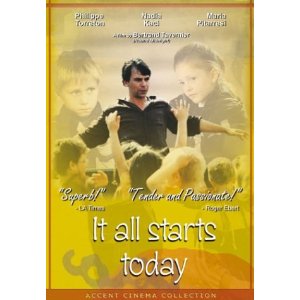
French film Director Bertrand Tavernier's  film It All Starts Today  is a beautiful testament to the commitment and humanity of teachers (and other front line workers) who work with families and children suffering the consequences of neo-liberal market  and economic "reform". 

Like Pierre Bourdieu's  book The Weight of the World: Social Suffering in Contemporary Society  Tavernier's film documents the new forms of social suffering that characterize not just French society, but the economies and societies of the western world.

Tavernier's deeply moving film tells the story of a kindergarten teacher in an impoverished region of France struggling to educate children of families devastated by unemployment, grinding poverty, deprivation, depression and economic hardship. These are children whose families are the casualties of neo-liberal market reform and economic and corporate restructuring.

The film shows the heroics and dedication of teachers, education aides, volunteers, health workers and social welfare workers who give themselves fully and devote their lives to improving the well being of the children and families in their care. 

In France, as in Australia, they do this despite poor pay and conditions, budget cutbacks and hostility, indifference and neglect from elected officials, politicians, some government agencies and workers, business groups and those who hold power.

 In Australia we accord little respect and honor to those front line workers and volunteers who work for a better world. We forget and ignore the teachers, child care workers, teachers aides, carers, aged care and disability workers, social welfare workers, aboriginal health workers, volunteers, family support workers, refuge workers, domestic violence counselors and millions of  other front line welfare and community workers who dedicate themselves to the care and well being of others, and who through their efforts make our society and communities better places.

Instead they are usually berated and stigmatized, labeled as do-gooders and bleeding hearts, or dismissed as rent seeking, vested interests who breed dependency and a welfare mentality in people.

No, in Australia we honor soldiers who fight in imperial wars, celebrities caught in the glare of their own importance, sportsmen who are paid exorbitantly and businessmen and corporations who pursue and accumulate wealth and power at the expense of the common good.

Jim Johnson has taken up a similar theme in a recent post on his excellent blog Notes on Politics, Theory and Biography and I thank him for his insights:
"I find it obsequious and cloying to hear the radio show hosts and politicians offering a "Thank you for your service" whenever they encounter a veteran or military personnel. What about the social workers and parole officers and teachers and, yes, scientists and artists, who work in underpaid professions for years and decades in order to contribute to a better world? After all, they could be out there peddling sub-prime mortgages (or some other form of snake oil) and making real money. When was the last time you heard someone - anyone - publicly thank those folks for their service? No, instead we are taking aim at them (the teachers and parole officers are, after all members of those dastardly public sector unions) in the misguided quest for fiscal responsibility"

Thursday, December 30, 2010

Robert Fisk: exposing brutality and hypocrisy in the Middle East

photo of families whose relatives vanished during the Algerian civil war (1990-98) demand to know what happened to their loved ones during a recent demonstation in Algiers (photo courtesy of AFP/Getty)

There is no better chronicler of the brutality of Western and Arab governments in the Middle East than Robert Fisk, the Middle East Correspondent for the UK Independent.

Fisk uncovers and exposes the hypocrisy of the West and its ally Israel, but is equally critical of the leaders, political elite and leadership of the Muslim world. And Fisk knows history well.

In his latest piece Robert Fisk writes of recent celebrations in Algeria to commemorate 50 years of freedom from French rule. Fisk points out that the generals and politicians who were out in full force making speeches against colonial tyranny were themselves responsible for the deaths of an estimated 25,000 Algerians during the Algerian Civil War of 1990-1998.

While the families of the dead and civil society groups seek justice for those who died during the Algerian civil war of 1990-98, Fisk reminds us that the security forces and army responsible for many of those deaths are still in control in Algeria. Only now they are allies of the USA in the fight against "terrorism".

Thursday, September 30, 2010

The rising power of European citizens

In recent days protests against government austerity measures, harsh public spending cuts and corporate culpability for the financial and economic crises have occurred in Cyprus, Greece, Italy, Latvia, Spain, France, Ireland, Germany, Belgium, Portugal, Poland.

Here is Richard Wolff on the significance of the street protests sweeping Europe over recent days.
"These are historic days and weeks in Europe. Unprecedented trade union unity across industries, unions, and countries -- with massive support from students, retirees, churches and public opinion polls -- directly confronts governments, demanding an end to making ordinary people pay for a capitalist crisis. The terms of public debate, policy and social change are shifting in directions not seen or believed possible in Europe for decades."

Wednesday, August 11, 2010

Films about France's dark colonial past


On Sunday night I watched the excellent French movie The Colonel on SBS. Part murder mystery, part historical drama, the film explores the dark side of France's colonial past, specifically the legacy of the Algerian War of Independence (1954-1962), which led Algeria to gain its independence from France.

The Algerian War of Independence lasted 8 years and cost some 1.5 million lives. The war saw countless atrocities by both sides and the systematic use of torture and targeting of civilians by the French military and the Algerian FLN.

The Colonel is one of a growing genre of outstanding and controversial French films that explore France's colonial legacy in Algeria. Some of these have been made by French film makers born in Algeria or Northern Africa. Although the war in Algeria left a bitter legacy in France, it is only recently that films are being been made about the subject, particularly the use by the French military of systematic torture and state sanctioned murder of civilians, and the use of weapons such as napalm.

These films are important, not just because they shine the light on France's colonial project, but also because they draw a parallel between past events and modern day warfare, the legality of torture and the "war on terror".

The Colonel (2006) Written by the legendary film director Costa Gavras , The Colonel juxtaposes two related narratives- the investigation of the murder of a famous retired French army Colonel who ordered atrocities and torture in Algeria, with the story of a young army officer who served in Algeria under the Colonel's command who went missing in action during the war. His story is told through a series of letters sent to an army officer investigating the murder of the Colonel.

Days of Glory (2006) exposes the discriminatory treatment by the French military and French authorities of Algerian soldiers who fought under French command during WW2. The film contrasts the courage of the Algerian men in fighting for France with their appalling treatment during and after the war. The film prompted the French Government to award pensions to the soldiers who had been denied pensions for over 60 years.

Hidden (2007) explores the individual and collective guilt associated with France's colonial past in Algeria. The film stars French actors Daniel Auteil and Juliette Binoche as a wealthy couple whose privileged lives are unsettled by a series of mysterious videos that keep appearing in the mail. Over time the videos expose more of the past of the character played by Daniel Auteil, who is implicated in a series of events inspired by an actual occurence in 1961 when French Police carried out a massacre of Algerian civilians in the middle of Paris. The true story of the massacre and the extent of the loss of life was covered up at the time and explained away as a riot.

Intimate Enemy (2007) explores the human costs of the civil war from the perspective of French soldiers, Algerian civilians and the Algerian combatants. Set in 1959, the film explores the experiences of a French battalion and its officers fighting in rural Algeria who are sent to liquidate a local FLN commander. The film shows the brutality and torture employed by both sides and exposes French use of systematic torture and napalm. The horrific consequences of such actions for the French soldiers, the Algerian civilians and combatants, is demonstrated.

Summer of 62 (2007) is a film about the final days of the Algerian War of Independence as viewed through the eyes of an 11 year old Algerian boy (whose father is fighting against the French) and his friendship with a French boy.

Outside the Law (2010) was released at the 2010 Cannes film Festival and is yet be seen in Australia. The film tells the story of three Algerian brothers who were forced out of Algeria by the French authorities in 1925 and who then grew up in mainland France. Eventually they end up joining the Algerian Independence movement inside France and stage attacks on Police and authorities within France. The film shows a number of massacres committed by the French authorities. The film sparked protests by army veterans groups and right wing groups who were outraged by what they claimed was an unjust portrayal of the French army's actions.