Showing posts with label WA politics. Show all posts

Thursday, January 14, 2016

When official reports obscure as well as explain: An analysis of the report on Cockburn Sound mass fish deaths

 
"Species loss is caused by the harmful actions of powerful actors, private interests that are facilitated by governments failing to act for the common good. At present, our political systems are deficient in preserving the variety of life around us."

David Ritter CEO Greenpeace Australia

The Department of Fisheries has released the report of its investigation into the massive fish die-off that occurred in Cockburn Sound in late November and early December 2015. Over 2000 fish and 15 species died.
 
An earlier piece I wrote on the environmental crisis is here and here.
 
However, like many official reports, the Fisheries report obscures as much as it explains. 

It is, for example,  silent on the extent to which thermal stress resulting from increased water temperature and oxygen stress caused by human induced climate change and global warming is a factor in the deaths in Cockburn Sound.

The Report finds that the immediate cause of the mass die-offs was an algal bloom of diatoms (of the genus Chaetoceros). This group of diatom have been implicated in fish kills both internationally and around Australia.

Diatoms are  the diameter of a hair, have spine-like bristles (setae) made of silica, and cause physical irritation to fish gills. The Report found that  algal numbers reached significant concentrations and the sectioned gills of freshly dead fish showed considerable physical irritation.

The report identified three potential contributing factors to the observed spike in diatom numbers- nutrients, higher than normal water temperatures, and reduced flushing conditions.
 
The report found no evidence of disease in the fish and no evidence of potential pollution or industrial causes of the fish kill.

It notes that the Department of Environment Regulation  assessed industry monitoring data and inspected local drainage systems, but no potential pollution sources were identified. The only substantiated spillage  identified was approximately 500 kilograms of canola grain at the CBH grain loading jetty, however there was no evidence of chemical contaminants in the spilt canola.
 
The Report found that the Southern end of the Sound was the likely source of the bloom.
 
The report links the fish deaths to poor water quality at the unstable southern end of the Sound. The area has historically had poor water quality issues including low dissolved oxygen levels associated with poor flushing of the embayment.  The report found that weak tides during the event may have been a contributing factor.
 
The southern end of the Sound is the site for  a proposed marine, canal and residential development between Cedar Woods and Landcorp, which includes a 500 boat pen, canal development, chalet style accommodation and an entertainment precinct.
 
Despite concerted opposition, the project received environmental approval in 2014 and has Government  and Opposition support, despite the EPA finding that the proposed development could worsen water quality in the southern part of the Sound
 
There has been strong and concerted public opposition to the  proposed development by environmental groups, campaigners and local communities and residents.
 
The Greens MP Lyn Mclaren used the release of the Fisheries Report to call on the Barnett Government to shelve the proposed development:
 
"The two causal factors of the fish kill were the algal bloom and dissolved oxygen. Both of these are known to be a problem in the southern area, so we should be working on improving the water quality at that area of the sound, not risking it by building a canal estate there."
 
The Fisheries Report leaves many questions unanswered.

The Report does nothing to dispel claims made at the time by the Barnett Government and government authorities that the mass die-off was a 'natural occurrence'. 

 Suggesting that an environmental catastrophe like this is a 'natural occurrence' implies it is a matter of chance and the workings of nature, rather than of human design and government and industry action and inaction. Events become arbitrary unforseen acts of nature, rather than manifestations of an economic and political order that is designed to maximise economic growth and profit at the expense of the ecosystem and the people and communities who share that ecosystem.
As Piers Verstegen from the Conservation Council of WA noted, this event should be a serious wake up call for the state of Cockburn Sound, not explained away as natural occurrence.
 
The Report does not identify  the underlying causes of  water quality issues in the Sound that resulted in the blooms that killed the fish, other than to identify three possibilities-nutrients, higher than normal water temperatures, and reduced flushing conditions. But we are no clearer in understanding the underlying cause(s) of the diatom bloom.

Clearly the marine environment in Cockburn Sound is changing for the worst and fish and marine life are struggling to keep up. It is essential that we know the exact cause of those changes. Without that understanding how can the Department and those responsible for the health of the Sound and its environment take the necessary action to ensure that water quality is improved and fish stocks protected?
The southern pocket is environmentally important to the health of the sound. It an area where sea grass is reasonably healthy and is also a fish nursery for a number of fish species.

Given its focus on the fish deaths, the Report is perhaps unsurprisingly silent on the likely impact of the proposed marina and canal development on water quality and fish stocks in the southern end of the Sound.

This is despite the likelihood that the proposed marina development will worsen water quality and threaten seagrass in the southern end of the Sound, thereby threatening fish stocks, bird life and marine life even further.

The report also says little about the long term impact of poor water quality on the viability of fish stocks in the Sound and proposes no remedial action to improve water quality to protect fish stocks in either the southern end of the Sound and/or the Sound as  a whole.

The report is also silent on the 'elephant in the room'- the extent to which thermal stress resulting from increased water temperature and oxygen stress caused by climate change and global warming is a factor in massive fish deaths like those that occurred in Cockburn Sound.

Ministers, politicians, authorities and government agencies seem unwilling to publicly acknowledge this issue and have avoided any use of the words 'climate change' in relation to the deaths.

But there is mounting evidence about the impact of climate change on the world's marine ecosystems and their vulnerable inhabitants and the role of climate change as a causative factor in mass die-offs of fish, marine life, whales, starfish, coral and marine invertebrates.

2015 study published in the  Proceedings of the National Academy of Sciences by scientists from Yale, UC Berkeley and University of San Diego concluded that mass die-offs of birds, fish and marine life have grown increasingly frequent and severe, hiking at a rate of 1 per year over the past ten years.

The researchers found that disease is responsible for 26 percent of  die-offs, making it the number one cause over the past 70 years. Direct human impact on the environment, including contamination is responsible for 19 percent.
On the effect of climate change, the report noted:

"... processes directly influenced by climate — including weather extremes, thermal stress, oxygen stress or starvation — collectively contributed to about 25 percent of mass mortality events."

According to the study, the mass kill events of the greatest magnitude "were those that resulted from multiple stressors, starvation, and disease."

Writing in Common Dreams, Deidre Fulton links animal die-offs across the globe to growing alarm about the deadly impact of climate change on the world's ecosystems and their vulnerable inhabitants.

Fulton lists examples of recent mass die-offs linked to the effects of climate change, including:
  • 8000 black-and-white common seabirds (murres) were found dead on beaches in Alaska's Prince William Sound, joining thousands more that washed up on beaches from California to the Gulf of Alaska over the past year. One hypotheses is that the birds' usual food supply—the schools of herring and other small fish typically found near the coast—has been decimated by warming oceans or this year's extreme El Nino weather pattern.
  • 45 pilot whales died in the southern Indian state of Tamil Nadu, after more than 80 were stranded on the shore.
  • a massive starfish stranding occurred on Moreton Island in Australia
  • drought in the Western U.S. has transformed stretches of rivers into a mass graveyards for baby salmon 
  • coral bleaching events around the globe are degrading and eroding the structure of living reefs
  • the mysterious die-off of endangered antelopes last spring in Central Asia, which killed more than half of the entire species in less than a month. 

In the Washington Post, Sarah Kaplan writes that unexplained die-offs, abnormally large strandings  and worldwide coral bleaching are bigger than almost anything else on record:

"Incidents like these are often mysteries to be unraveled, with scientists sorting through various explanations—hunger, habitat loss, disease, disorientation—for the mass death. But in a swath of recent cases, many of the die-offs boil down to a common problem: the animals' environments are changing, and they’re struggling to keep up." 
Here in WA, the response of the Barnett Government to the Cockburn Sound environmental crisis has  been shambolic and inadequate.

The Environment Minister has been missing in action. At the height of the crisis the Minister claimed that water quality in the Sound was improving.

The Government claims that no change is needed in the monitoring of the Sound and has instigated bare-bones" environmental monitoring of water quality and only released a tender for that after the crisis. A former Manager of the Cockburn Sound Management Council (CSMC), claimed the tender was "bare-bones" environmental monitoring to allow the council to meet the requirements of the State Environmental Policy.
 
The failure of the Barnett Government and the responsible authorities to provide a convincing explanation of the underlying causes of the water quality issues that caused the mass fish die-offs in the Sound, combined with their unwillingness to publicly acknowledge that thermal stress resulting from increased water temperature and oxygen stress caused by climate change and global warming as a significant factor in the fish deaths, only leads to greater disbelief and cynicism among ordinary citizens concerned about the health of the Sound and the viability of fish and marine life stocks.

Tuesday, October 30, 2012

The hubris of Emperor Barnett

Clever action by WA Unions to highlight the hubris and skewed priorities of "Emperor" Colin Barnett and his Liberal-National Coalition Government.

The Emperor has spent over $26 million to refurbish a heritage listed building as his private office while his Government cuts public services and imposes austerity measures and huge increases in gas, eletricity and water charges on ordinary West Australians.

This report is from Perth Now.
WESTERN Australian Premier Colin Barnett was not amused by the gift of a train shaped cake from union officials to welcome him to his refurbished $26 million offices in Perth. 
 
Mr Barnett moved into the renovated Hale House this week, after an extensive upgrade which earned the new office the nickname the "Premier's Palace".

Unions WA said the cake was a symbol of the skewed priorities of the Barnett government, which it says could have spent the money on new train carriages, or other public amenities.

"Instead of investing in big monuments to himself, the premier has an opportunity to put money into things more valuable to working West Australians," said Meredith Hammat, acting secretary of Unions WA.

"Make sure we have decent support services, and proper public transport so working Western Australians can go about their business in a fair way.
"This cake is a symbol of how the government should be investing in quality public services, things that really matter."

On delivery of the cake by Ms Hammat, a government official turned away both the gift and the union representative, saying he had been instructed not to allow entry to either.

Hale House is a heritage-listed former school boarding house which had fallen into disrepair.

The school's former dining room has become the new reception area, with the premier to conduct his business out of the headmaster's old bedroom and sitting room.

The renovation also features crystal light fittings, a $120,000 artwork and a cabinet room table and chair setting believed to be worth $50,000.

Monday, October 1, 2012

Gerry Georgatos on Serco's ongoing contract failures

I have posted before (here) about Gerry Georgatos's pioneering approach to investigative journalism. As the WA reporter for the National Indigenous Times Gerry combines investigative reporting with PhD studies and human rights and social justice campaigning.

Gerry is the only journalist in WA and one of the few in this country willing to investigate the appalling record of the UK multinational Serco, who runs more and more of the nation and WA's public services.

Serco has highly profitable contracts with the Gillard Government to run Australia's controversial immigration detention centres and also runs many of Australia's defence and military bases, including overseas military bases.

Since the Barnett Government came to power Serco's power and influence in Western Australia has grown, thanks largely to their profound and deep conections within the Liberal Party and the Government bureaucracy.

Serco won a contract to run WA's largest hospital Fiona Stanley Hospital despite having no experience running hospitals in Australia. From November it will run WA's only juvenile prison. It already runs Acacia Prison. Serco took over the highly controversial prisoner transport contract from G4S.

Gerry's latest report which will appear in the National Indigenous Times this week describes Serco's continual and constant contractual failure in the prisoner transport contract.

Whistleblowers to National Indigenous Times correct, SERCO wrong says government arbiter
Gerry Georgatos
The multinational SERCO has been hit with a fine of nearly $600,000 and has been told to get its act together. Department of Corrective Services and SERCO whistleblowers to the National Indigenous Times had said that SERCO had been failing to meet its prisoner transport contract duties - and had failed to turn up to pick up prisoners for court appearances, had failed to provide staff for prisoners attending public hospitals and had taken prisoners to the wrong prisons.
SERCO is one of the world's wealthiest organizations and holds not only prison management and prisoner transport contracts, however lucrative immigration detention contracts, and is entrenched in the service delivery of public transport, human resource management and public welfare components and the public health systems.
The Contract for the Provision of Court Security and Custodial Services annual report noted that a performance improvement notice was issued and the reason for this was "persistent poor performance."
In May, a customer satisfication survey was conducted by a government arbiter and found a satisfaction rate of only 52.6 per cent. The annual survey referenced 32,000 prisoner transfers and movements 6,600 court sitting days.
Social researcher  and SERCOWATCH spokesperson, Colin Penter said that the fine and the one in two failures exposed by the survey and by whistleblowers evidences "a consistent failure of SERCO failing to meet targets" and that the underperformance impacts on the prisoners.
SERCO took over the prison transport and court services contracts from G4S, the company in whose care Aboriginal Elder Mr Ward died from horrific burns and dehydration in the back of a prison van on a 43 degree day during a 360km desert drive.
"SERCO has improved nothing, they are just as bad as G4S which killed Mr Ward," said UWA law student and former Deaths in Custody Watch Committee chairperson, Marianne Mackay.
"They are unfit to hold any tenders and contracts to do with the criminal justice system. Our people suffer in their hands."
"Nyoongar man Grantley Winmar died in SERCO run Acacia Prison after being neglected for days - he died of haemorrhaging."
The Australian Institute of Criminology in its 2008/2009 report noted that prison deaths in private company managed prisons died at three times the rate than those dying in government run prisons - 4.5 deaths per 1,000 prisoners in private prisons compared to 1.3 deaths per 1,000 prisoners in government run prisons.
Mr Penter said SERCO cannot be trusted with the profit motive appearing to be foremost. "In the UK SERCO was found to have lied 252 times, and the failures of the SERCO run prison in Christchurch are there for all to see - it comes down to gross neglect."
"To put everything in context SERCO's neglect leads to deaths." In the UK SERCO was slammed for the death of a 14 year old boy in their custody  
"What is disturbing for me is that the whistleblowers who were in a way the 'family', the support, of the prisoners are now gone from inside. They were right all along despite SERCO and the Department of Corrective Services saying otherwise."
In recent months there has been an outcry against the Department of Corrective Services push to use video-link and Skype technology for court appearances and in that prisoners were refused transport to funerals.
The annual report revealed that this is already in place and has reduced the attendance of prisoners to and from courts by nearly 30 per cent in the past year due the increased use of video-link technology.
"A son and daughter, despite being an inmate, should be allowed the dignity of attendance at a parent's funeral, it is both a customary right and the humane thing. Using money as an excuse to stop our people attending funerals well the line must be drawn and this not allowed," said Ms Mackay.
"Our people should also have court attendance in person, so they know what's going on and can speak for themselves and not be removed from their full set of rights and comprehension by being stuck in a prison room and in front of a camera where they can input very little - this should be illegal."
A DCS spokesperson said, "It is too early to assume any service delivery trends or issues from a single survey. DCS Commissioner Ian Johnson was reported saying that the DCS is constantly developing "practices that reduced the need for unnecessary prisoner transport" and that in fact he said "70 per cent of all appearances were now by video link."

Saturday, September 15, 2012

Gerry Georgatos on Serco's prisoner transport contract

Gerry Georgatos is a West Australian journalist who combines investigative reporting with a powerful commitment  to campaigning on social justice and human rights issues.

Gerry is  a Western Australian based reporter for the National Indigenous Times for whom he writes important stories about Indigenous and social justice issues that few other journalists are willing to cover.

Gerry is also the Principal and Convener of the Human Rights Alliance through which he has initiated  and led groundbreaking social justice campaigns in WA. Gerry is also a Phd researcher  on Aboriginal Deaths in custody.

It is this combination of investigative journalism, social and political research and social justice campaigning that has resulted in Gerry exposing injustices ignored by the mainstream media and politicians, including the illegal imprisonment of Indonesian youths in adult prisons in WA, Police violence inflicted on a young Aboriginal man in Albany and the appalling state of Aboriginal homelessness in the Kimberley region.

As well as the National Indigenous Gerry's articles also appear in many other places including Indy Media, Indy Media Brisbane, Green Left Weekly and the Donnybrook-Bridgetown Mail.

Gerry's article below is about the decision by the UK multinational corporation Serco and the WA Department of Corrective Services to deny Aboriginal prisoners access to prisoner transport to attend family funerals. 

The article will appear in the National Indigenous Times this week
Gerry Georgatos on Aboriginal Funeral outrage
The National Indigenous Times has been contacted by two sources during the last couple of weeks, one within the Department of Corrective Services (DCS) Western Australia and another within SERCO, that Aboriginal inmates will no longer be transported to funerals. Instead they may be left with the option of paying their respects to loved ones by either viewing a recorded or where possible live screening of the funeral and the procession while alone in a prison wing room. This has been slammed as inhumane, and culturally inappopriate by most Aboriginal Elders.
Both sources said that this initiative was flagged allegedly due to SERCO's reluctance to transport prisoners to funerals. The multinational which has the contract to much of the State's prisoner transport, and manages Acacia Prison, on the outskirts of Perth, and the lucrative Immigration Detention Centre network Australia-wide, is allegedly reluctant to provide compulsory funeral attendances for Aboriginal inmates - it has been alleged that SERCO management claimed high prison officer risk issues at funerals and also allegedly cost benefit issues. SERCO is one of the world's wealthiest companies.
UWA law student and Nyoongar rights activist Marianne Mackay the former chairperson of the Deaths in Custody WA contacted the National Indigenous Times a few days ago to confirm that she had also been advised that an Aboriginal prisoner was refused transport to a funeral last Friday. "This is a first, it doesn't happen that one of our people is not allowed to attend a funeral. Apparently SERCO refused to transport him and this has stunned us considering how everybody knows how important it is for our people to attend funerals. It attacks our cultural integrity."
SERCO communications spokesman Tim Evans said, “The issue was discussed at length at WA Estimates hearing in July when the decision was made by the Department of Corrections.” There was no other comment.
The WA Estimates did not discuss some of the allegations raised by the whistleblowers. Questions will be tabled next week in State Parliament in response to the claims by whistleblowers in this article.
At the WA Estimates the WA Commissioner of Corrective Services Ian Johnson said the State Government had asked him to make a two per cent saving in their budget. “We had spent around $1.1 million to transport people to funerals. We certainly recognise there is an importance in doing that. There is significance, obviously, for all people to attend funerals, but particularly for Indigenous people in terms of their family relationships. However, how long is a piece of string? It becomes a situation where you cannot control the expenditure in continuing to provide the opportunity for people to attend funerals,” said Commissioner Johnson.
He said that Skpye had been successfully trialled for prisoners who could not be transported to funerals. Aboriginal rights advocates described this as an outrage for their people.
Another Nyoongar rights activist, Iva Jackson-Hayward has responded with a call for the State Government to ensure that the DCS and SERCO ensure Aboriginal inmates do not have their cultural rights eroded. "The DCS and SERCO are dutibound to protect the rights of our people. Aboriginal women and men in prison cannot break their customary duty to attend funerals. It's outrageous what is happening, and it's a human rights abuse. This is all about money, and SERCO trying to make more of it by abusing the rights of our people. It is the Government's duty to pull SERCO into line."
Ms Mackay said the Inspector of Custodial Services, Neil Morgan was contacted on Friday.
The WA Prison Officers Union (WAPOU) said the State Government should scrap SERCO's prisoner transport contract. WAPOU Secretary John Welch made this call following another whistleblower's leaking of serious allegations.
The whistleblower said SERCO transported prisoners to wrong prisons, was late in bringing prisoners to their Court appearances, transported seriously ill prisoners in prison vans instead of ambulances. It was only a couple of months ago a prisoner who had open-heart surgery was returned to the prison in a van instead of an ambulance and arrived with serious injuries which the DCS tried to play down however CCTV footage proved otherwise.
All three whistleblowers said SERCO was not turning up to transport Aboriginal prisoners to family funerals, and that SERCO made no effort to account for its failure.
Mr Welch said SERCO's failure to ensure contracted prisoner transports gave rise to stress and tensions in prisons.
"These latest allegations are so serious that the Barnett Government should cancel SERCO's contract and bring these services back for the Department of Corrective Services to run so that we can be confident the community is being kept safe."
Australia has one of the world's worst prison suicide rates, with privately run prisons, according to the Australian Institute of Criminology, enduring proportionately more deaths in custody than Government run prisons.
Other serious allegations were made by the whisteblowers to the National Indigenous Times and we will follow these through.

Sunday, September 2, 2012

When citizen protests saves lives

Last week I spoke at a protest attended by over 150 citizen activists  outside the Northam (Yonga Hill) Immigration Detention Centre.  

The protestors rallied against mandatory detention, recent changes to Australia's asylum seeker policies and the profiteering and human rights abuses of Serco, the UK corporation that has a $1.6 billion contact with the Gillard Government to run the immigration detention system.

Inside the Centre 600 asylum seekers are imprisoned by the Australian Government, the Department of Immigration and Serco.

The most powerful speaker was "J" a Sri Lankan man who had been imprisoned on the Christmas Island Detention Centre. His speech pointed to the importance of citizen protests for the health and wellbeing of people in detention. J suggested that protests  actually save lives as they push back against the harm caused by mandatory detention.

 His speech is posted below: 
Hi everyone, my name is P***11, that’s what I used to be called in the detention, P***11. Being next to this detention centre just reminded me of how I was in the Christmas Island Detention. I don’t know which words should I use to describe that experience...should I use terrible? It was really - very, very bad - extremely bad. Being in somewhere you’ve never done anything wrong, and you’re locked up...and you run away from your country, from the place where is your family - looking for freedom – then – when you - the first time you put your step in Christmas island, you say hey, I am free now, like you know, almost now I am free, then unfortunately you are locked up for a year or something like this there. And...it’s like prison, it is a prison, it is not detention.

Everything – everything is like, the doors are locked, you can’t go through any door if you don’t have an officer next to you, even the medical area. The medical area should be like for if someone is sick or he needs just treatment and...that door...I just remember very well - it was that thick. It’s very, very bad to be there even afterwards – I never had any problem, mental problem - even in Christmas Island - but I had um somehow a sleeping problem, I couldn’t like sleeping more than two hours, like continuously. So two hours, wake up, then do something, then another two hours. Afterwards when I came to Australia – the mainland –and I am free - I shouldn’t have that problem because I don’t worry about anything but still I have that problem for a while for like the first 6 or first 7 months there.

The main issue there is you’re locked up and everyone is depressed, you just see your friends go, you make friend today - next day is gone. You don’t know, he’s just in the midnight, suddenly he is gone, he’s just like, next day you are looking for him then suddenly, you can’t find him because he has been transferred somewhere else.


Every week or every couple of days you will witness someone hang himself and that will like bring you down and already the detention is like kind of hell – you know I never been to hell – but it is hell. You know if you are somewhere in the hell and you want to climb up, you want to get out, but somehow, who runs that detention say, get down, that’s your place, it’s not up. It’s like every time you try to be better healthier, somewhere to do something good they say get down that’s your place, up is not your place.


Um personally, I witnessed three people, they commit suicide, you know one of them they uh, Sri Lankan guy, poor guy, he is died. He commit suicide by his bed- um – his bed sheets, um and he make like rope or something and he hang himself up, with somewhere very high. Just ask yourselves what kind of motivation he had to go all the way up just to hang himself and kill himself. And he was one of my friends, he had like problem like staying there for long time and depressed and he ended with, why am I here? Like what’s the end? Let’s just finish it, let’s kill myself and that’s it.
 
I never thought about these things in my life, but when I was in Christmas Island I thought about it once and thank god I didn’t do anything like this. But there are heaps of people who do it around you, all your friends think about it, all your friends are depressed, if you are trying your best to be like positive, you cannot because your friends who runs the detention, like total negative and racist. Totally racist...

I would say thankyou for every single man and woman who came here. I really, really, really appreciate it, appreciate it that you support my case and my friends case. And I just I talk you about one thing, I remember one of the time we did a protest at Christmas island and some people they did it in Sydney, we couldn’t see them because they are far away but we saw them, we saw some uh photos over the internet and we were so happy, we were so happy. Like okay, not all of them racist, there is some of them there, they like us, they want us and say okay okay, some of us say okay I’m going to like fight and stay healthy, maybe one day I get my visa.


And by the way, one of the first English words we have learned there is ‘racist’. Um so please, please, please show us if you are welcome us, show us. I swear to god you give us heaps of motivation to stay alive, we don’t hang ourselves, we don’t hang ourselves, we don’t commit suicide inside the detention. We say okay this country, the government don’t like us maybe, but the people like us. So and finally we will get in.

Sunday, November 6, 2011

Artistic freedom Western Australian style

Sometimes artists and charities who take money from mining companies in Western Australia give the game away.

This story Mining Company cash creates movie making boom  appeared on the ABC TV program Stateline WA on Friday November 4 and demonstrates that the primary reason for the "philanthropic" activity of the mining industry in WA is self interest.

The message is very clear- we will sponsor you but you must not speak certain truths about the industry. In other words the mining industry buys the silence and acquiesence of those it sponsors.

Listen to the journalists and artists in the ABC story who make it very clear that with the money comes conditions and the expectation is that you must show the mining industry in a favourable light.

Show the mining industry in a less than favourable light in their eyes or speak certain truths about the industry and you can say goodbye to the sponsorship.

One interviewer put it this way:

" We can't say we want you to sponsor us but the script says you are unscrupulous swines who rape and pillage the land..... they see the first draft of the script....... they don't want the industry shown in an unfavourable light..... you don't bite the hand that feeds you".
Of course this story reflects a much larger issue- the way that the mining industry and corporations in WA are using their money and power to shape the arts and cultural industry and the charitable sector to serve their corporate interests.

This article by Rosemary Neill provides an insight into the corporate takeover of the arts and cultural industry and charitable sector in WA:
In a harbinger of this, some of the country's most powerful businesspeople have teamed up with artists and launched a new, turbo-charged arts lobby, the Chamber of Arts and Culture, aimed at developing a coherent cultural vision for WA. Among the chamber's founding members are Rio Tinto iron ore chief executive Sam Walsh, prominent arts patron and businesswoman Janet Holmes a Court, former WA Chamber of Commerce and Industry boss John Langoulant, KPMG national executive director Helen Cook and former Australia Council chairwoman Margaret Seares.

An alliance of high-powered executives -- some drawn from the blokey resources and engineering sectors -- intent on proselytising for the arts is a first not just for the West but, arguably, for the nation. Walsh says this move signifies that "the state is growing; there is a need for a more creative and vibrant community and arts and culture will help us deliver that and help us attract people. I think the stars are aligned . . . we have a unique opportunity in Perth and WA's history, building on the mining boom, to work on these things." The unfailingly courteous Rio Tinto boss says the chamber has received "very strong support" from Day and federal Arts Minister Simon Crean. He stresses it is not merely an arts lobby; that it will engage with governments, the regions, schools and untapped audiences to spread the word about culture.

Wednesday, July 6, 2011

Clare Sambrook exposes the consequences of privatising services for vulnerable West Australians

Clare Sambrook is an award winning British journalist who has written this remarkable piece on the death of Mr Ward in the back of a G4S van in the Eastern Goldfields region of WA.  
Her article reveals the lethal consequences of contracting out to profit making companies, be they G4S or Serco,  public responsibility for vulnerable people, be it the care of prisoners, or for that matter vulnerable youth, children or adults. It does not matter whether it is G4S or Serco. There is no place for them in the care of people.
Ultimately there is little difference between Serco and G4S. The Barnett Government has awarded Serco the new contract to transport prisoners around WA (instead of G4S) and G4S staff will simply transfer across to Serco, the new contractor. This is despite widespread opposition and protest in WA against G4S's previous contract and Serco's new contract to run prisoner transport.

Clare Sambrook writes:
"Indeed the case of Mr Ward provides a shocking glimpse behind the corporate spin, exposing shakiness in the logic that has propelled the global boom in privatisation of core public services".
Clare Sambrook links Mr Ward's death to the profit seeking mantra of companies like G4S and Serco who see the death of a person in their care as simply a risk of doing business. Her report of a business briefing by G4S and its senior Executives in London is chilling.
"Thousands of miles away from scorchingly hot Kalgoorie, here in the UK G4S executives briefed financial analysts the other day. There was a slide show — “Core values: Customer Focus, Expertise . . . Integrity (We can always be trusted to do the right thing)”. Director David Taylor-Smith ran through the company’s UK business, £1.2 billion of it, £700 million with government — the UK Border Agency, the Ministry of Justice, the National Offender Management Service. (Only yesterday morning G4S corporate development director Peter Neden sat in committee room 6 at the Palace of Westminster, arguing the case for “reform” of the probation services.)

“We’re now bigger than the Scottish Prison Service and Northern Ireland Prison Service combined,” said Taylor-Smith. “So we’re starting to get proper scale now in the UK as a kind of a credible alternative to national bodies running prisons.”

There’d been major wins in providing “facilities management” for NHS hospitals: "we do 13 acute hospitals now. So that’s great.” 

About Welfare to Work (“when that’s clocked in next year that will be £130 million”), Taylor-Smith joked: “I’m just reminding those taxpayers, if there are British taxpayers in this room, £159 billion spent in this area of government.” G4S will be paid by results, managing subcontractors getting long term unemployed people back into work (or at any rate off the state’s books).

“We see this as providing significant additional growth opportunities,” said Taylor-Smith, confiding: “Two nights ago I was with [government ministers] Iain Duncan Smith, Oliver Letwin, Crispin Blunt and they’re talking now also applying this into the prisons programmes, into drug programmes and also benefit fraud.  (It pays to get friendly with G4S. Former Labour Home Secretary John Reid was trousering G4S fees of £50,000 a year even before he’d left Parliament. Now Lord Reid is a G4S director.)
The analysts asked about Australia. The year after Mr Ward’s death G4S lost its contract to run Australia’s refugee detention network and last month it lost the Western Australia court security and custodial contract as well (both pieces of business picked up by Serco).

Nick Buckles, who is paid £27,000-a-week, said of the Australian market: “We haven't had a good run recently on care and justice because of a major incident that happened about three years ago.”

But, looking on the bright side, he said: “there is only two or three major players, typically sometimes only two people bidding for care and justice. And with . . . our global expertise, in time we will become a winner in that market because there's a lot of outsourcing opportunities and not many competitors operating down there.”

Wednesday, June 22, 2011

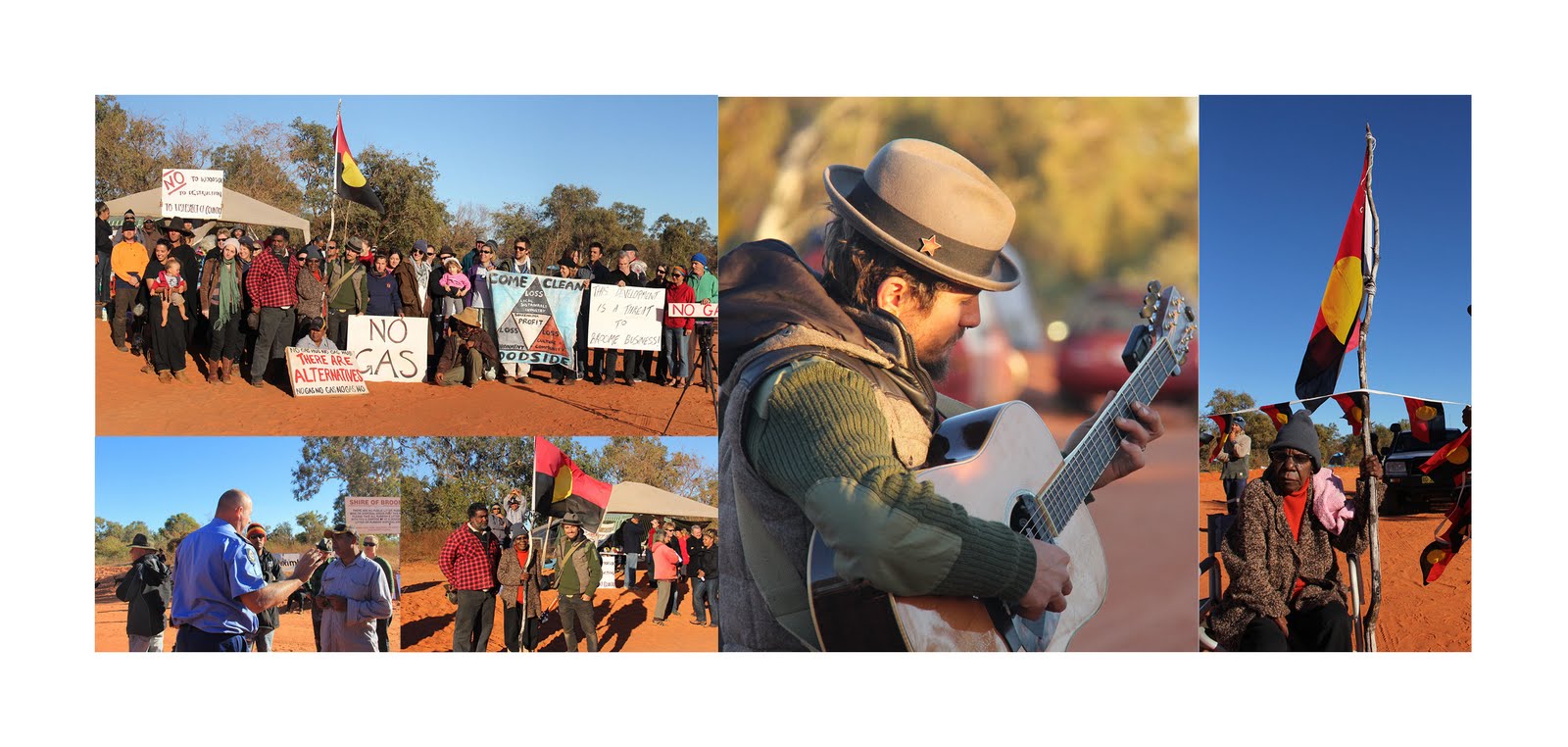
Kimberley blockade and protest against Woodside's corporate invasion and the WA corporatocracy

West Australian Greens Senator Scott Ludlum made an important speech in the Australian Senate today about the protest and blockade against Woodside in the West Kimberley, now into its third week.

For 16 days hundreds of protestors have been blockading access roads to James Price Point, the site of the proposed $30 billion gas hub 50 kilometers north of Broome in the Kimberley region. The protestors are preventing Woodside contractors from reaching the site to carry out surveys and clear vegetation. Despite having no environmental or heritage clearances the State and Federal Governments have allowed Woodside to commence the work (you can follow the protest here).

Here are some extracts from Scott Ludlum's speech in the Senate today:
These scenes are being played out all over again as Woodside moves heavy equipment on site to begin land clearing for the Browse Basin gas project-a gigantic industrial complex which is being proposed for 40 or 50 kilometres north of Broome at the moment. It is amazing to hear the reports and see what is happening up there. We now have a blockade camp at Minari Road. They have had up to 120 people blocking the road and trying to stop-successfully-Woodside and its contractors getting equipment onto country. 

It is extraordinary to see this because this project has not yet been approved by either the state government or the federal government. In my experience non-violent direct action, with people putting themselves in the way to stop these sorts of projects, generally comes last, after all options have been exhausted. But in this case it is happening before either the state or federal government has given formal approval-because the company has decided to move in and start land-clearing anyhow. They are proposing to put in roads and flatten areas-allegedly to do work to complete their environmental impact processes-before approvals have been given.
The residents of the Kimberley do not necessarily want the same mistakes that have plagued the Pilbara and the south of our country to be repeated and that is why they are standing up. What needs to happen surely would be obvious to anybody with a basic appreciation of what has gone on in Australia and how we can do things differently in the Kimberley. We need to listen to local voices for local governance and local economic development in a form that is appropriate to the Kimberley and not simply to repeat the mistakes of the past at the behest of oil and gas companies and mining companies. That will end up locking-in on non-extractive economic development that is not based on chewing down the resource base on which we depend.
While the protests and blockade in the Kimberley has a strong local focus and are being led by local Aboriginal people and people who live in the West Kimberley, they also  reflect a growing protest movement erupting all over the state opposed to the WA corporatocracy- the system of government in WA that exists to serve the interests of corporations and the wealthy, and which involves close ties between business, corporations like Woodside and the Barnett Government  and its public service bureaucracy.

Some examples of other protests include:
  • campaigns against proposals to mine coal and bauxite in the densely populated South west of the State
  • campaigns against multinational corporations like Serco and G4S who are winning more and more contracts  from the Barnett Government to provide public services
  • campaigns against the privatization of public services and public assets to corporations in areas such as public hospitals, prisons, public utilities, infrastructure, health care and justice
  • campaigns against the uranium mining and nuclear industry
  • legal action by local residents against Alcoa for the harm done to communities and residents in the South West
  • local community action against polluting corporations in towns and communities such as Kwinana and Esperance
  • campaigns against mining companies granted access to community water supplies in the Wheatbelt 
  • community opposition to Monsanto's introduction of GM crops and its takeover of grain research and production in WA.

Monday, June 6, 2011

Breaking the silences in WA history: A history of WA forest protest movements

Reading a PhD thesis is not something you do for fun.

But Ron Chapman's PhD Fighting for the Forests: A History of the WA Forest Protest Movement 1895-2001 is an important document of WA  history.

I have long argued that  protest action by ordinary West Australian citizens, in the form of social movements and civil society action, has been at the forefront of most significant social, political, economic and environmental change in this state. This is not reflected in traditional narratives about Western Australian history which largely marginalize or trivialize the action taken by WA citizens fighting for social, economic, racial and environmental justice.

So I was excited to read Chapman's thesis which shows that forest protest has been a major force for environmental and political reform throughout WA history.

Chapman shows how over time small scale protest activity by citizens was transformed into a social movement that had a significant influence on forest policy and practice, culminating in the defeat of the Court Government in 2001 and the adoption of policy by the Gallop Government to protect WA forests

Chapman describes the diversity of protest activities used by WA civil society groups to focus public attention on forest issues and pressure the WA Government to change its forest policies and practices. He shows how protest groups had to constantly adapt organization and strategies to the changing social and political conditions.

Chapman's analyses the campaigns and strategies used by West Australian citizens and civil society groups from 1895 to 2001. He distinguishes a number of distinct periods, firstly from the late 19th century to 1950, and then a second period from 1950 to 2001, characterized by 5 distinct phases:
  1. Formative phase from the 1950's-60's which saved urban bushland.
  2. Transitional phase during the 1970's which adopted assertive forms of protest.
  3. Collaborative phase during the 1980's when campaigners began to collaborate with and influence political parties.
  4. Expansionary phase during the 1990's which saw the spread of local protest groups in the South west.
  5. Confrontational phase which involved an intensive campaign of confrontational and direct action.
Chapman's research demonstrate the importance of "localism" as an activist and organizing strategy. Chapman shows how the WA native forest protest movement established a network of urban and south-west activist groups which encouraged broad public support.

The eventual success of the forest protest movement resulted from the rise of these organized and effective local groups and campaigns focused on public education, media exposure and local action. The transformation of local action into an influential social movement played a significant role in bringing down a government and protecting  WA forests.